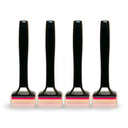
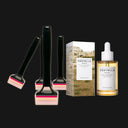

Stamping in summer? Timing, sunscreen, when to skip: the short rule list.
Microneedling knowledge base
Dermastamp or dermaroller?
Microneedling at home: the complete Dermastamp guide
After microneedling: what to put on your skin, and what not to
Clinic or home?
Before you microneedle
Minimum skincare routine
UV radiation and the skin
Which sunscreen should you choose?
Sunscreen myths
Moisturising ingredients
Face washing
Dermastamp for eyebrows
Minoxidil: effects, forms, side effects
Oral DHT blockers
Natural DHT blockers
Telogen effluvium: sudden, diffuse shedding
Vitamins for hair loss
Hair loss shampoos
Hair growth serums: what's in them?
Topical finasteride (Fynzur)
Finasteride and having children
Finasteride and minoxidil together
Dutasteride mesotherapy
Clascoterone and the new agents
Finasteride side effects
Post-finasteride syndrome
Stopping finasteride
Initial shedding
Finasteride after a hair transplant
Antiandrogens in women
LED mask knowledge base: what it can do, what it can't, and who it's for
Eyes and the LED mask
Frequency and duration
Who the LED mask isn't for
The LED mask's colours
The LED mask's specification
Blue light and breakouts
Sunscreen or LED mask
Choose your area
Every concern has its own page, with the detailed case and the evidence level.


Frequently asked questions
Quick, specific answers to the most common questions. Search, or browse by topic.
WHAT IS THIS?
Microneedling is a skin treatment in which tiny needles make controlled micro-injuries in the skin, and this triggers the body's own repair response, with new collagen. The clinical version uses deeper needles under medical supervision; the at-home Dermastamp is a fixed 1 mm. On the scalp, the goal is to stimulate the environment around the follicles; on the face, the remodeling of the skin's tissue. The evidence is about the mechanism, not our device: we have no study of our own, we reference other people's research.
The needle creates tiny, controlled micro-injuries in the skin, and this triggers the body's own repair response: an inflammatory signaling phase, then new collagen and growth factors. On the scalp, the goal is to stimulate the environment around the follicles. As for when you might see anything, we have no measured number of our own. The studies measure in months: hair studies typically use a 12–24 week window, with clinical devices. The mechanism in detail: /pages/dermastamp-utmutato-1mm
Clinical microneedling works with 1.5–2.5 mm needles, often with a motorized pen, local anesthetic, and medical supervision. The home Dermastamp is a fixed 1 mm. Whether 1 mm at home is riskier than a shorter needle, we don't know, there's no measurement on that. What we do know: the chance of irritation and infection grows with depth, which is why deeper treatment stays with professionals. The advantage of the home route is that it can be done regularly and costs substantially less.
Yes, it can be done at home, with the right needle length (1 mm maximum) and by following the proper disinfection protocol (below, and in the user guide as well). The 1 mm Dermastamp was designed for exactly this: deep enough for an effective treatment, but not so deep that it would require a medical procedure. With at-home treatment, many people build a regular skin-care routine without salon visits.
Almost every skin type: dry, normal, combination and oily skin alike. It can also be used on sensitive skin, but less often and with lighter pressure. It is forbidden on areas with active acne, inflammation or rosacea. For darker skin tones (Fitzpatrick IV–VI), a prior dermatologist consultation is recommended due to the risk of PIH (post-treatment hyperpigmentation).
This is general information, not medical advice. If unsure, ask a doctor.
Mainly the face (forehead, cheeks, jawline), neck, décolletage, and the backs of the hands. It's also used on the scalp for hair loss, especially combined with minoxidil. It's also used on the belly, thighs, and arms for stretch marks (striae). Around the eyes it can be used with caution, but NOT on the eyelids or the mucous membrane of the mouth. Never bring the stamp to the lips or directly to the eye.
Three things reduce the risk the most: a 1 mm needle, one Dermastamp per treatment, and disinfection with 70% alcohol before use. What's important to see clearly about the device's paperwork: the device is on the market as a Class I medical device (EU MDR 2017/745) and is listed in EUDAMED. That is registration and traceability. Conformity is declared by the manufacturer; no notified body has examined the device itself, and no one has stated that it works. The documented risks (granuloma, scarring, discolouration, infection) and the full list of contraindications are here: /pages/mielott-megveszed
Most of it comes down to three things. The first is needle length: at home, 1 mm is the upper limit, and deeper is not better. The second is consistency: once every two weeks on the face, once a week on the scalp, because the repair work happens during the rest period in between. The third is aftercare: soothing, hydrating ingredients afterwards, and pausing irritating actives (retinol, AHA, BHA). The most common mistake is treating too often. The timing table: /pages/dermastamp-tippek
Medical alcohol for disinfection: before stamping, the stamp needs to be soaked in medical alcohol, which is easy to get at any pharmacy. If you use it on your face, SPF 50 sunscreen: skin after stamping is more sensitive to UV radiation, so sunscreen matters.
It's not the regeneration itself that ages the skin; problems can come from treating too often, too deep or with poor technique. Microneedling creates controlled micro-injuries, to which the skin can give a wound-healing response: collagen and elastin remodeling may start, which can support improvement in skin texture and fine lines. That is not the same as chronic inflammation or continuous tissue stress.
It can become harmful if you don't allow enough regeneration time, treat irritated skin, press too hard, repeat too often, or don't follow the hygiene and aftercare rules. The goal of home use is not to constantly "work" the skin, but to give a regenerative stimulus rarely and in a controlled way, then let it recover.
It can become harmful if you don't allow enough regeneration time, treat irritated skin, press too hard, repeat too often, or don't follow the hygiene and aftercare rules. The goal of home use is not to constantly "work" the skin, but to give a regenerative stimulus rarely and in a controlled way, then let it recover.
RESULTS
We have no measured number for this, and anyone who names an exact week is making it up. What can be known: the skin's renewal processes are slow, which is why the studies also measure in months, not weeks. The scalp studies typically measured in a 12–24 week window, with clinical devices, not ours. It's worth photographing yourself from the same angle and in the same light, because the mirror won't show you a small change.
The evidence is about the MECHANISM of microneedling, not our device. We have no study of our own, and no one has run a separate study on the 1 mm at-home stamp. What we reference is other people's research, typically done with clinical devices (a 1.5-2.5 mm roller or pen, under medical supervision). One needle-depth analysis on the scalp found that 1 mm and shorter needles didn't give worse results than deeper ones. What it will do for you, we can't promise. You'll find the honest balance sheet, use case by use case, on the individual use-case pages.
We don't promise results, and we have no study of our own. What the research behind MICRONEEDLING shows, we've written up use case by use case, together with the level of evidence and its limitations. The strongest evidence is for acne scars and stretch marks, the picture is more mixed for wrinkles, and for pores there is no clean clinical number. On the scalp, there is a randomized study of the microneedling + minoxidil combination, done with a clinical device. The individual pages: /pages/aknehegek, /pages/striak, /pages/rancok, /pages/porusok, /pages/hajhullas
First it's worth thinking through whether the expectation is realistic: the studies measure in months, not weeks, so after a few treatments there's no verdict to give yet. If it's been going for months already, review the technique: are you pressing perpendicular, 4–6 presses per area, did you keep the rest period (every two weeks on the face, weekly on the scalp), and was the aftercare consistent. And for some people it doesn't bring meaningful change, that has to be said too.
We have no measured number for this. Both the hair cycle and skin renewal are measured in months, which is why the studies are built that way too: on the scalp, they typically looked at a 12-24 week window, with clinical devices. Anyone promising weeks is claiming more than the evidence covers.
Main factors: (1) Age – younger skin regenerates faster. (2) Your skin's starting condition – moderate concerns typically respond better than severe, deep-set scars. (3) Treatment discipline – regularly spaced treatments with no skipped sessions. (4) Quality of aftercare – skin-supporting actives (vitamin C, peptides, retinol kept well away from treatments). (5) Lifestyle – sleep, hydration and sun protection all matter.
There's no comparative study on this, so we don't claim that the home treatment ends up in the same place. The clinical treatment works with a deeper needle, stronger energy, and in a professional's hands, so for deep acne scars and pronounced wrinkles it can realistically deliver more. The home device's advantage is regularity and cost. A comparison of the two routes, prices included: /pages/klinika-vs-otthon-microneedling
ROLLER OR STAMP?
A dermaroller is a cylindrical device: the needles enter at an angle and cause dragging. A dermastamp punctures exactly perpendicular and doesn't drag the skin's surface. The result: less irritation, more precise treatment on small areas (nose, around the eyes, lips), and a lower risk of pigmentation.
For facial skin goals (wrinkles, pores, skin tone), the stamp has the edge: its perpendicular puncture gives a more even micro-injury pattern. For hair loss on the scalp, the stamp is also the better fit, because it navigates easily between the hairs: it doesn't snag on hair and gives even coverage regardless of hair density. A roller can be a more convenient alternative on large, flat areas (belly, thighs, stretch marks).
For three reasons: (1) No dragging: the roller pushes the skin sideways as it rolls, which can cause micro-tears. (2) More precise on small areas (nose, around the eyes, next to the lips). (3) Lower PIH risk: even, perpendicular puncture patterns are less likely to provoke hyperpigmentation, especially on darker skin tones.
It can be used, but it's not optimal. The angled puncture of the needles poses a risk both for scarring and for recovery time. If you already have a roller, it can be used on the face at a short needle length (0.25-0.5 mm), but in the long run the stamp is the better investment for the face. Think of the stamp as the simple tool that gives you the most control possible, and the easiest way to start microneedling.
Stamp: face (every area), scalp (hair loss), neck, décolletage, smaller targeted areas. Roller: large, flat surfaces – belly, thighs, arms (for stretch marks), back. Most people can cover every target area with the stamp – the stamp works everywhere, but it can be slower on larger surfaces.
According to our customers, the stamp is generally less painful. Above 0.5 mm a roller can cause a noticeable pulling sensation, while at the same needle length the stamp only gives the "feel" of the puncture. Most users describe the 1 mm stamp as 'stinging but bearable'. On more sensitive areas (forehead, nose) some pain is to be expected with either device, unfortunately there's no way around that.
If you're planning it for the face, neck, or scalp, the stamp is clearly the first choice. The 1 mm Dermastamp version is suitable for large, flat body areas too, causing less trauma to the skin for the same stimulation. Stamp first; a roller only if you have a specific need for large body areas.
The dermapen is more of a tool for experienced home users or clinics. It's motorized and can be more precise in good hands, but it's much easier to botch a treatment with it, and you have less direct control over pressure and depth if you rush or hesitate. The Dermastamp is exactly for people just getting started with microneedling: you decide precisely where you work, how hard you press, and how long you spend on a given area. It's hard to do it wrong, which makes it a much safer entry point for beginners. I've been microneedling for 4 years, and in that time I've tried a great many microneedling devices. For a sustainable and simple at-home routine, the stamp design is the best choice.
NEEDLE LENGTH
For the face, the 1 mm needle is the general recommendation: it reaches an adequate depth for treatment, but doesn't go into the depth range where medical supervision would be needed. For beginners and long-term routine users alike, this is the safest choice. That's exactly why the Dermastamp comes in a 1 mm size.
A 0.5 mm needle reaches the lower part of the epidermis: good for delivering active ingredients, but modest for a deeper effect. A 1 mm needle reaches the upper part of the dermis. For regular, results-focused treatment, 1 mm is the recommendation.
Generally no. Above 1.5 mm, the risk of at-home treatment rises significantly: deeper penetration, more inflammation, longer recovery, and elevated infection risk. Needle lengths above 1.5 mm are for salon or medical use, where treatment is done under controlled conditions. At-home maximum: 1 mm.
This is general information, not medical advice. If unsure, ask a doctor.
For the scalp, 1 mm is recommended – it reaches sufficient depth and is easy to work with on the scalp. The Dermastamp comes in a 1 mm size and is suitable for the scalp too. On a sensitive scalp, it's worth starting with lighter pressure for the first treatments.
A 2 mm needle penetrates into the deeper layer of the dermis and causes fully bleeding micro-punctures. At home, going this deep with an improperly disinfected device poses an infection risk, and healing also takes several days. 1 mm is the safe maximum for home use: results are achievable without going further than that.
This is general information, not medical advice. If unsure, ask a doctor.
For beginners, the 1 mm needle is recommended, and this is the single, uniform recommendation: there's no need to 'ease in' with a shorter needle. Regulate the intensity with pressure and the number of stamps instead, not by changing the needle length. At home, 1 mm is entirely appropriate and safe from the very first treatment.
The Dermastamp is made with a fixed 1 mm needle length, with 80 gold-coated steel needles. The needle material passed the EN ISO 10993-1, -5 and -10 biocompatibility standards. An important limitation of the sensitization test is that it was done on a guinea pig model, so not on humans. That's a good sign, but it doesn't erase the risk of a known metal allergy. The full material and document chain: /pages/mielott-megveszed
No. Facial skin thickness doesn't vary between people enough for that to be something you'd compensate for by changing needle length. Regulate intensity with the number of stamps instead (4–6 stamps per area), not by swapping needle length. Stay at 1 mm, that's the recommendation for everyone.
The Dermastamp's needles are made of medical-grade 304 stainless steel with a real gold coating, the same base material used in surgical instruments. According to independent laboratory tests (TÜV SÜD, SGS) and the biocompatibility tests mandatory for skin-contact medical devices (EN ISO 10993-1, -5, -10), no nickel or cobalt leaches from the needles, and it showed a 0% reaction in the contact allergy test. It is suitable for people with metal allergies too. Before use, it's worth testing it on a small area (e.g., the crook of the elbow).
The Dermastamp is a fixed 1 mm because for home use, we deliberately didn't want to put a device adjustable between 0.25 and 3 mm in people's hands. Too much needle depth can pose an irresponsibly high risk for home users, especially on the face, sensitive skin or the scalp. We chose the 1 mm depth because for general home use it can already deliver meaningful stimulation, but it doesn't hand you extreme depth.
Adjustable stamps have another problem: many people use the same device over and over. Although the surface can be disinfected, contaminants can get into the base and the parts around the retracting needles that can't be reliably cleaned at home. That's why we chose a cleaner, simpler and safer protocol: fixed 1 mm needle length, single-use device, fewer points of failure.
Adjustable stamps have another problem: many people use the same device over and over. Although the surface can be disinfected, contaminants can get into the base and the parts around the retracting needles that can't be reliably cleaned at home. That's why we chose a cleaner, simpler and safer protocol: fixed 1 mm needle length, single-use device, fewer points of failure.
USAGE
Apply it to clean, freshly washed skin. Hold the stamp at a right angle (perpendicular) to the skin and press 4-6 times, slightly offset, on the same small area, then move on. Work systematically: row by row, not randomly. Sliding or dragging is forbidden; only a straight up-and-down motion. A full face treatment takes 8-10 minutes.
Medium, even pressure – firm enough that the needles reliably penetrate, but there's no need to force it. With correct pressure, the skin blanches slightly around the needles (momentary loss of blood flow), then flushes back. If the skin stays white for a long time or bleeds, it's too much. If nothing changes at all, it's probably not deep enough.
4-6 stamps per area is the recommendation. That means: press the stamp down 4-6 times on the same small area (about 1-2 cm²) before moving on. Fewer than 4 stamps: under-treated. More than 6: unnecessary, and it leads to irritation. Be systematic and even.
Recommended order: 1. forehead, 2. left side of the face, 3. right side of the face, 4. nose, 5. chin line / jawline, 6. neck. You can skip the eye area, or treat it separately and carefully. Don't move to the next area until you've stamped the current one evenly.
Cleanse the face – remove makeup and sunscreen residue. Disinfect the Dermastamp: place it in its protective cap, fill it with 70% isopropyl alcohol (IPA) so the needles are submerged, then wait for it to dry. Optionally, apply a hyaluronic acid serum right before stamping.
Apply a soothing, hydrating serum: hyaluronic acid, centella asiatica, or niacinamide. The user guide asks you to skip retinol for 24 hours; beyond that, 72 hours is the caution practice, and on sensitive or discolouration-prone skin, returning between day five and day seven. Skip AHA/BHA acids and alcohol-based products for at least 48 hours. Don't go out in the sun without sunscreen. Don't exercise for 24 hours. Facial redness is normal for 2-24 hours.
Usually 5-10 minutes, for both the face and the scalp. It also depends on how large an area you're treating and at what pace you work, but an average treatment fits comfortably within that. You don't need to spend hours on it: effectiveness doesn't come from duration, it comes from technique and consistency.
It can be used either way, but it's optional, and pay close attention to what you apply. Treated skin takes in actives more readily. Do NOT apply retinol, AHA, or vitamin C right after. For acids and vitamin C the time before reintroducing them differs from person to person, so there, watch what works for you. For retinoids, the user guide asks for 24 hours; beyond that, 72 hours is the caution practice, and on sensitive or discolouration-prone skin, returning between day five and day seven.
FREQUENCY
For facial skin, once every two weeks is the recommendation; for the scalp, once a week. The difference comes from the two areas' different regeneration needs: facial skin is more sensitive, and the once-every-two-weeks protocol gives enough stimulus without overloading it. On the scalp, especially combined with minoxidil, the once-a-week treatment is more effective. The most common misconception: that on the face too, "once a week is enough, or you can even go bolder". For the face, once every two weeks is the correct protocol.
With treatments that are too frequent, the skin can't regenerate before the next one. This causes chronic micro-inflammation, which paradoxically can have a damaging effect rather than an improving one. The result: irritated, red, sensitive skin, and a worsening condition instead of an improving one. Keep the 7-14 day break.
Face: minimum 14 days (the protocol is once every two weeks). Scalp: minimum 7 days (once a week). The difference is because facial skin has a more delicate structure and needs more time for full regeneration. The scalp is thicker and more resilient – that's why it tolerates a once-weekly treatment. If your skin or scalp is still sensitive after the recommended break, give yourself more time – the final reference point is always your individual reaction.
No. For facial skin the recommended protocol is once every two weeks; twice a week goes far beyond that, and it's counterproductive. For the scalp, twice a week isn't advised either: once a week is the optimum, and going more often doesn't speed up results. The regeneration time has to pass before the next treatment; the "more = better" logic emphatically does not apply here.
Once you've reached a state you're happy with, a once-a-month maintenance rhythm is reasonable. As for exactly how many treatments it takes before switching back, we have no measured number; you'll see it on yourself. In the active phase, the direction is once every two weeks on the face and once a week on the scalp.
We have no measured number for this, and we can't tell you the number of treatments in advance either. The studies measure in months: on the scalp, typically in a 12–24 week window. What helps: photograph yourself from the same angle and in the same light, because the daily mirror check swallows slowly building change.
Not necessarily, but more sensitive areas (around the eyes, neck) may need more rest time. The face generally regenerates faster than large areas of the body. On the scalp (for hair loss), once a week is also the optimum. If you treat several areas at once, the 7-14 day rest period applies to each of them.
Forbidden on Dermastamp day: chemical peels (AHA/BHA), retinol, strong vitamin C treatments, microdermabrasion, laser treatments. For retinol that isn't enough: the user guide gives no duration for the time before the treatment, and our own caution recommendation is that it should be left out on the day of the treatment and for at least 2 days before it, with tretinoin and concentrated products for 3-5 days, and on sensitive or discolouration-prone skin for 5-7 days. Allowed on Dermastamp day: hyaluronic acid, niacinamide, centella, aloe vera, soothing masks. The treated skin is more sensitive; irritating actives can act much more strongly than usual in this case, and can cause damage.
This is a long process, not a few-week project. A concrete milestone is 4 treatments: for facial skin, at once every two weeks, that's about 2 months; for the scalp, at once a week, about 1 month. This doesn't mean every result shows after 4 treatments, but that it's a realistic point where there's already something to evaluate.
WHEN NOT TO?
No. Using the stamp over active pimples, cysts or pustules is forbidden – the needles carry bacteria into the deeper layers of the skin and can spread the inflammation across the whole face. Wait until the active breakout settles, and only treat the remaining, inactive areas. If it's just one or two pimples, you can simply skip around them, provided the rest of the area is clear.
This is general information, not medical advice. If unsure, ask a doctor.
Not recommended. During pregnancy and breastfeeding the skin is in a changed hormonal state, healing processes can differ, and the effect of ingredients absorbed through the micro-injuries is unknown. The expectation: during pregnancy, avoid elective skin treatments that can safely be postponed. Ask your obstetrician-gynecologist if you're unsure.
This is general information, not medical advice. If unsure, ask a doctor.
During an active rosacea flare it's forbidden: the micro-injuries worsen the vascular inflammation. With a rosacea-prone skin, when the skin is not in a flare, it can be tried cautiously and at lower intensity, but a dermatologist consultation is strongly recommended. Rosacea fundamentally doesn't improve with microneedling; the dilated vessels require other treatments (laser, IPL).
This is general information, not medical advice. If unsure, ask a doctor.
With active symptoms (inflamed, flaking, itchy skin), it's forbidden. On inflamed skin, the micro-injuries worsen the symptoms and open a gateway for infection. On skin in remission, with no symptoms, careful use may be possible, but only with a dermatologist's approval. The affected area must never be treated during an active flare-up.
This is general information, not medical advice. If unsure, ask a doctor.
No. Sunburned skin is in an inflamed, fragile state; microneedling would make it worse, not better. Wait for full regeneration (1-2 weeks from the sunburn, until the skin regains its normal texture). On the day of dermastamping, exposing the treated area to strong sun isn't advised; sunscreen afterwards is a must.
This is general information, not medical advice. If unsure, ask a doctor.
With caution. On blood thinners (warfarin, aspirin, heparin, NOACs), the skin is more prone to bleeding, and the micro-injuries bleed for longer. This alone isn't a disqualifying reason, but the intensity of the treatment should be reduced, and the cleanliness of the device matters even more. A consultation with your treating doctor is recommended if you take any anticoagulant.
This is general information, not medical advice. If unsure, ask a doctor.
Not recommended. With a keloid tendency, the skin responds to injuries with excessive scar tissue formation. The micro-injuries can trigger keloid formation, especially on the face, chest and shoulder areas. If keloids have developed from your previous wounds, don't use a Dermastamp without getting a dermatologist's or surgeon's opinion.
This is general information, not medical advice. If unsure, ask a doctor.
In poorly controlled diabetes (high blood sugar), wound and skin healing is slow and unpredictable, so microneedling carries an elevated risk. With well-controlled, stable diabetes, use can be considered, but with medical approval. If in doubt, ask your treating doctor.
This is general information, not medical advice. If unsure, ask a doctor.
No, and it's especially forbidden around the lips. The active herpes virus (HSV-1) can spread on the stamp's needles, and the micro-injuries can lead to the virus spreading and to a severe Herpes simplex outbreak across the whole treated area. Even after herpes remission, it's worth waiting a few days before treating the area around the lips.
This is general information, not medical advice. If unsure, ask a doctor.
Not recommended during chemotherapy or alongside active biologic therapy. An immunosuppressed body heals the micro-injuries more slowly and is also more susceptible to infections. After oncological treatment has ended, in the recovery phase, it may possibly be an option with the treating doctor's permission – but that is strictly a medical decision.
This is general information, not medical advice. If unsure, ask a doctor.
AFTERCARE
Both are optional, not required steps: you can use something beforehand, but you don't need to. If you're unsure what to do, the simplest solution: wait a few hours until the skin settles down, then moisturise. If you do apply something right before or after, look carefully at what's in it. After microneedling the skin is more sensitive, so a minimal-ingredient, gentle product is the more logical choice than a complex serum full of active ingredients. That's why a gentle Centella Asiatica serum went up on our site too. It's not required, but for anyone looking for something, its formula is simple.
Avoid for at least 48 hours: AHA/BHA acids (glycolic acid, salicylic acid), strong vitamin C (ascorbic acid) formulas, alcohol-containing toners/mists, fragranced products, makeup. On the opened skin surface, these irritate far more intensely than usual and can cause serious chemical burns or inflammation. For retinol and retinoid derivatives, the user guide asks for 24 hours; beyond that, our own caution practice is 72 hours, and on sensitive or discolouration-prone skin, returning between day five and day seven.
On the day of the Dermastamp, avoid direct strong sunlight. If you have to go out, apply SPF50+ sunscreen – but only after the skin has calmed down a little (1-2 hours). In the 24-48 hours after treatment, the skin's UV sensitivity is heightened, so intense sunbathing or tanning beds are forbidden, and sun protection is mandatory.
No makeup for at least 24 hours: makeup ingredients (pigments, preservatives, alcohol) can cause irritation and infection through the opened skin channels. If after 24 hours the skin looks completely normal (not red, not sensitive), maintenance products can go on. If it still feels sensitive, wait longer.
Avoid intense exercise for at least 24 hours. Sweat carries salts and bacteria into the open skin channels, which can cause irritation and infection. A light walk on the evening of the treatment day is fine, but pools, steam rooms, and saunas are forbidden for the first 24-48 hours.
It's best to minimize face washing on the day of treatment – use a gentle cleanser before the treatment. If you do need to wash afterwards, use only a mild, fragrance-free, sulfate-free cleanser with lukewarm water. Don't rub your face, and don't use a cleansing brush. In the morning (the day after treatment), you can carry on with your normal routine.
The first 48 hours: hyaluronic acid, centella, niacinamide, aloe vera, and nothing else. After 2-4 days: your normal skincare can return (vitamin C, peptides). After 5-7 days: retinol and exfoliants can be reintroduced gradually. Most important of all: SPF50+ sunscreen every morning, on the day of the treatment and in the weeks that follow.
Very important, don't skip it. Skin after a treatment is more sensitive to UV radiation. The next day, a mineral (physical) sunscreen is recommended; after that you can switch back to your usual, normal sunscreen. The goal is not to needlessly irritate the freshly treated microchannels with a potentially harsher chemical filter while the skin hasn't stabilized yet.
After microneedling, in the first days the physical, also called mineral, sunscreen is generally the safer choice, especially on sensitive or irritation-prone skin. The main filters in physical sunscreens are zinc oxide and titanium dioxide, while chemical sunscreens work with organic UV filters. Both types can protect effectively, but mineral sunscreens are often better tolerated on sensitive skin and are less likely to sting or irritate.
After microneedling the skin is temporarily more sensitive, so on the first day it's worth choosing a simple, fragrance-free and alcohol-free SPF50 mineral sunscreen. Once the skin has fully calmed down, you can return to whatever sunscreen you normally tolerate well. The point is not that chemical sunscreen is "bad", but that on freshly treated skin, the simplest, least irritating formula can be the better option.
After microneedling the skin is temporarily more sensitive, so on the first day it's worth choosing a simple, fragrance-free and alcohol-free SPF50 mineral sunscreen. Once the skin has fully calmed down, you can return to whatever sunscreen you normally tolerate well. The point is not that chemical sunscreen is "bad", but that on freshly treated skin, the simplest, least irritating formula can be the better option.
IS THIS NORMAL?
Yes, this is completely normal. Redness lasting from 30 minutes to a few hours after microneedling, and a possible feeling of warmth, signal that the skin is responding to the treatment. It usually subsides within a few hours, but in some people it can persist for up to 24 hours. If the redness is still intense after 48 hours, or comes with a burning sensation, it's worth seeing a dermatologist.
Usually 2-24 hours. The redness is strongest in the first 1-2 hours, then gradually eases. For most people it's barely visible after 4-6 hours, and completely gone by the next morning. With more sensitive skin, larger treated areas or firmer pressure, the redness can last longer. If it's still strong after 48 hours, see a doctor.
Yes, mild swelling is normal and part of the inflammatory response. The area around the eyes is especially prone to swelling. It usually goes down within 24-48 hours. A cold-water compress can ease it. If the swelling persists past 48 hours, is painful, or comes with a feeling of tightness, that's unusual and needs a medical opinion.
Yes, after a 1 mm treatment, tiny pinpoint bleeding spots (petechiae) can appear, especially on more sensitive areas (nose, forehead, temples). It's a sign of treatment at the right depth: the needles reach the capillaries. They disappear within a few hours. If there's heavy bleeding over a large area, reduce the pressure.
Yes, on days 2-5 after treatment, a small number of people experience mild flaking as the damaged upper layers shed and new skin comes to the surface. Don't rub it, don't pick at it, don't exfoliate! Let it come off naturally. This is a sign of active regeneration. If the flaking is severe, or comes with pain or pus, see a doctor.
Mild itching during the first 12-24 hours is normal and, as part of the healing process, a usual reaction of regenerating skin. Don't scratch it! If the itching is intense, doesn't go away, and comes with a rash or redness, it may signal an allergic reaction or infection; in that case, medical advice is needed.
This is general information, not medical advice. If unsure, ask a doctor.
A 1 mm treatment feels different in intensity on different areas of the face. More sensitive areas: forehead, nose, jawline, eye area. Less sensitive: cheekbones, cheeks. Most users describe it as 'prickly but bearable.' Pain threshold varies from person to person. If it hurts a lot, reduce the pressure.
See a doctor immediately if: strong swelling, redness or pain persists after 48 hours; pus or discharge appears; a fever develops; the face is heavily swollen in uneven patches (possibly an allergic reaction). These can be signs of infection or an unexpected complication. The normal symptoms (redness, mild swelling, flaking) resolve on their own within 24-72 hours.
This is general information, not medical advice. If unsure, ask a doctor.
DISINFECTION
Before treatment: place the Dermastamp in its protective cap, fill it with 70% isopropyl alcohol (IPA) so the needles are fully submerged in alcohol, and wait for it to dry. After treatment: the Dermastamp is single-use; throw the whole device away, don't try to disinfect and reuse it.
70% isopropyl alcohol (IPA) is optimal. Why 70% and not 100%? Because the water content helps destroy bacterial cell walls; 100% IPA evaporates faster and is less effective as a disinfectant. Ethanol (70%) works too. Avoid fragranced, coloured, or additive-laden alcohol sprays.
The single-use design gives the most well-thought-out at-home protocol. Every session is a clean start: each treatment begins with a new device, e-beam treated at the factory and then disinfected by you before use. Less uncertainty at home: you don't have to wonder how many times you've already used it, how clean it has stayed, or whether the needles have degraded. One treatment = one Dermastamp: a simpler, more consistent and more hygienic routine.
The Dermastamp is single-use: after every treatment, throw the whole device away. There's no need to store a used Dermastamp between treatments. If you bought several stamps at once, store them in a dry, cool, dark place, in their original packaging, until use.
The skin needs to be cleaned thoroughly, but it doesn't need to be disinfected with alcohol: 70% IPA applied to the face is irritating and dries out the skin barrier. Enough: a thorough face wash with a sulfate-free cleanser, then patting dry with a clean towel. The skin barrier's normal microbiome is not the enemy; proper disinfection of the device is what's critical.
A non-disinfected stamp can carry bacteria and fungi into the skin's micro-injuries – and these can cause infection. Symptoms: unusual redness, pus-filled pustules, painful swelling. A single missed disinfection rarely leads to serious infection, but skipping it regularly leads to serious skin problems. The 70% IPA is not optional – it's a basic requirement.
This is general information, not medical advice. If unsure, ask a doctor.
No. The Dermastamp is single-use: autoclave re-sterilization is neither necessary nor possible (the plastic parts can't take autoclave heat). After every treatment, the whole device has to be thrown away. Before use, the Dermastamp needs to be soaked in 70% IPA using the protective cap; that's the only disinfection step required.
No, the Dermastamp is not marketed as a sterile medical device. During manufacturing it goes through e-beam (electron beam) treatment, which is an extra hygiene step, but it does not mean sterility. That's why it's important that you disinfect the Dermastamp yourself before every treatment: place it in the protective cap, fill it with 70% isopropyl alcohol (IPA), soak it for a few minutes, then let it dry. The Dermastamp is single-use: after every treatment, throw the whole device away.
The e-beam treatment is a quality-assurance and hygiene step during manufacturing: the packaged product is briefly exposed to an electron beam. This is NOT a sterility promise; the Dermastamp is not placed on the market as a sterile medical device. In its unopened state, the product goes through an extra, documented hygiene step. After opening, the home environment varies, which is why the manufacturer's instruction is: 1 treatment = 1 Dermastamp. This way, every treatment starts with a predictable device and consistent hygiene.
Yes, it's more expensive than using the same device for months. But if you're microneedling at home, hygiene isn't something worth leaving to chance. The Dermastamp creates tiny channels in the skin, so the cleanliness of the device isn't a side detail, it's one of the basic conditions of the treatment.
A new, single-use stamp gives you a cleaner and more predictable protocol: you don't have to wonder whether the old device's needles have dulled, been damaged, or whether contamination is left in a part you can't properly clean at home. Yes, this makes the cost of one treatment higher, but in exchange you get less hygienic and technical uncertainty.
A new, single-use stamp gives you a cleaner and more predictable protocol: you don't have to wonder whether the old device's needles have dulled, been damaged, or whether contamination is left in a part you can't properly clean at home. Yes, this makes the cost of one treatment higher, but in exchange you get less hygienic and technical uncertainty.
MINOXIDIL
It's recommended to restart minoxidil after 24 hours. During this time the scalp stabilizes, and the chance that the product becomes needlessly irritating through the open microchannels decreases.
Microneedling may help increase the scalp's permeability, so minoxidil can reach the tissue around the hair shafts better. The Dermastamp on its own may also act on the scalp's circulation and condition. According to some studies, the combination may give a better result than minoxidil alone.
No. Freshly treated scalp is sensitive, and minoxidil, especially if it's alcohol-based, can irritate the open microchannels. Wait 24 hours before restarting minoxidil.
For treating hair loss, the 5% minoxidil solution or foam is recommended. For men 5%, for women typically 2-5%. Alcohol-free formulas are less irritating on treated scalp. Avoid overly dilute (1%) or strongly alcoholic formulas. The Dermastamp can be used on its own, but combined with minoxidil, some users experience better results.
Yes, that's the established combination. Applying minoxidil twice daily is the usual protocol, and the Dermastamp once a week adds the complementary scalp treatment. On Dermastamp day, skip the minoxidil, and only restart your usual routine after 24 hours have passed.
The first faint changes (possible vellus hairs) may appear after 6-8 weeks in some users. Visible hair thickening and densification may be noticeable after 3-4 months of regular treatment. Full results can be evaluated after 6-12 months. The key: don't stop the treatment early. The hair cycle is 3-4 months, and the results are just as slow.
RETINOL
The user guide asks you to skip retinoids for 24 hours after the treatment. Beyond that, 72 hours is the caution practice; on sensitive or discolouration-prone skin, returning between day five and day seven; for more concentrated products, a full week. There's no exact, study-measured threshold. The sequence: Dermastamp in the evening, retinol no sooner than 72 hours later. For the time BEFORE the treatment the user guide gives no duration; our own caution recommendation is that the retinol should also be left out on the day of the next treatment and for at least 2 days before it.
Yes. The user guide gives no duration for the time BEFORE the treatment, so this is our own caution recommendation: on the day of the Dermastamp and for at least 2 days before it, it's advised to drop the retinol, because on sensitized, exfoliated skin the stamp triggers a stronger reaction. With tretinoin and concentrated products, 3-5 days; on sensitive or discolouration-prone skin, 5-7 days. An example: Dermastamp Sunday evening, retinol no sooner than Wednesday evening (72 hours: the user guide asks for 24 hours after the treatment, the 72 is our own caution), and the next treatment, according to the user guide, no sooner than 7-14 days later.
Retinol already increases skin cell turnover and the thinning of the top layer on its own. On skin opened up by the Dermastamp's micro-injuries, retinol penetrates much deeper and acts more intensely, which can cause strong irritation, burn-like symptoms, and PIH (post-treatment hyperpigmentation). The two effects are additive, and combined they can't be controlled well.
Yes, every retinoid (retinol, retinaldehyde, retinyl palmitate, retinyl acetate, tretinoin, adapalene, tazarotene) should be avoided around the Dermastamp on the same principles. The stronger ones (tretinoin, adapalene) even more so, because they are higher in potency. BEFORE the treatment the user guide gives no duration, so this is our own caution recommendation: the day of the treatment and at least 2 days before it; with tretinoin and concentrated products, 3-5 days; on sensitive or discolouration-prone skin, 5-7 days. AFTER the treatment the user guide asks for 24 hours; beyond that, 72 hours is the caution practice, on sensitive or discolouration-prone skin, returning between day five and day seven, and for more concentrated products, a full week.
For tretinoin users, the break is especially important: stop it at least 3-5 days before the stamp, and don't apply it for 5-7 days afterwards either. Tretinoin is a strong retinoid, and the combined effect leads to severe irritation, peeling skin, and pigmentation problems. Coordination with a dermatologist is recommended if you intend to use both.
This is general information, not medical advice. If unsure, ask a doctor.
The user guide asks for 24 hours; beyond that, 72 hours is the caution practice. If your skin is more sensitive, prone to discolouration, or used to a weaker retinol formula, give it until somewhere between day five and day seven, and for a more concentrated product, a full week. The test: if the skin is no longer red, isn't flaking, and feels normal, retinol can be reintroduced in a small amount. For the first few times, apply it less often (e.g., 1x a week instead of 2x), then gradually work back up.
It's not worth applying retinol to an area you've just microneedled. Microneedling temporarily makes the skin more sensitive, so retinol can more easily cause stinging, redness, dryness or irritation. This avoidance rule applies primarily to the treated area. If you use a retinoid on other, untreated skin, that's generally not the same risk, but in the case of pregnancy, breastfeeding, a strong prescription retinoid, damaged skin or a large surface area, ask for medical advice.
ACTIVES & COMBOS
Strong ascorbic acid (10%+) serums can irritate the treated area: a break of at least 24-48 hours is advised. L-ascorbic acid at low pH (below 3.5) is especially irritating on open channels. Alternative: the more stable forms of vitamin C (ascorbyl glucoside, MAP) are less irritating and can be brought back sooner. After 24 hours, test gradually.
Yes, hyaluronic acid is one of the best actives after dermastamping: it can go on immediately, right after the stamp. It hydrates, strengthens the skin barrier, and absorbs especially well through the open channels. Low-molecular-weight (LMW) HA penetrates deep, while higher-molecular-weight HA hydrates at the surface. The combination is ideal.
Yes, niacinamide (vitamin B3) is one of the best-tolerated actives after the dermastamp. It can be applied right after the treatment: it reduces inflammation, strengthens the skin barrier, evens out skin tone and regulates sebum production. An extra advantage: niacinamide reduces the risk of PIH, which is especially important for darker skin tones.
Off-limits on dermastamp day and for the 48 hours before and after. AHA/BHA acids exfoliate the skin's upper layers; combine that with microneedling and the skin is overloaded, and intense irritation, burning symptoms, and PIH can develop. Keep at least 2 days between the treatment cycle and your acid routine.
Yes, peptides are excellent companions after the Dermastamp. Through the micro-injuries, they absorb deeper into the skin. Recommended peptides: matrikine peptides (Matrixyl, Argireline), copper peptides (GHK-Cu), signal peptides. They can be applied immediately after treatment.
Centella asiatica (CICA) is one of the best anti-inflammatory and skin-supporting plant extracts you can apply after the Dermastamp – even right after the treatment. Its active compounds (madecassoside, asiaticoside) can help calm and regenerate the skin. It's an ideal first step in the post-Dermastamp routine.
A simple rule: if an ingredient can be irritating even under normal conditions (acids, retinol, strong vitamin C), wait with it after the Dermastamp. If an ingredient is soothing and hydrating even under normal conditions (HA, niacinamide, peptides, centella), it can go on right away. If you're not sure: in the first 24 hours, only hyaluronic acid and centella, and watch how your skin reacts. For retinoids, the user guide asks for 24 hours; beyond that, 72 hours is the caution practice, and on sensitive or discolouration-prone skin, returning between day five and day seven.
GOALS & AREAS
The dermastamp creates tiny, controlled micro-injuries on the skin's surface. The skin responds with a regeneration process: collagen and elastin production may increase, which over time can give a firmer, more even complexion. For fine lines, this can be useful because the skin's structural support may improve, so surface wrinkles can become less noticeable. Deep, expression-related, or firmly set wrinkles can't be fully erased with at-home dermastamping, but skin texture and fine lines can gradually improve with regular, careful use.
The Dermastamp can help improve the appearance of certain acne scars, mainly shallower rolling and boxcar type scars. Microneedling creates tiny, controlled micro-injuries, to which the skin can respond with regeneration and collagen production. Over time this can give a more even skin texture, but deep ice pick scars, strong indentations or very old scars often need treatment performed by a professional. The results are gradual, and can usually be assessed after several months of regular, careful use.
The Dermastamp doesn't "close up" pores, but in some cases it can make them look less noticeable. Microneedling may support the skin's regeneration processes and collagen production, which can improve firmness and texture around the pores. That can make the skin surface look more even. If the main cause of enlarged pores is heavy sebum production, genetics, or clogged pores, the Dermastamp alone won't be enough; proper cleansing, hydration, sun protection, and a pore-friendly routine matter too.
The dermastamp can help improve an uneven complexion, but with hyperpigmentation it must be used carefully. Microneedling may support skin renewal, so improvement may show with certain post-acne marks or uneven texture. With pigment spots, however, treating too aggressively, too often, or without sun protection can also make things worse. After treatment the skin can be more UV-sensitive, so SPF50+ sun protection is mandatory, especially for pigmentation-prone skin.
Using a 1 mm dermastamp in the immediate eye area at home is not recommended. The eyelid, the corner of the eye, the tear duct and the very thin skin under the eye are sensitive areas, where the risk of irritation, swelling, bruising and flawed technique is higher. If someone is considering microneedling for the fine lines or dark circles near the eye area, that's better discussed with a professional. For home use, stick to the safer areas of the face, and don't stamp in the immediate vicinity of the eye.
The skin of the neck and décolletage is thinner, more sensitive, and often heavily UV-exposed, so it calls for a more careful technique than the face. The dermastamp may help with fine texture, small wrinkles, and mild skin laxity, because the micro-injuries can set off a regeneration process that may come with collagen and elastin production. On these areas, start with lighter pressure, less frequent treatment, and stepped-up aftercare. With intense irritation, active inflammation, sunburn, or sensitive skin, don't treat the area. Sun protection is especially important here.
For stretch marks, the Dermastamp can mainly help gradually improve skin texture and the appearance of the marks, but it doesn't remove them completely. Microneedling creates tiny micro-injuries, to which the skin may respond with regeneration and collagen production. Fresher, red-to-purple stretch marks generally may respond better, because the tissue is still in a more active state, while old, white marks change more slowly and to a more limited extent. On the body, patience is needed: visible change usually develops over months, with consistent use.
For signs of ageing on the backs of the hands, the dermastamp can mainly help improve skin texture, fine wrinkles and mild skin laxity. Microneedling creates tiny, controlled micro-injuries, to which the skin can respond with regeneration and collagen and elastin production. The skin on the back of the hand, however, is thinner and heavily UV-exposed, so it calls for a more careful technique, consistent hydration and daily sun protection alongside. Deep wrinkles, pronounced skin thinning, protruding veins or significant volume loss can't be fully corrected with at-home dermastamping.
HAIR LOSS & SCALP
For the scalp, the 1 mm Dermastamp is the recommendation: it reaches an adequate depth for the treatment without causing excessive bleeding or injury. It also maneuvers well between the hairs on the scalp. If your scalp is very sensitive, start with lighter pressure.
It's best to stamp after washing your hair, on towel-dry hair and a clean scalp. Part the hair over the thinning area, then work systematically in smaller sections, so no spots are missed and no single point gets over-treated. Don't use it on dripping-wet hair, because it's harder to see and reach the scalp precisely. Don't use minoxidil on the day of treatment, and as a general safety rule, wait at least 24 hours before restarting your minoxidil routine.
The Dermastamp on its own can also support the scalp's regenerative processes, because microneedling creates tiny, controlled micro-injuries, to which the skin can respond with a local wound-healing response involving growth factors. Combined with minoxidil, it can be a stronger direction because microneedling may improve the scalp's uptake of the active ingredient and complement minoxidil's effect on the hair follicles. So the Dermastamp is not just a “booster tool”, but for hair loss, your best odds generally come from thinking of it as part of a consistent, multi-element routine.
With hair loss, the Dermastamp's result can only be judged slowly, because the hair cycle is measured in months. For some people, the first thing they notice is an improvement in scalp condition, less irritation, or tiny baby hairs appearing, but more visible thickening generally takes several months of consistent use. Combined with minoxidil the odds of results may be better, but the Dermastamp on its own may also give the scalp a stimulating signal. A realistic evaluation point is more like 3-6 months, and the fuller picture shows over 6-12 months.
In androgenetic alopecia, the Dermastamp on its own doesn't block the effect of DHT and doesn't remove the genetic cause of the hair loss, but by stimulating the scalp's micro-environment it can be a useful addition. Microneedling may trigger a local regeneration response and may support the environment of the hair follicles, so it can make sense in AGA too, especially in early or moderate thinning. Combined with minoxidil, a DHT-lowering treatment, or a doctor-recommended hair-loss protocol, it's generally a stronger strategy than used on its own.
Women can also use the Dermastamp for hair thinning, provided there's no active inflammation, infection, wound or any condition that makes microneedling inadvisable. The Dermastamp is not a hormonal device; it may stimulate the scalp's local regenerative processes, so it can be applicable regardless of sex. With female hair loss, however, clarifying the cause is especially important, because iron deficiency, thyroid problems, hormonal imbalance, postpartum hair loss or medications can also be behind it. It may be combinable with minoxidil, but for women, the strength and the routine are worth discussing with a dermatologist.
Off-limits with active scalp inflammation, a seborrheic dermatitis flare-up, an active psoriasis patch, or herpes zoster (shingles on the scalp). Avoid the area around fresh wounds and surgical sites. If the scalp is severely irritated or very sensitive (for example chemically treated or dyed recently), start on a small area and test first.
This is general information, not medical advice. If unsure, ask a doctor.
Immediately after treatment: let it regenerate, or apply alcohol-free hyaluronic acid / centella tincture. Avoid on the scalp for the first 24 hours: alcohol-containing tonics, caffeine solutions, essential-oil blends. Restart minoxidil only after 24 hours have passed. Your morning routine (shampoo, conditioner) can continue the day after treatment.
It's definitely worth getting the cause of the shedding investigated before you start any treatment (microneedling included). In women there's a good chance of a treatable underlying cause (thyroid, iron deficiency, hormonal cause); identify and treat that, and microneedling builds on a much better foundation. In men, about 95% of cases have a genetic background (androgenetic alopecia). There, microneedling plays more of a complementary role alongside the established treatments (such as minoxidil and finasteride), not a standalone solution.
With colour-treated hair, the most important thing is not to microneedle on a freshly dyed, irritated, or sensitive scalp. After hair dyeing, the scalp can be temporarily drier, more sensitive, or stingier, especially after oxidative dye, bleaching, or a stronger chemical treatment. Before microneedling, wait until the scalp has fully calmed down: no burning, itching, flaking, sores, or sensitivity. Before treatment, the hair should be clean and towel-dry, and don't wash out dye residue with an aggressive shampoo right before microneedling.
As a general rule, wait at least 3-5 days after dyeing your hair before microneedling the scalp. With bleaching, strong lightening, a permanent chemical treatment or a sensitive scalp, plan for a 7-10 day break instead. If the scalp is still burning, itching, flaking, red, broken or feels tight, don't microneedle, even if a few days have already passed. After microneedling, it's also worth waiting at least 3-5 days before the next hair dye, because freshly treated scalp can be more sensitive to the dye chemicals.
No, hair loss isn't only about minoxidil, but it's important to distinguish between proven pharmaceutical treatment and supportive cosmetic scalp care. Minoxidil is one of the best-known, most-studied actives for androgenetic hair loss, but it's not ideal for everyone, and in Hungary the sale of minoxidil products is a regulated pharmaceutical category, which is why we are not developing a minoxidil product.
Our own hair loss serum (in development) is not meant to act as a drug replacing minoxidil, but to combine non-minoxidil, scalp-supporting ingredients. Directions like caffeine, niacinamide, panthenol, peptides, adenosine, rosemary extract or other ingredients of interest for the scalp barrier and microcirculation. These don't represent the same level of evidence as minoxidil, but in a well-built routine they can play a supporting role. Rosemary oil, for example, has some smaller studies and popular comparisons, but the expert consensus is that it shouldn't be treated as a miracle cure or a proven minoxidil substitute.
The Dermastamp can be interesting in such a routine because it may stimulate the scalp's local regenerative response and complement the use of scalp care serums. The goal is a consistent, multi-element hair loss routine: scalp stimulation, the right actives, avoiding inflammation and irritation, and dermatological treatment when needed.
Our own hair loss serum (in development) is not meant to act as a drug replacing minoxidil, but to combine non-minoxidil, scalp-supporting ingredients. Directions like caffeine, niacinamide, panthenol, peptides, adenosine, rosemary extract or other ingredients of interest for the scalp barrier and microcirculation. These don't represent the same level of evidence as minoxidil, but in a well-built routine they can play a supporting role. Rosemary oil, for example, has some smaller studies and popular comparisons, but the expert consensus is that it shouldn't be treated as a miracle cure or a proven minoxidil substitute.
The Dermastamp can be interesting in such a routine because it may stimulate the scalp's local regenerative response and complement the use of scalp care serums. The goal is a consistent, multi-element hair loss routine: scalp stimulation, the right actives, avoiding inflammation and irritation, and dermatological treatment when needed.
Yes, low-level laser/light therapy, or LLLT, can be a logical addition to a hair-loss routine. Microneedling can set off mechanical stimulation and a regeneration response in the scalp, while LLLT may act on the follicles' environment through light-based stimulation. The two don't do the same thing, so in theory they combine well in a multi-part routine. Several clinical studies and reviews exist on home LLLT devices used for hair loss, but the results may depend on the device, the wavelength, the dose, and consistent use.
We're thinking in this direction too: we plan to carry a laser hair-stimulation helmet that fits alongside the Dermastamp and a scalp-care routine. Importantly, LLLT isn't an instant solution either. With hair loss you have to think in months, and with androgenetic alopecia, addressing the DHT effect can remain a separate question, worth discussing with a dermatologist.
We're thinking in this direction too: we plan to carry a laser hair-stimulation helmet that fits alongside the Dermastamp and a scalp-care routine. Importantly, LLLT isn't an instant solution either. With hair loss you have to think in months, and with androgenetic alopecia, addressing the DHT effect can remain a separate question, worth discussing with a dermatologist.
Don't microneedle right after bleaching. Bleaching is a heavier chemical load on the scalp than a regular hair dye, so it's more likely to cause dryness, stinging, flaking, or irritation. Wait at least 7-10 days, and only treat the scalp once it's completely calm, not red, not sensitive, and free of sores or flaking. If any irritation remains after bleaching, the scalp needs to be restored first, not microneedled.
No results for this search.