

Which colour of light is good for what in the LED mask? The wavelength, the two studied bands, and the colours for which I didn't find a study.
The colour of the LED mask stands for a wavelength, and human studies exist for two bands, both acne studies on acne-prone skin: for the violet-and-blue range, the part between 414 and 445 nanometres, and for red, between 630 and 670 nanometres. For yellow, green, and cyan light I didn't find a human study, nor for the 850-nanometre infrared on its own; white light appeared in one study as a comparison arm, and the mixed blue-red light gave a significantly better result than it at every measurement point for inflammatory lesions. If you don't have a basic routine (cleansing, moisturising, daily sunscreen), you'll probably regret the money spent on the mask: daily sunscreen has more and stronger evidence behind it, and costs a fraction of the price.
What is wavelength, and why does its colour matter?
Light travels as a wave, and wavelength is the distance between two consecutive wave crests. It's measured in nanometres, and one nanometre is a millionth of a millimetre. The eye perceives this distance as colour: the shorter wave looks violet and blue, the longer one red. The visible range falls roughly between four hundred and seven hundred nanometres. The eye no longer sees ultraviolet light below four hundred or infrared above seven hundred, even though light is present there too.
The shorter the wavelength, the more energy a photon, that is, a single packet of light, carries. This is why ultraviolet radiation damages skin: individual photons are energetic enough to break chemical bonds in skin cells. Photons of visible and infrared light are weaker than that, they don't break down DNA directly, so they act differently, if they act at all. All of these arrive from the sun at the same time. An LED mask gives off one or more narrow bands of this: each LED type shines around a set wavelength, with a spread of a few nanometres.
In practice, this means the word "blue" or "red" isn't precise enough on its own. Under blue light, one of the studied devices meant 415 nanometres; many masks' blue mode shines at 450 nanometres or above, and for that on its own I didn't find an acne study. Look for this: the nanometre value next to the colour in the mask's description, because the colour's name doesn't tell you which band you're in.
From visible light to near-infrared. The coloured bands are the masks' typical modes; the marked ranges are the ones with human studies on acne-prone skin: blue between 414 and 445 nm, red between 630 and 670 nm.
Why does the colour of the light matter to skin?
Light can only act on the molecule that absorbs it. Every molecule only absorbs certain wavelengths, and lets the rest pass through or reflects them. That's why colour isn't irrelevant: the same light means nothing to one molecule while it excites another.
For violet and blue light, the absorbing molecule is porphyrin. Porphyrins are ring-shaped compounds, produced by Cutibacterium species that live on the skin, one of which is Cutibacterium acnes, which plays a role in acne formation. Porphyrin's main absorption peak, the Soret band, sits at 405 nm. In a 2024 study, of 16 bacterial strains isolated from healthy volunteers' skin, two, one C. acnes strain and one C. granulosum strain, showed a porphyrin-like absorption peak, between 402 and 413 nm (12.5%) according to the abstract, more broadly between 389 and 416 nm according to the study's results text; according to the authors, in the other Cutibacterium strains tested, porphyrin production may have stayed below the detection limit of the instrument used in the study. According to the text of this same study, high coproporphyrin III production, whose typical absorption range falls between 400 and 415 nm, is in the literature primarily characteristic of the species Cutibacterium granulosum, at a lower level in C. acnes. 1 Porphyrin, if it absorbs the light, can trigger chemical reactions that can damage the bacterium itself. This is the mechanism behind blue-light acne devices, and we know it from other people's studies, not from a specific mask's own measurement.
For red and near-infrared light, the absorbing molecules sit in the cell's mitochondria. The mitochondrion is the energy-producing part of the cell. In Avci and colleagues' 2013 review, the sentence reads: the photons are absorbed by mitochondrial chromophores in skin cells. 2 A chromophore is the part of a molecule that absorbs light. The absorbed energy may set the cell's metabolism in motion; what shows up on the skin from this, only a human study can say, the mechanism alone cannot.
What you can take from this: a colour only makes sense on the skin if there's a molecule that absorbs exactly that wavelength, and if this has also been measured in humans. The following sections go through this colour by colour.
I tried eight LED masks before I started marketing my own, and that's why I knew what I was looking for: in addition to the colors, the nanometer value.
 See the LED mask
Violet and blue light: what has been studied?
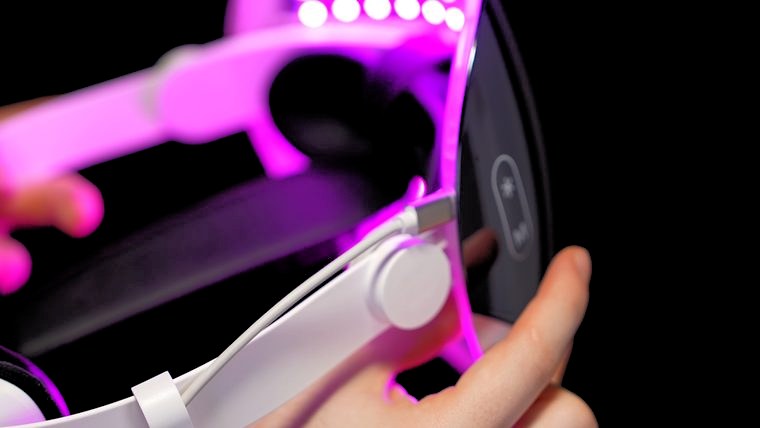
Blue-light studies on acne-prone skin worked between 414 and 445 nm. JAMA Dermatology's 2025 review pooled six randomised studies with 216 participants on at-home LED devices, and states that blue devices worked between 414 and 445 nm, red devices between 630 and 670 nm. 3 The lower end of this band falls within coproporphyrin III's absorption band of 400 to 415 nm, the upper end doesn't: at the bottom of the band, the literature's "blue" light is more violet, at the upper, 445 nm end it approaches blue.
Papageorgiou and colleagues in 2000 split 107 people into four groups: blue light alone at 415 nm, mixed blue and red light at 415 and 660 nm, white light, and 5% benzoyl peroxide cream. They received the light for 15 minutes a day, for 12 weeks. In the mixed blue-red group, inflammatory lesions improved by an average of 76% (95% confidence interval between 66 and 87%), and this was better than the blue-only group at weeks 4 and 8, but not anymore at week 12. 4 The blue-only group's own percentage isn't in the abstract, so I can't quote it.
Gold and colleagues in 2011 treated one similar pimple on each side of the face in 30 people, one with a home-type, handheld blue LED device (the wavelength, 414 nm, is given by the JAMA review's table 3), the other with a sham device, in a randomised arrangement; the treatments were given at the clinic, twice a day, over two days, and under blue light the difference was significant (p<0.025). 5 The limitation is large: there were only four treatments total, over two days at the clinic, not unsupervised at-home use, and the result applies to one pimple each, not the whole face.
Ash and colleagues in 2015 studied 414 nm blue light in 41 people; measured at week 12, the number of inflammatory lesions in the treated group decreased by 50.02%, in the control it increased by 2.45%. 6 This number still can't be attributed to the blue light, though, because the study gave the light together with in-house-developed creams, so the effect of the cream and the light can't be separated.
Nestor and colleagues in 2016 studied a 445 and 630 nm at-home mask over 12 weeks, with three arms, in an evaluator-blinded, randomised arrangement: in the mask group, the number of inflammatory pimples decreased by 24.4% from baseline, in the benzoyl peroxide group by 17.2%, in a third group combining the mask with 1% salicylic acid and retinol by 22.7%; all three numbers are within-group changes, not between-group differences. 7 Among the six studies included in JAMA Dermatology's 2025 review, this is the highest blue wavelength studied, at 445 nm.
The picture is different for blue light at 450 nm and above. On Europe PMC I looked with six different searches for a human acne study run with blue light alone, at 450 nm or above: across the six searches, every result where the wavelength was stated was a treatment combined with red, infrared, gel, or a photosensitising agent. A 2022 study with 28 people compared a red-only and a blue-only arm on acne, but I couldn't determine the blue arm's wavelength from either the available abstract or its related sources, so I can't classify this study. I also didn't find a study that compared 415 nm and 460 nm blue side by side. Many masks' blue mode shines at 450 nm or above, and for this wavelength alone there's no acne study I can classify. Look for this: the nanometre value of the blue or violet mode in the description, because standalone, blue-only studies exist at 414 and 415 nm (Papageorgiou; Gold at the clinic, over two days; Ash together with creams), while the 445 nm evidence is itself about combined light (Nestor, blue and red together).
Red light: what has been studied?
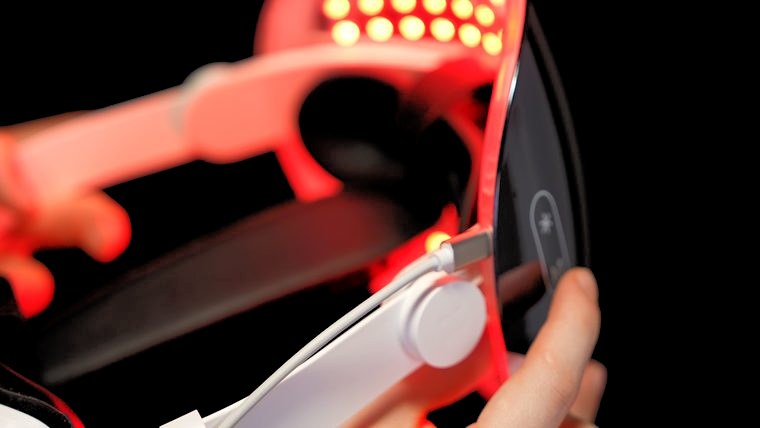
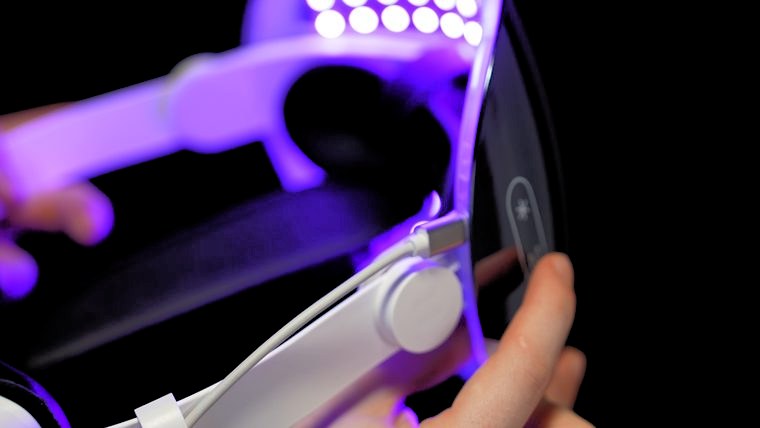
There is a red-only test on acne-prone skin exposed to red light. In 2007, Na and Suh treated one half of the faces of 28 volunteers with a portable red LED device, while the other half remained a control; they received light for 15 minutes twice a day for 8 weeks. The number of inflammatory and non-inflammatory lesions on the treated side was significantly improved compared to the control side, and the visual analog scale score on the treated side decreased from 3.9 to 1.9. 8 The device's red band fell between 635 and 670 nm, according to the JAMA review table. The study is small, single-blind, and 2007.
The JAMA Dermatology 2025 review also calculated the pooled effect, but not from all six studies: five studies for inflammatory lesions, four studies each for non-inflammatory lesions, and total medical impression score. Compared to the control, inflammatory lesions changed by 45.3% (95% confidence interval 25.1 to 65.5%), non-inflammatory lesions by 47.7% (between 18.0 and 77.4%), and the total medical impression score by 45.7% (between 29.1 and 62.4%) in favor of the LED devices. 3 This number comes from a mixed asset population, including red, blue and combo assets, so it cannot be applied to any color separately.
Red light is also used in combination with blue in more recent studies. In 2026, Friedmann et al. compared a home device combining 660 nm red and 415 nm blue light to a 415 nm-only blue device: 30 participants planned, 23 completed, once daily for 8 weeks. Inflammatory lesions decreased in both groups, there was no significant difference between the two groups, the total medical impression score at week 8 was in favor of the combined device. 9 The study was open, without a dummy arm. A 2025 study of a portable mask called Omnilux Clear gave 415 and 633 nm simultaneously for 7 weeks, 4 times a week; 30 people were enrolled, 29 completed it, and 25 of them (86%) improved at least one grade on the overall medical impression scale; all participants also received a standardized cleanser, moisturizer, and daily SPF 30 sunscreen and were allowed to use only study-provided skin care products, so the number is not for light alone. The study was funded by the manufacturer of the device, GlobalMed Technologies. This study was also open, without a control group. 10
Red light has also been tested for wrinkles, using other means. In 2025 by Bragato et al., 95 women between the ages of 45 and 60 years used a red LED mask around 660 nm three times a week or twice a week for 4 weeks, with a sham-treated control. There were no significant differences between the groups (including the sham-treated control) on three wrinkle scales (WAS) evaluated on photos by an expert blinded to the allocation. In the blind, software measurement (ImageJ), four facial regions were measured: the forehead, the glabella, and the area around the right and left eye. In two of these, at the glabella and around the right eye, the length of the wrinkle was significantly reduced in the light-treated groups compared to the sham-treated control (p<0,001), a homlokra és a bal oldalra a vizsgálat nem közölt szignifikáns csökkenést; ez a saját olvasatom: a jobb-bal aszimmetria egy szimmetrikusan világító maszknál óvatosságra int az eredmény értelmezésénél. A résztvevők elégedettsége is magas volt. 11 There is stronger evidence that daily sunscreen slows down skin aging: in the 2013 four-and-a-half-year randomized study of 903 people by Hughes et al., no further skin aging was detected in daily sunscreen users, and skin aging was 24% less than in occasional users. 12 There is a separate article about this: Sunscreen or LED mask: which is the stronger evidence? Look for this: in the red mode, the band between 630 and 670 nm, because there is a test for this on acne-prone skin; and for wrinkle promises, ask for the result of the blind scale, not satisfaction.
Infrared light: why can't you see it, and what do we know about it?
Near-infrared light has a longer wavelength than what the eye can detect, so an 850 nm LED looks dark even when switched on. In many masks, infrared isn't a separate mode: it runs together with every colour, and this doesn't always come across in the description. Its mechanism is the same as red's: the photons are absorbed by mitochondrial chromophores in skin cells, as Avci and colleagues described in 2013. 2
Among the studies reviewed for this article on acne-prone skin, I didn't find one that measured the standalone effect of infrared light. Some of the wrinkle studies gave red and infrared light together, so their effects can't be separated there either. For light above one thousand nanometres, advertised under the buzzword "deep infrared," I didn't find a sham-device-controlled study on skin; the only one I found had no control, and it gave this light together with red and near-infrared, so its standalone effect can't be isolated.
Look for this: whether the description says infrared can be switched on separately or runs in every mode; and if a seller cites "deep infrared," which sham-device-controlled study they mean.
Yellow, green, cyan, and white light: what are they good for?
For yellow, green, and cyan light, I didn't find a controlled human study in the literature I reviewed; there is a study for white light, but only as a comparison arm: in the Papageorgiou 2000 study, the mixed blue-red light gave a significantly better result than white at every measurement point for inflammatory lesions. Manufacturer descriptions recommend yellow for pigment spots, green for uneven tone, cyan for calming, and I couldn't find the cited study anywhere for any of these. Seven colours, then, don't mean seven pieces of evidence.
There's a single piece of mechanism data for the band between blue and green: coproporphyrin III, one of the Cutibacterium porphyrins, has, besides its main peak around 405 nm, smaller absorption maxima in the Q-band too, at 496, 530, 566, and 619 nm; of these, 530 is green, and 566 sits at the upper edge of the green band. A 2026 in vitro study on a bacterial culture of the Cutibacterium acnes subsp. elongatum strain compared 496 nm cyan and a 547 nm green: the authors chose both light sources based on coproporphyrin III's absorption profile, and write that both spectra overlap substantially with the Q-band maxima. The 496 nm cyan still gave a stronger bacterial reduction than the green, 2.31 log versus the green's 0.74 log, at an identical, 9-hour, 50 mW/cm² irradiation; the authors explain this by the higher absorption. The study didn't test violet or blue light. 13 This is data measured in a test tube, not studied in humans, and not at the wavelength of the masks' cyan mode either.
What you can take from this: of the seven colours, there's a human acne study for two of them and their combination (the violet-blue band between 414 and 445 nm and red between 630 and 670 nm); white light appeared in one study as a comparison arm, and the mixed blue-red light gave a significantly better result than it at every measurement point for inflammatory lesions; for yellow, green, and cyan, I didn't find a study behind the description's promise.
Which mode should I use?
This article doesn't give a table matching mode to skin type for this question, because such a table would claim that the mask treats a specific skin problem, and no study says that about any at-home mask. What can be known stands above: there's a study on acne-prone skin for the violet-blue band and for red, both with a small sample; the longest studies run 12 weeks, the shortest treatment stretch is two days, and the mixed blue-red light was better than blue-only for inflammatory pimples in the first weeks. For yellow, green, and cyan, I didn't find a human study; white light appeared in one study as a comparison arm. From this, you decide what to expect from a mode.
It's part of the context that Cochrane's 2024 review processed six systematic reviews from 275 studies, with 40,910 people with acne, and found no high-certainty evidence for the effect of any included acne treatment; even for over-the-counter benzoyl peroxide, only very low-certainty evidence. 14 The light studies are small within this field, and their result should be measured against that.
Look for this: in your own mask's guide, the time limit and the contraindications, and for the colours, the nanometre value; you can piece together what the colours mean from the studies above yourself.
There's a human study for two bands, both small and short, on acne-prone skin; for yellow, green, and cyan I didn't find one, white was a comparison arm in one study. Instead of the colour's name, the nanometre value tells you where you stand.
What do the LED mask's colours mean?
Each colour means a wavelength, in nanometres. Violet and blue are shorter waves, red is longer, infrared is invisible to the eye. There's a human acne study for the blue band between 414 and 445 nm and for red between 630 and 670 nm, according to JAMA Dermatology's 2025 review of at-home LED devices; for yellow, green, and cyan light I didn't find one, white light appeared in one study as a comparison arm, and the mixed blue-red light gave a significantly better result than it at every measurement point for inflammatory lesions. Look at the nanometre value instead of the colour's name.
How long should I use each colour for?
This article doesn't assign a time to a colour. The referenced studies' durations differed from study to study, and where the time per session was stated, I found this: Gold and colleagues (2011) gave the blue light at the clinic twice a day for 2 minutes, with a handheld, spot-treatment device, on one pimple each; the blue and mixed light were given elsewhere for 15 minutes a day over 12 weeks (Papageorgiou 2000); the red for 15 minutes twice a day over 8 weeks (Na and Suh 2007); another blue-red device (Omnilux Clear, Ablon 2025) for 10 minutes, four times a week; the blue-red mask (Nestor 2016) for 15 minutes a day over 12 weeks; and the wrinkle study's red mask (Bragato 2025) for 21 minutes, two or three times a week. Your own mask's guide gives the time limit; frequency is covered in a separate article in the knowledge base.
Can you mix colours, for example blue and red?
Some of the studies did exactly this. In Papageorgiou 2000, the mixed 415 and 660 nm light was better than blue-only for inflammatory pimples at weeks 4 and 8, but not anymore at week 12. In Friedmann 2026, no significant difference was found in lesion count between the 660 and 415 nm combination and blue-only at 415 nm. Whether a given mask can give two colours at once shows up in its description.
What is violet light in the LED mask?
There are two types of purple on the market. One is an independent violet LED, around 415 nm, the other is a blue and red LED at the same time, which the eye sees as purple. In my mask, the individual chip with a peak between 414 and 415 nm is the blue mode, the purple mode connects it with the red, according to the manufacturer's spectrometer measurement. Blue and red light have also been tested together in acne studies, with other devices, without near-infrared; on my mask, the near-infrared also goes with them, and the same wavelength does not mean the same device, dose or treatment time. The nanometer value in the manufacturer's description or a spectrum measurement tells you which one is in a mask.
Why can't I see the infrared light in the mask?
Because the 850 nm near-infrared has a longer wavelength than what the human eye can detect. The LED is lit, the eye just doesn't register it. In many masks, infrared runs in every mode alongside the visible colour, and only the description tells you this, not your eyes.
What is yellow light in the LED mask good for?
In the literature I reviewed, I didn't find a controlled human study for yellow light. Manufacturer descriptions typically recommend it for pigment spots, without a citation. If a seller mentions a study for yellow mode, ask for the author and the year, because I couldn't cite one in this article.
What is green light in the LED mask good for?
I didn't find a controlled human study for green light either. There's a single piece of related data: coproporphyrin III, one of the Cutibacterium porphyrins, has two Q-band absorption maxima falling here: 530 is green, 566 sits at the upper edge of the green band. A 2026 in vitro study on a bacterial culture of the Cutibacterium acnes subsp. elongatum strain compared a phosphor-converted green LED, with a peak at 547 nm, to a 496 nm cyan: at an identical 9-hour irradiation, the green gave a bacterial reduction of 0.74 log, the cyan 2.31 log. According to the authors, both light sources' spectra fit well with the Q-band maxima, and they explain the difference by the cyan's higher absorption. This happened in a test tube, it can't be carried over to skin, it wasn't studied in humans, the study didn't test violet or blue light, so I can't show a study behind green mode's promises.
What is the difference between purple and bluer blue mode?
Cutibacterium species porphyrin has a major absorption peak, the Soret band, at 405 nm, measured peaks in one study fell between 402 and 413 nm, and blue acne studies worked between 414 and 445 nm. I couldn't find any acne studies on 450 nm blue per se, nor any that compared 415 and 460 nm blue side by side. The two are also different to the eye: 415 is purple, 450 is the blue we call blue. The peak of the blue mode of my own mask is 414 nm, as measured by the manufacturer.
Is red light good for wrinkles?
There are studies on it, with other devices. In Bragato 2025, in 95 women, with a red mask around 660 nm, after 4 weeks there was no difference between the groups on the blinded wrinkle scale (WAS), including the sham-treated control; in the blinded, software-based measurement (ImageJ), of four facial regions, in two, at the glabella and around the right eye, wrinkle length decreased significantly in the light-treated groups compared to the sham-treated control (p<0.001), the study didn't report a significant decrease for the forehead and the left side, and satisfaction was also high. Daily sunscreen has stronger evidence for slowing skin ageing (Hughes 2013, 903 people, four and a half years). A separate article in the knowledge base covers this.
Is a seven-colour LED mask better than a two-colour one?
The number of colours isn't a number of evidence. There's a human acne study for the violet-blue band (between 414 and 445 nm) and for red (between 630 and 670 nm); for yellow, green, and cyan light I didn't find one, white light appeared in one study as a comparison arm, and the mixed blue-red light gave a significantly better result than it at every measurement point for inflammatory lesions. A seven-colour mask, then, gives more modes, not more evidence. What matters is whether the two studied bands are included, and at what wavelength.
Is blue light dangerous for the eyes?
According to the ICNIRP guideline 2013, the blue light retina hazard weight function is highest around 435 and 440 nm, 415 and 460 nm get the same weight, and it reaches a weight of 0.940 at 450 nm. This means that the modes that give blue light are more sensitive to the eyes than red: in a mask, in addition to blue, it can also be purple, cyan and white. Eye protection, the eye pads of masks and the reported eye case are discussed in a separate article in the knowledge base.
What if my skin got worse after a colour?
Stop using it, and check your mask's guide for the list of contraindications: photosensitising medications and conditions involving photosensitivity can cause a reaction with any visible colour. If the redness or the rash doesn't go away, show it to a dermatologist. An individual reaction can't be predicted from small, short studies; the knowledge base's contraindications article lists who the mask isn't for.
After eight masks: my own mask's colours, in numbers
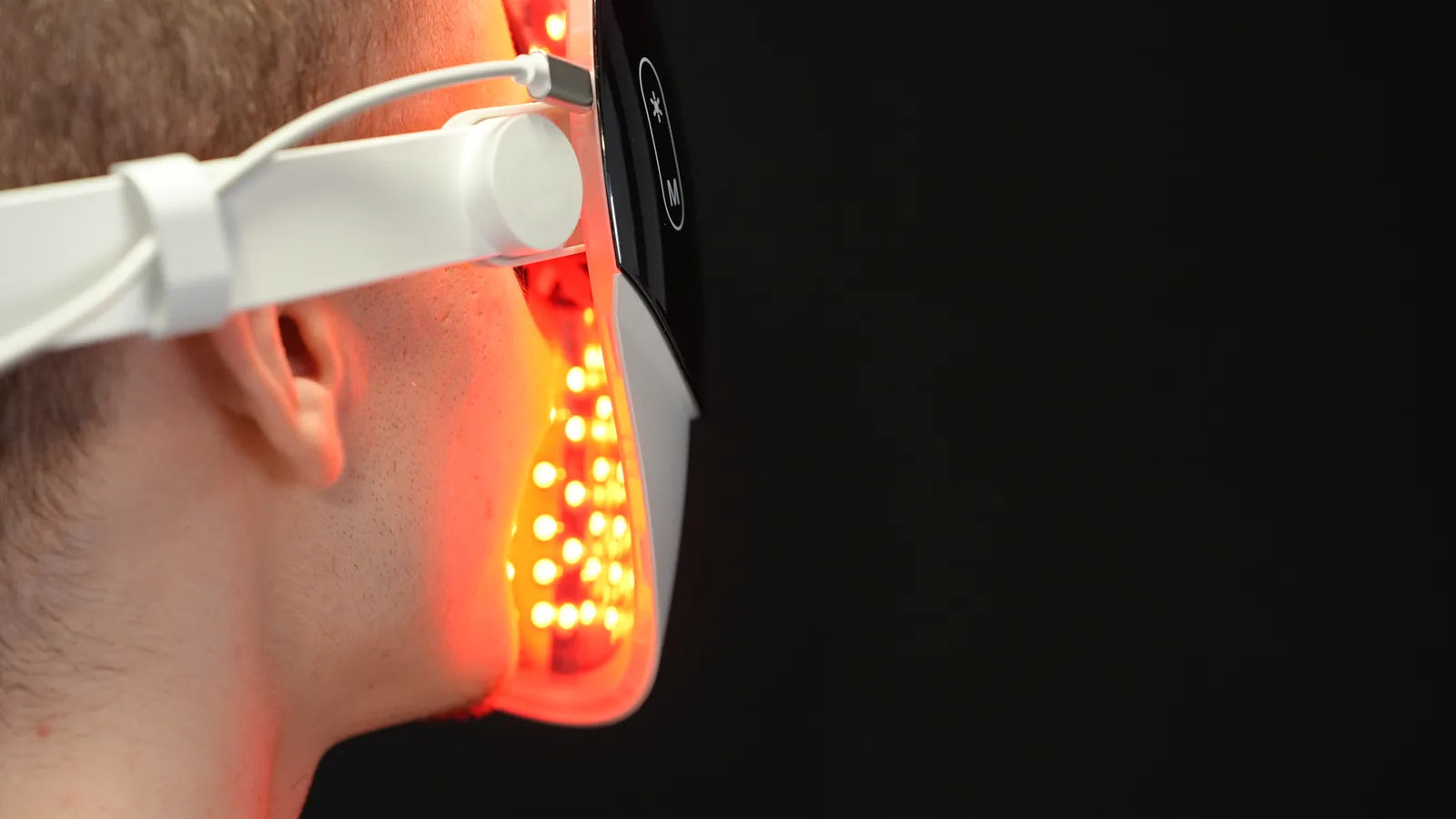
I tried eight LED masks before I started marketing my own, and that's why I knew what I was looking for: in addition to the colors, the nanometer value. The manufacturer measured all seven modes with a spectrometer. This revealed that there are three types of visible tiles in the mask: a blue 414 nm, a green 515 nm and a red 634 nm, next to them is the near-infrared, which works in all modes; for this, the manufacturer gave a measured peak of 852,7 nm in a previous announcement. The seven modes consist of: one tile each for blue, green, and red, purple for blue and red, cyan for blue and green, yellow for green and red, and white for all three at the same time. The mask has 99 LEDs, each with four chips.
This is the specification. A test tells you what a given wavelength means on your skin; the sections above are examples of this. The 414 nm of the blue mode is at the lower end of the 414 to 445 nm band of the blue acne tests, the 634 nm of the red is in the red band of 630 to 670 nm, the purple mode gives both. The referenced studies were made with other devices, and the same wavelength does not mean the same device, dose or treatment time. The manufacturer's measurement for all seven modes a on the product page you can also look at it.
I don't assign a mode to a skin image: from the tests above, you can see what was measured for which band. The mask is not a medical device, it is a home lighting device for cosmetic purposes, and I am its dealer: a on the product page I also described the other details, eye protection and limitations.
Sources
The referenced studies were done with other devices, under other conditions; none of them are about this mask, and the mechanism sources don't imply a result for any particular skin.
- Serrage HJ, Eling CJ, Alves PU et al. Spectral characterization of a blue light-emitting micro-LED platform on skin-associated microbial chromophores. Biomed Opt Express, 2024. PMID 38855662.
- Avci P, Gupta A, Sadasivam M, Vecchio D, Pam Z, Pam N, Hamblin MR. Low-level laser (light) therapy (LLLT) in skin: stimulating, healing, restoring. Semin Cutan Med Surg, 2013. PMID 24049929.
- Ershadi S, Barbieri JS. At-Home LED Devices for the Treatment of Acne Vulgaris: A Systematic Review and Meta-Analysis. JAMA Dermatol, 2025. PMID 40042878.
- Papageorgiou P, Katsambas A, Chu A. Phototherapy with blue (415 nm) and red (660 nm) light in the treatment of acne vulgaris. Br J Dermatol, 2000. PMID 10809858.
- Gold MH, Sensing W, Biron JA. Clinical efficacy of home-use blue-light therapy for mild-to moderate acne. J Cosmet Laser Ther, 2011. PMID 22091799.
- Ash C, Harrison A, Drew S, Whittall R. A randomized controlled study for the treatment of acne vulgaris using high-intensity 414 nm solid state diode arrays. J Cosmet Laser Ther, 2015. PMID 25594129.
- Nestor MS, Swenson N, Macri A, Manway M, Paparone P. Efficacy and Tolerability of a Combined 445nm and 630nm Over-the-counter Light Therapy Mask with and without Topical Salicylic Acid versus Topical Benzoyl Peroxide for the Treatment of Mild-to-moderate Acne Vulgaris. J Clin Aesthet Dermatol, 2016. PMID 27354885.
- Na JI, Suh DH. Red light phototherapy alone is effective for acne vulgaris: randomized, single-blinded clinical trial. Dermatol Surg, 2007. PMID 17903156.
- Friedmann DP, Verma KK, Gidwani KA, Nguyen M, Gharibvand L. Comparing a Red and Blue Light-Emitting Diode Light Device With an Existing Blue Light Device for At-Home Treatment of Inflammatory Acne: An Open-Label Randomized-Controlled Trial. Dermatol Surg, 2026. PMID 41886698.
- Ablon G. A 7-Week, Open-Label Study Evaluating the Efficacy and Safety of 415-nm/633-nm Phototherapy for Treating Mild-to-Moderate Acne in Adolescents and Adults. J Clin Aesthet Dermatol, 2025. PMID 41416031.
- Bragato EF, Paisano AF, Pavani C et al. Role of photobiomodulation application frequency in facial rejuvenation: randomized, sham-controlled, double-blind, clinical trial. Lasers Med Sci, 2025. PMID 40167796.
- Hughes MC, Williams GM, Baker P, Green AC. Sunscreen and prevention of skin aging: a randomized trial. Ann Intern Med, 2013. PMID 23732711.
- Haag R, Gurow O, Mack M, Moisel J, Hessling M. Enhancement and Limitations of Green-Spectrum Dual-Wavelength Irradiation in Porphyrin-Based Antimicrobial Strategies Targeting Cutibacterium acnes subsp. elongatum. Pharmaceutics, 2026. PMID 41599178.
- Yuan Y, Wang Y, Xia J et al. Topical, light-based, and complementary interventions for acne: an overview of systematic reviews. Cochrane Database Syst Rev, 2024. PMID 39440650.
- ICNIRP. Guidelines on limits of exposure to incoherent visible and infrared radiation. Health Physics, 2013; 105(1):74–96, Table 2.