

Dermastamp or dermaroller? Which is good for what, and why.
Both are microneedling: they open tiny channels in the skin to trigger the body's own repair process. The difference is how the device moves, and that matters more for hair than for skin.
What is a dermastamp and what is a dermaroller?
Dermaroller: a spiked cylinder on a handle. You roll it across the skin; as it turns, the needles go in and out at an angle.
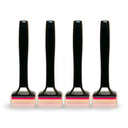
Dermastamp (manual): a stamp head with needles. You press down and lift it in one spot, perpendicular, without dragging.
Both are microneedling: the micro-injury triggers the skin's own repair response. The effect comes from the mechanism itself, not from the specific device.
How does microneedling work?
The needle creates tiny, controlled injuries that trigger the skin's repair response: new collagen and growth factors, skin renewal. Singh 2016 On the scalp, the goal is to stimulate the environment around the follicles; details: male pattern hair loss and female hair loss.
The evidence belongs to the MECHANISM (microneedling), typically from studies done with clinical devices. No separate study has been done with our specific home device, we reference the mechanism.
Geometry is the difference
The dermaroller is a rotating cylinder: it goes in and out at an angle, so instead of a point it leaves elongated, triangular tears (dragging the tissue between entry and exit). The manual stamp presses perpendicularly down and up, in one spot: point-like channels of even depth, with intact skin in between.
More details
The "tram-track" scar is a documented side effect of microneedling, and it is more common with rollers than with stamps. Chu 2021 Cureus 2025
The literature links it to excessive pressure, especially over bony areas, and it can be avoided with less pressure and a shorter needle. Pahwa 2012 Exactly why the angled entry and exit gives a more elongated, uneven mark is my own geometric explanation, not a study finding.
Transient redness, on the other hand, is strongest with the stamp among the microneedling forms. Cureus 2025
In this article, the Dermastamp is on the stamp side.
 See the Dermastamp
Why is the roller harder to use in hair?
Longer hair winds around the rotating roller. This makes the micro-injuries uneven, and where the hair is denser, the needle doesn't reach the same depth everywhere. The worst case: the roller can even pull out the very hair you're trying to save. The stamp works in one spot, perpendicularly: the hair doesn't wind around it, and the depth is more predictable.
The difference at a glance
| Manual stamp | Dermaroller | |
|---|---|---|
| Movement | perpendicular, up and down in one spot | rotating, rolled across |
| Wound shape | point-like channel | elongated, angled tear |
| Depth | even | variable |
| Scalp | hair doesn't wind around it | hair can wind around it |
| Large area | slower | faster |
| Transient redness | typically stronger | typically milder |
| Control | you're in control, few chances for error | the roller dictates |
Why isn't a deeper needle better?
It's tempting to think a deeper needle is worth more. The research says otherwise: a pooled analysis of 12 studies (631 people) found that needle depth (up to 1 mm vs over 1 mm) had no meaningful effect on the hair outcome. Ahmed 2025 In the scalp studies, the deeper needle didn't add anything extra; these were done with clinical devices.
By purpose, the literature roughly splits like this: wrinkles and ageing 0.5-1 mm; scars 1.5-2 mm (these are deeper, clinical treatments; a comparison of the two paths: clinic or home). Singh 2016 All of this comes from studies done with clinical devices, not with the Dermastamp.
What does the research say?
For hair, the strongest data is on the combination of microneedling and minoxidil. In a 100-person, evaluator-blind study, by week 12 the group also receiving microneedling had a hair count increase of 91.4 hairs/cm², versus 22.2 for minoxidil alone (p=0.039). Dhurat 2013 This is the increase, not the total hair count.
These studies were done with a 1.5 mm roller, under clinical conditions, not with the 1 mm Dermastamp.
Why isn't the 540-needle roller better?
A dermaroller can be made with as many as 540 needles, but more needles doesn't mean deeper or more even penetration. The more needles share the same hand pressure, the less each one gets, so most needles only scratch the surface.
It's the same principle as the bed of nails trick: if someone lies on hundreds of nails, none of them penetrate, because the body weight is spread across all the points. Under a single nail, that same weight would pierce the skin. Pressure decides, not the number of points.
The Dermastamp works with 80 needles. Enough to cover a meaningful area with one press, and few enough that each needle has sufficient pressure behind it to pierce the skin. I tried many microneedling devices before settling on this one, and needle geometry was the main reason. The needles penetrate perpendicularly, point by point, opening even, clean channels exactly where you want them.
What happens to serum afterwards?
Microneedling opens tiny channels in the top layer of the skin. These close within hours, but while they're open, an active ingredient applied to them finds a more direct path into the skin than when left on the surface. Cureus 2025
It's not known exactly how much more gets absorbed, because this varies by skin, by serum, and by technique. Anyone promising a specific percentage is claiming more than the evidence supports. The mechanism is real, its magnitude is not established.
An open channel also means bad things can get in too. Right after microneedling, only put simple active ingredients on the skin. No perfume, alcohol, acids, or retinoids.
When is the roller more practical?
On large areas of the body (back, thighs) the roller is faster, and on closely shaved or hair-free scalp the hair-strand problem doesn't come into play either. With a quality device and light pressure, its risk can be reduced. Pahwa 2012 For the face and scalp with hair, though, the stamp is more predictable.
When should you NOT microneedle at home?
There are cases where microneedling at home is not recommended, and you should see a dermatologist instead:
- Active, inflamed acne on the area to be treated (the needle can spread the infection).
- Rosacea, eczema, active skin inflammation.
- If you're prone to keloids (overgrown scars).
- During or shortly after isotretinoin (Roaccutane) treatment.
- Active herpes, open wound, recent tanning or sunburn on the area.
Hygiene always applies: wash your hands, wash your skin with a foaming cleanser and let it dry, and disinfect the stamp's needle head with 70% or stronger alcohol before use (alcohol is only needed for the needle head). After the treatment you throw it away, never share the single-use head with anyone else.
Same with a dermapen? (dermapen vs dermaroller)
The dermapen is a motorized, pen-like device: the needles move up and down quickly, perpendicularly, driven by mechanical vibration. Its movement geometry is closer to the stamp (perpendicular) than to the roller, but a motor drives it, not your hand. For home use, the manual stamp is simpler and more predictable: no motor, no cable, no speed setting you could get wrong.
What do you get with the Dermastamp?
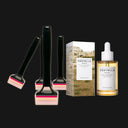
The Dermastamp needle is medical-grade SUS304 stainless steel with a gold coating. An independent lab test checked it for 21 heavy metals, and every one stayed below the limit, meaning the needle doesn't release harmful metal even when it penetrates the skin. During manufacturing, the product undergoes high-energy electron-beam (e-beam) irradiation, which reduces its bioburden. This doesn't make it sterile, so you still need to disinfect it before use, but it gives a cleaner starting point than a plain packaged device.
The Dermastamp is single-use. You take one piece into your skin once, then throw it away, so every treatment starts with a fresh needle. With a roller, you use the same 540 needles again and again, and at home it's hard to reliably keep the gaps between the needles clean. That's why clinics work with single-use heads.
Which one for you?
- you'd use it on the face, eyebrows, or scalp with hair
- control and few chances for error matter to you
- you're a beginner
- you want even depth
- you'd treat a large body area (back, thighs) quickly
- your scalp is closely shaved or hair-free
- you accept the bigger dragging motion for the speed
The full picture, with every documented risk and contraindication: risks and things to know.
Frequently asked questions
Is a dermastamp or dermaroller better for hair loss?
On the scalp, many choose the stamp because the hair doesn't wind around it and the depth is more even. The effect comes from the microneedling mechanism itself, not from the specific device.
What does it mean that the roller leaves an elongated mark?
The rotating cylinder goes in and out at an angle, so the channel isn't point-like but elongated and triangular. With heavy pressure over a bony area, this can even leave a linear mark. Pahwa 2012 With the perpendicular stamp, the channel is point-like.
As a beginner, which one should I choose?
If predictability (face, eyebrows, scalp) and few chances for error matter to you, the manual stamp is the friendlier start: no motor, no rotation, the needle length is fixed.
How often can I use it?
On the face, one session every 2–3 weeks, for at least 4–6 treatments; on the scalp, one a week, so the skin can fully heal between sessions. The dermastamp is single-use: every treatment gets a new, disinfected stamp. Repeating more often, impatiently, doesn't speed up the result, but it can irritate the skin.
What should I do after the treatment?
That evening, don't rub it or wash it off, let it dry on its own, and don't put anything on it. The next morning, foaming cleanser, Centella serum, moisturiser, and finally SPF 50; sunscreen is needed every morning from this day on. For 24 hours, avoid makeup, swimming pools, saunas, tanning beds and strong sun. Retinoid and vitamin C: the user guide says 24 hours for retinoids, I wait 48 hours to be on the safe side. Acid exfoliants (AHA/BHA): at least one week, a published review recommends this. Every skin is different, find out what works for you. The full pre- and aftercare list: risks and things to know.
What is the needle made of?
Medical-grade SUS304 stainless steel with a gold coating. An accredited lab (TÜV) tested the needle for heavy-metal release across 21 metals, and every value stayed below the limit.
 Touch-free
If the needle device isn't for you
Microneedling isn't like rubbing in a cream: it comes with a protocol, which I provide, and it isn't for everyone. I have another product that doesn't touch your face: the LED light mask. A different device with a different purpose; its own page describes everything about it, including what it isn't for.
For both, the basics come first: daily sunscreen, a gentle cleanser, a moisturiser.
Sources
These studies are about the mechanism of microneedling, typically with clinical devices. No separate study has been done with our device, we reference the mechanism.
- Chu S, Foulad DP, Atanaskova Mesinkovska N. Safety Profile for Microneedling: A Systematic Review. Dermatol Surg. 2021. PMID 34448760 · the tram-track scar as a documented side effect.
- Physiological Mechanisms and Therapeutic Applications of Microneedling: A Narrative Review. Cureus. 2025. PMC PMC11993440 · by modality: tram-track strongest with the roller, redness strongest with the stamp.
- Pahwa M, Pahwa P, Zaheer A. "Tram track effect" after treatment of acne scars using a microneedling device. Dermatol Surg. 2012. PMID 22587597 · the mechanism of the tram-track effect: excessive pressure over bony areas, avoidable with less pressure.
- Dhurat R et al. A Randomized Evaluator Blinded Study of Effect of Microneedling in Androgenetic Alopecia. 2013. PMID 23960389 · microneedling + minoxidil vs minoxidil alone (100 people, 12 weeks, 1.5 mm roller).
- Ahmed KMA, Kozaa YA, Abuawwad MT, et al. Evaluating the efficacy and safety of combined microneedling therapy versus topical minoxidil in androgenetic alopecia. Arch Dermatol Res. 2025. PMC PMC11890238 · 12 studies, 631 people; needle depth (≤1 mm vs >1 mm) did not affect the hair outcome.
- Singh A, Yadav S. Microneedling: Advances and widening horizons. Indian Dermatol Online J. 2016. PMC PMC4976400 · the mechanism of microneedling (growth factors, collagen induction) and needle length by purpose.