
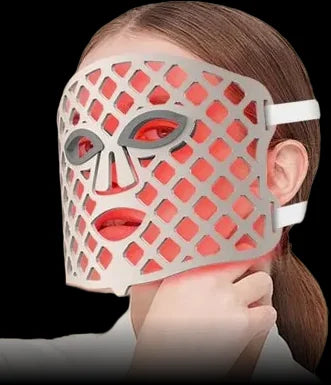
 RED MODE
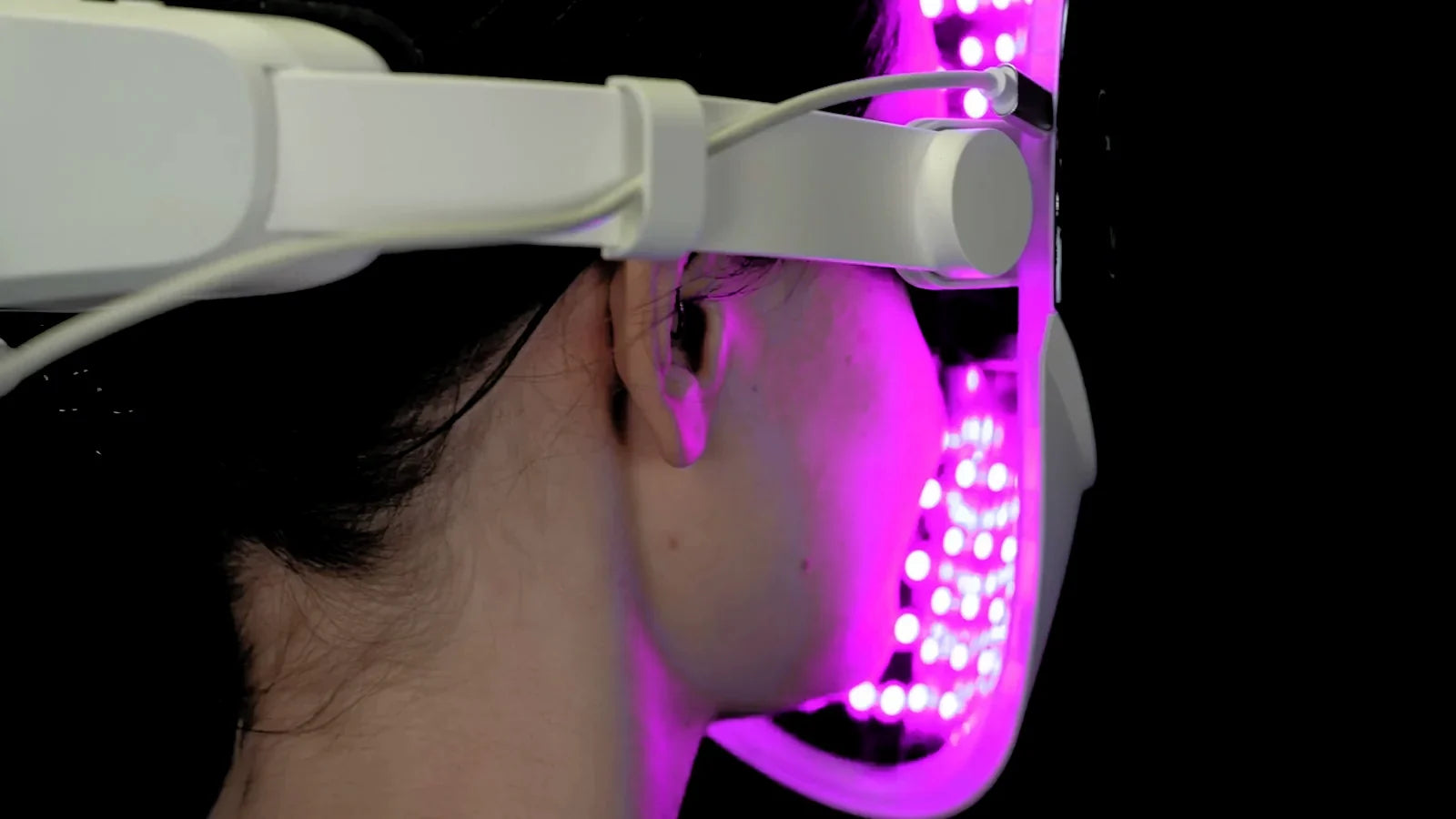
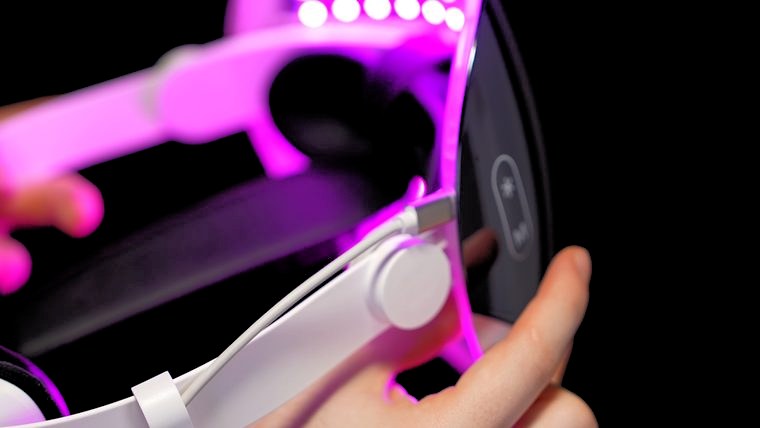
 PURPLE MODE
A premium rigid-frame LED mask where I paid attention to
eye protection.
Refined to perfection with 3D printing.
With LED masks, it's standard practice to promise big percentages and exact deadlines. You won't find that on this page. I write down what the device does, what's known about the light and what isn't, and also why you shouldn't buy it.
What the market promises, and what I say
- Reduce wrinkles by 32%, in just two weeks.
- 30% fewer wrinkles and 57% fuller skin in 8 weeks.
- Boosts collagen production and speeds up the repair of damaged skin cells.
- The results are confirmed by independent testing.
- There's no clinical study on this mask. Not from me, not from anyone else.
- I don't quote a percentage and I don't give a deadline. I have no measurement that would let me read one out.
- There are clinical studies with positive results at the wavelengths of the red and purple modes. They were done with other devices, and I cite them below along with their limits.
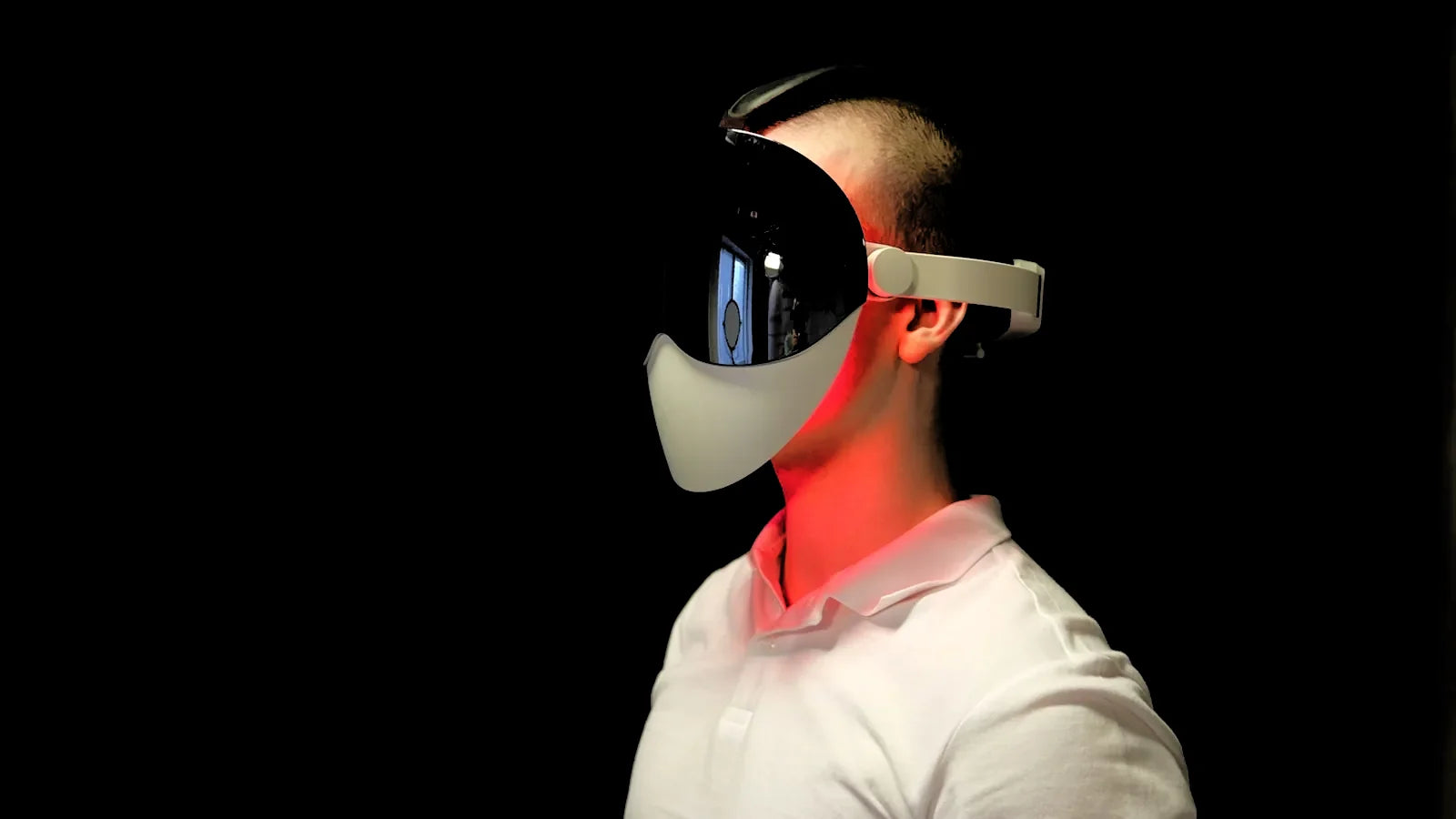
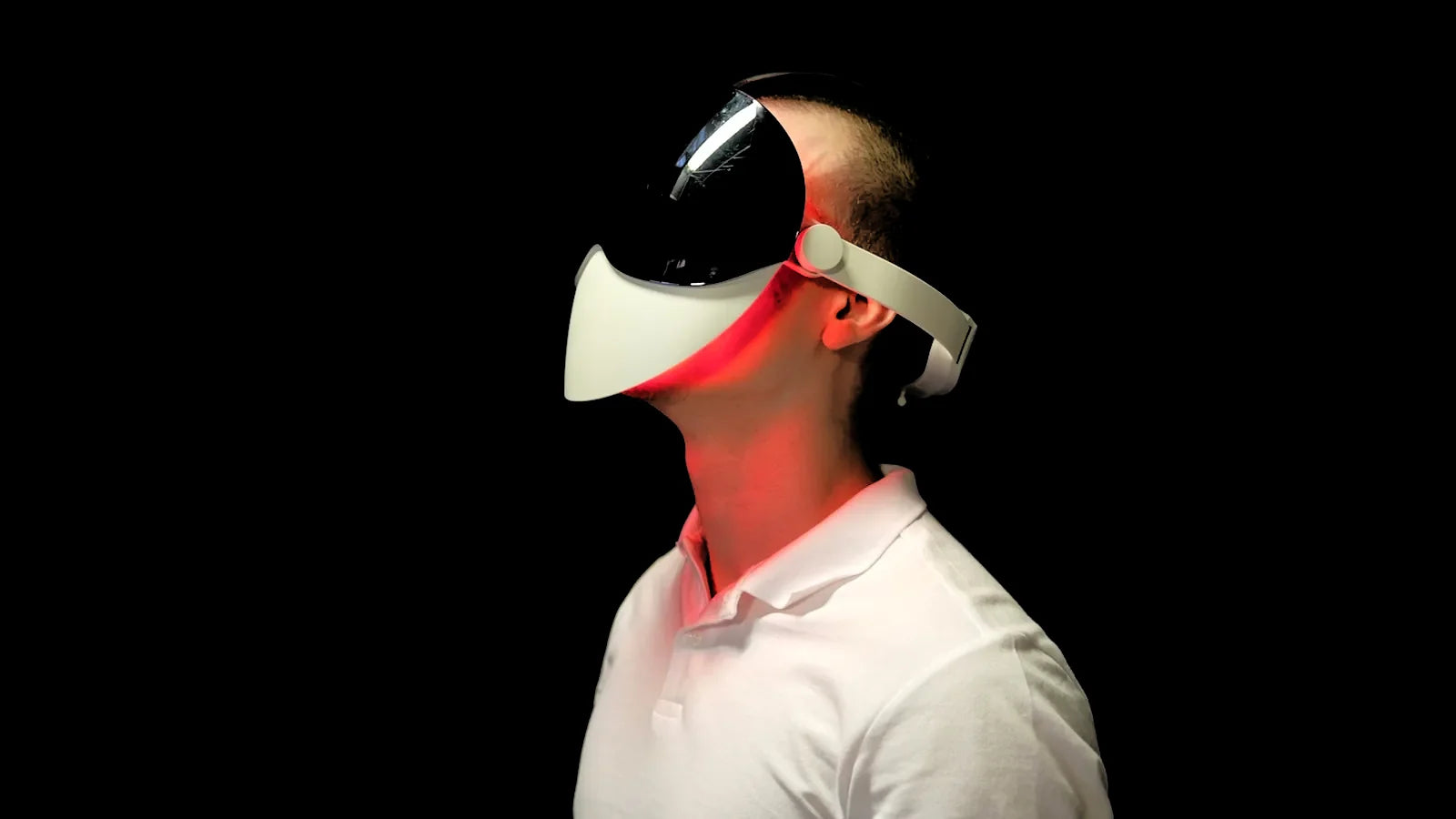
- There are no LEDs on the eye line. I considered eye protection more important than extra coverage. ↓
Why this matters at this price
This is a purchase in the hundreds of thousands of forints. For a decision this size, you also need to know what the device can't do.
what these promises stay quiet about: your eyes
None of the promises above say anything about your eyes, even though light reaches them too. For masks that hug the face, this is the most sensitive point: some have little coverage around the eye, and the LEDs sitting there light up close to the eye. The photo shows one like that. There's also one that protects even with an open eye cutout. That's why it's worth a look.
See for yourself, two minutes
- Open any other at-home LED mask product page.
- Find the photo where a model is wearing the mask switched on.
- Look at the model's eye. If the LEDs light up in front of the eye too, the eye cutout is open, and the light goes into the eye.
Why this is worth looking at, and what the eye case published in 2020 was, I describe in the eye section, along with its limits.
What's different about this mask, and why it's better
A sealed, padded covering around the eye
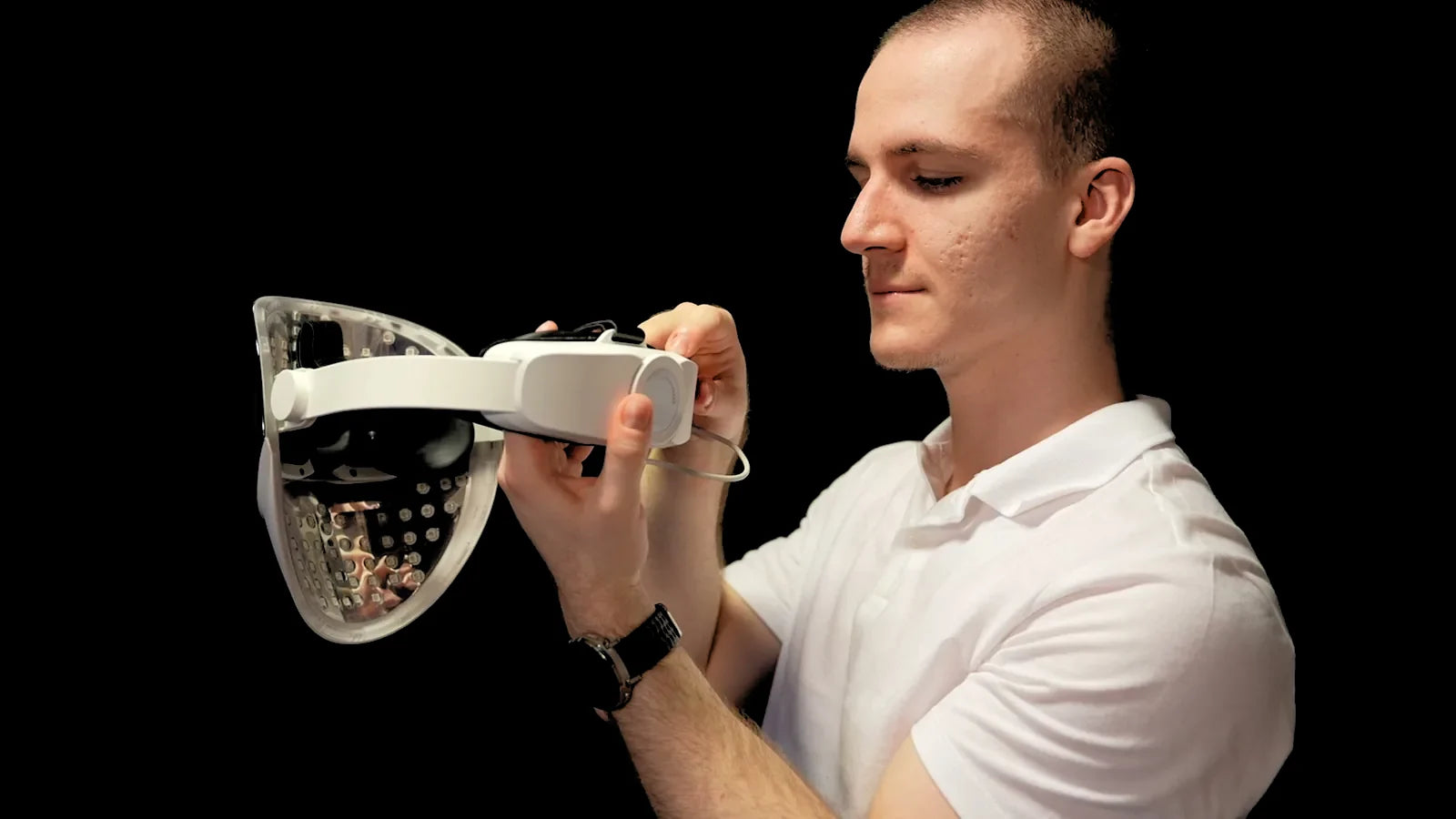
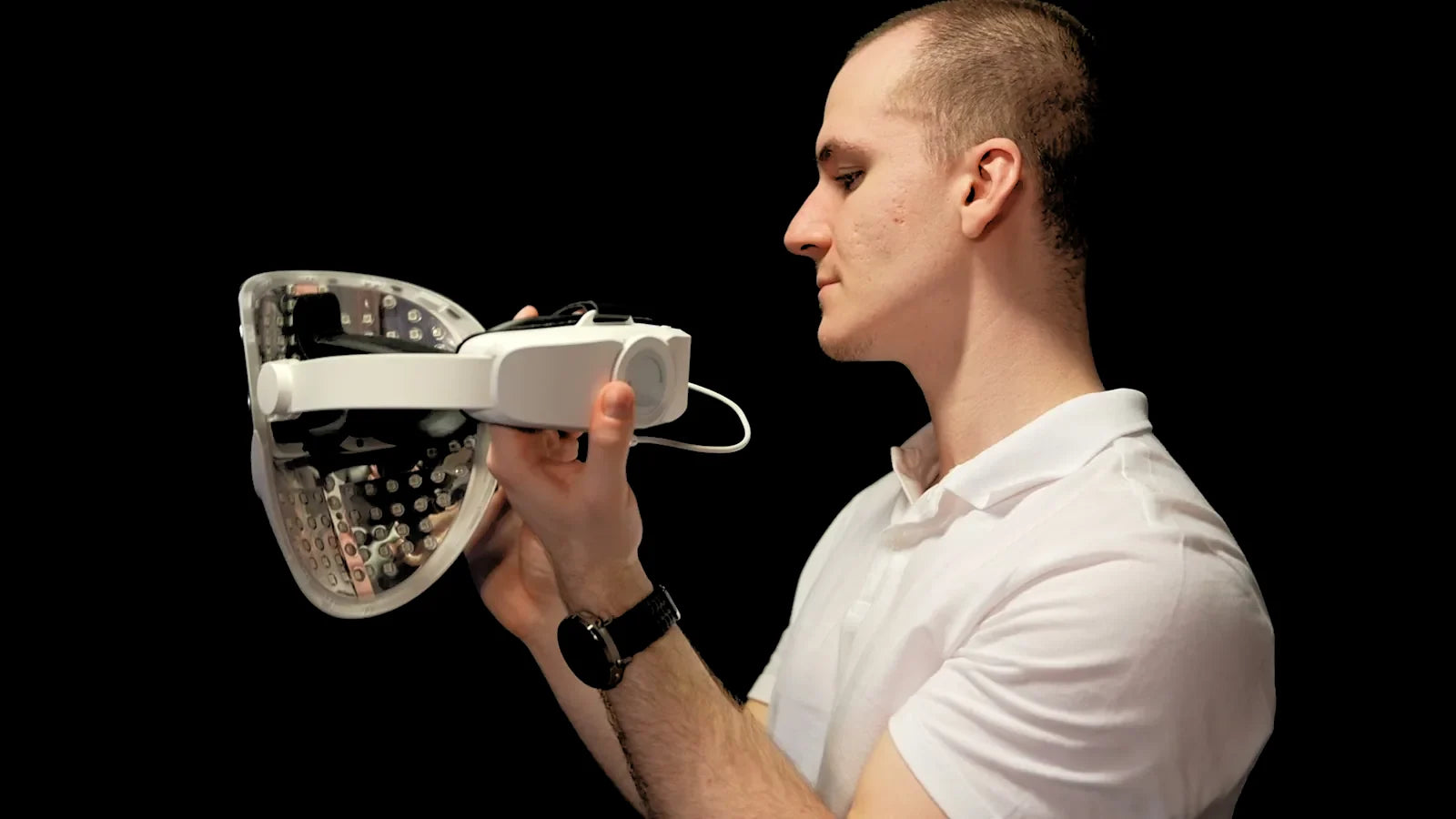
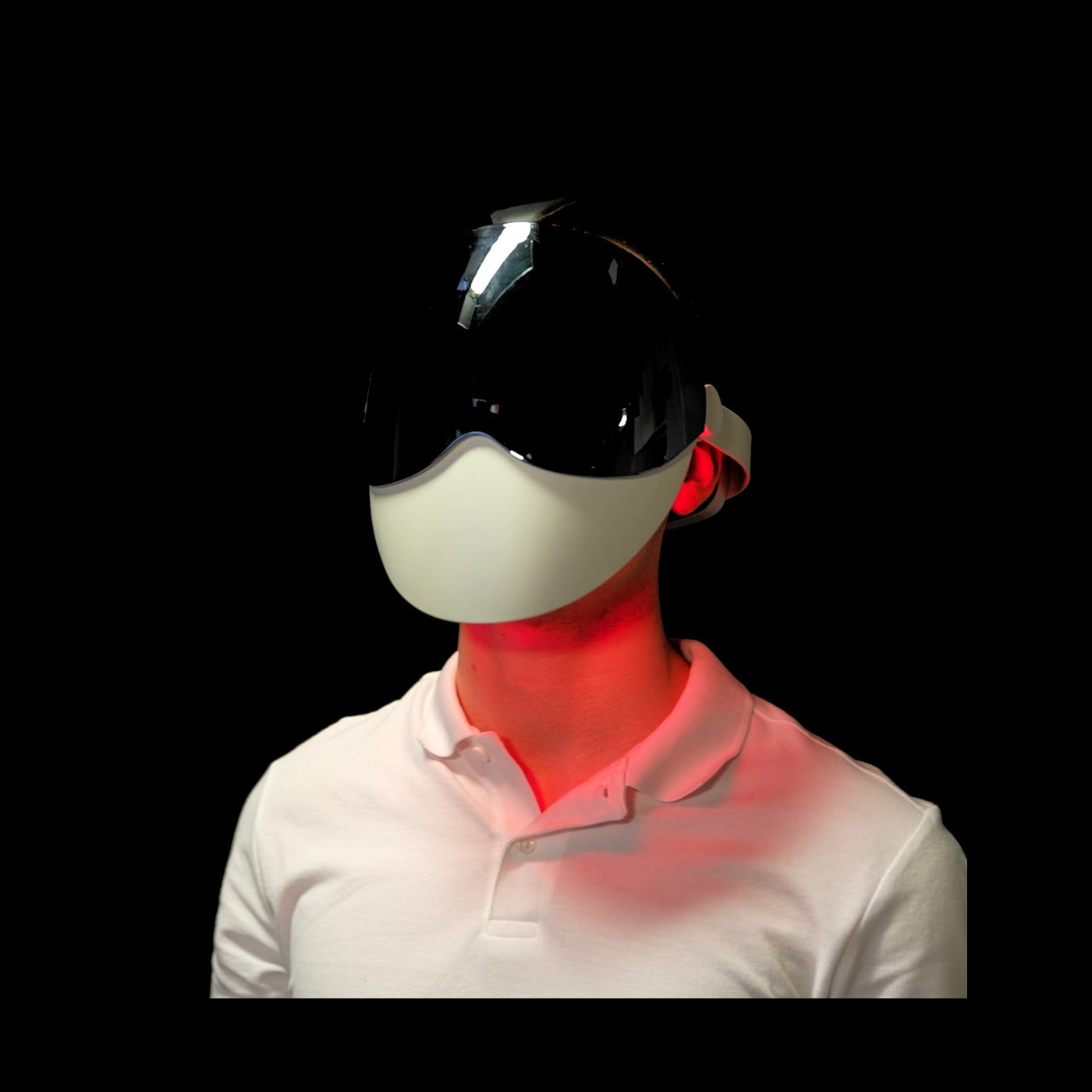
The LED matrix breaks at the eye line, and a padded silicone covering closes around the eye. The covering is part of the structure, not a removable accessory.
Why this was the deciding factor
In 2020, a case was published where, after blue light from an open-eye-cutout mask, damage to the retinal pigment epithelium remained even at the follow-up check. The blue light in the case was between 460 and 470 nm; the mask's blue mode is 450 ± 10 nm according to the manufacturer, directly below it, touching its tolerance range. This carried the most weight in deciding which of the eight masks I tried I would bring to market. The details and the source are in the eye section.
Doesn't touch your facial skin
The panel sits on a rigid frame, the LEDs are about a centimetre from your skin, and that's the same at every use. Your skin can breathe underneath it, and there's no friction on inflamed skin.
Why one centimetre is a good spot
This is my own hypothesis, not a measured result. With a dense LED grid, the light cones of neighbouring diodes already overlap at one centimetre, so the skin gets more even light than with a face-hugging mask, where there's a hot spot under each diode and shadow between them. At this distance, the light from a grid of sources barely weakens yet, while the air can still circulate, and the panel doesn't rub against inflamed skin.
Whether one centimetre is better than direct contact, I haven't found a study that answers. Face-hugging silicone seals off your facial skin; on inflamed skin, friction and a sealed surface are exactly what you don't want.
The LEDs don't bend
They sit on a rigid board. In a foldable mask, they flex at every use.
What this means for the lifespan
Bending stresses the solder joints and the conductive traces; on a rigid board, that stress isn't there. I have no measured lifespan data on it, so I'm not claiming it lasts longer. Only that one known source of wear is missing from it.
Lands in the same spot every time
The rigid frame keeps the LEDs at the same distance from your face, always.
Why this is hard on a silicone mask
On a face-hugging sheet, the distance of the LEDs depends on the shape of your face and how you put it on, so it varies by session and by area of the face. On the rigid frame, that variable drops out.
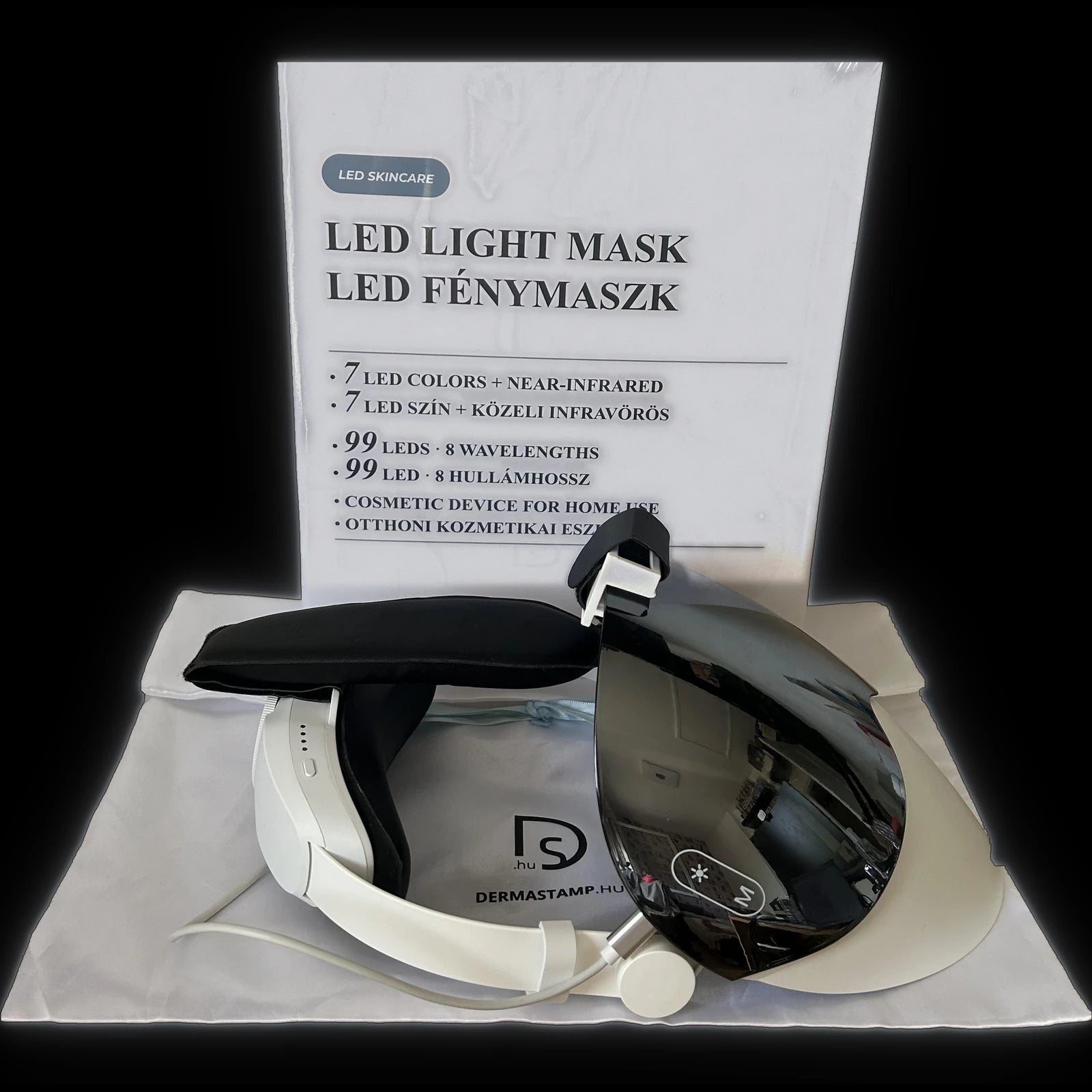
The rigid frame folds up, and it comes with a white satin pouch with the dermastamp.hu logo for travelling. The real advantage of the silicone mask is the smaller packed size.

My mask: a sealed eye covering, the panel doesn't touch your skin, the LEDs don't bend, and it lands in the same spot every time. Silicone's advantage: smaller packed size. That's it, on the structural points.
SIMPLE TO USE
Scroll: this one motion is the whole thing (after a one-time setup).

What was left after eight masks

I bought and tried 8 different LED masks on my own face before deciding which one to sell. This is the one that was left.

I found the best LED mask and made it even better with 3D printing. I'll keep improving it with accessories, and if you have any suggestion after using it, I'll design it and print it.
What I wasn't happy with, I designed and printed
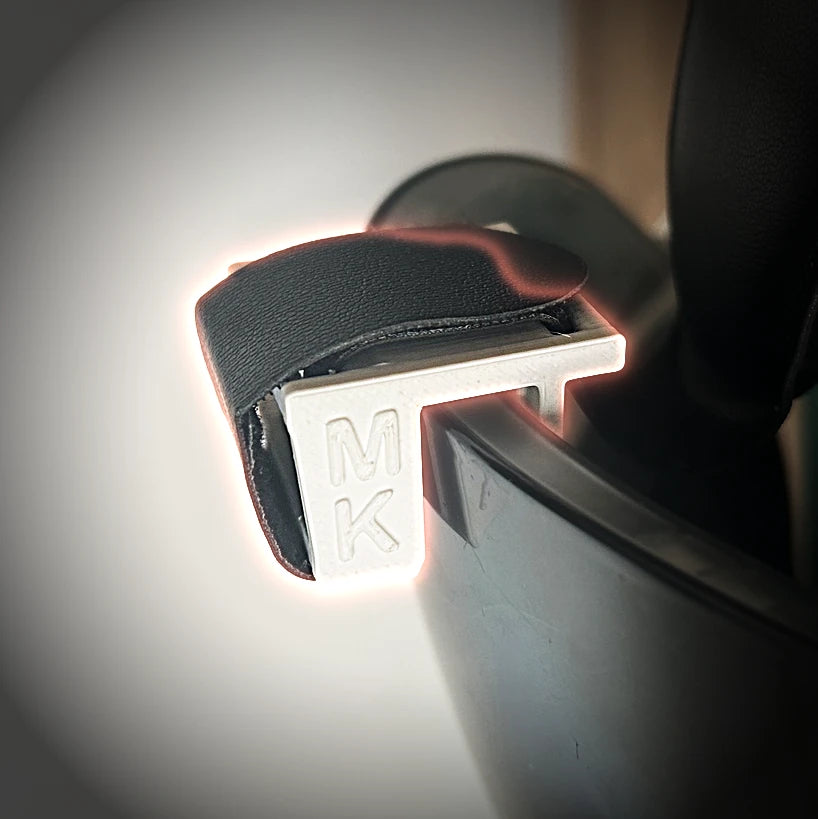
One thing bothered me about the mask: the front strap's connection point. I designed an adapter for it and printed it. This piece ships with the mask, it's part of what you get.
If you want another one
The adapter doesn't open the electronics and doesn't touch the light. It's a structural piece that holds the strap. I print it myself, so you can ask for as many as you want: a spare, a different colour, a modified version.


The image is a rendered view from the actual model released for printing. This is the final version: I printed it, tried it on, and it's the one that stayed.
With your own monogram, if you want it
In the photo, my own two letters are on the piece. At checkout, you pick two letters from a dropdown, and I print them in: your monogram, or any two letters you like. Free.
The dropdown offers your own language's alphabet, accented and non-Latin letters included. The mark sits on the outer side panel of the rail, outside what the strap holds: it doesn't open the electronics, and it doesn't touch the light. If you don't choose a letter, you get a plain, unmarked piece.
Why you shouldn't buy it
If you don't have a basic, consistent skincare routine, this device isn't for you. And there are much cheaper wins ahead of it in the queue, ones the mask doesn't replace.
If you're looking at it for how your skin looks: what you can do besides the mask
1. Sunscreen every morning.This is the step behind a randomized trial: 903 adults, four and a half years, and daily users showed no increase in skin aging, 24% less than occasional users. If you only have money for one thing, this should be it.
2. Gentle cleanser and moisturizer, every day.For years, not weeks. This part is free, and without it the layers placed on top of it are worth little.
3. Evening active ingredient.Retinoids are the standard drugs for this purpose. Retinal and retinol are available without a prescription, also in drugstores. Tretinoin, on the other hand, requires a prescription, and your dermatologist decides: which one is right for you, in what strength, when it should not be used, and why it is not compatible, that is his question. I don't write anything down, and it's worth starting there, not with a light device.
4. What is also important:There is plenty of literature on the effects of sunbathing and smoking on the skin. There isn't any about this mask, so I can't say that it evens anything out.
And only then the mask.An additional layer to what is already going: the last step in the sequence, not the first.This mask is not a medical device and I do not promise results with it.
The source for point 1:Hughes et al., 2013. Sunscreen and prevention of skin aging: a randomized trial. Annals of Internal Medicine, PMID 23732711. Randomized, community-based trial, 903 adults, Nambour, Australia. Relative odds 0.76 (95% CI 0.59 to 0.98). This review is about the sunscreen, not this mask. The authors note as limitations that some outcome data were missing and that the study was underpowered to detect medium effects.There is no such test for this mask, and I do not claim that it can do something similar.
If you're looking at it for breakouts: what you can do besides the mask
1. Look at the cause first, not the light.How long has it been? Is it accompanied by something: changing medication, birth control, sweat after sports, rubbing a helmet or cap, hair care on the forehead. What are you using now and since when? If your answer to any of them is that you don't know, start with: it's free and worth more than a device.
2. See if it really is acne.Not everything that looks like acne is acne, and not everyone reacts the same way. A dermatologist can decide this, a device cannot. If there are inflamed, painful nodules, or a scar remains after them, the dermatologist is the first step.
3. The base is also the base here.A gentle cleanser without rubbing, a moisturizer and sunscreen that doesn't clog pores, and consistency. This part is free.
4. Your dermatologist decides on the basic pharmacy products, and it is worth starting there, not with a light device.
And only then the mask.A well-built light source that is added to an already working routine.This mask is not a medical device and is not intended to diagnose, treat or cure acne.
LED Light Therapy Mask
-

 Rigid frameDoes not touch the skin
- Closed eye shield, part of the structure
- Ratchet headband, set it once
 Light99 LEDs, 7 modes
- 634 nm red · 415 nm violet · 450 nm blue
- 850 nm near-infrared in every mode
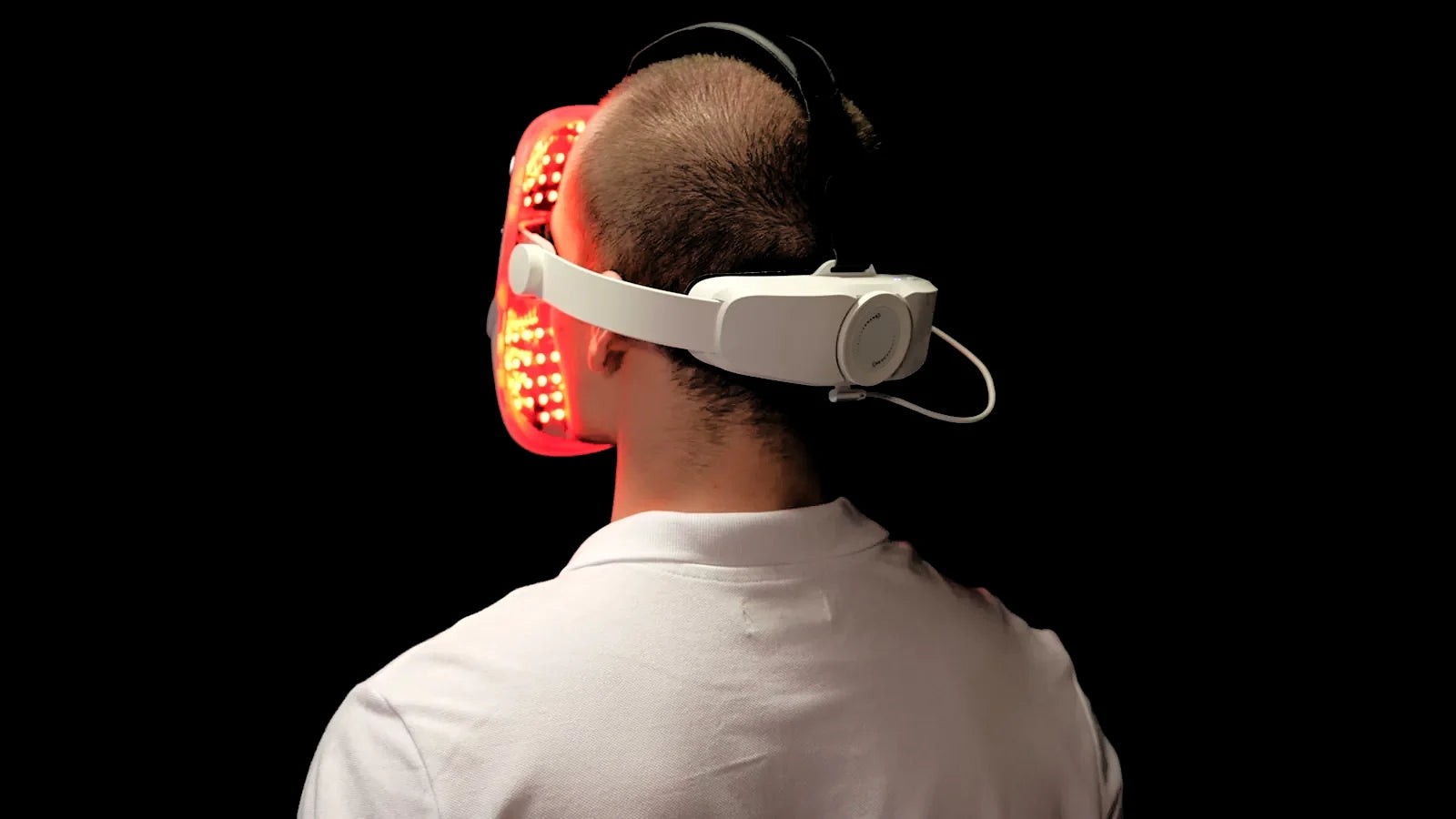 Rear moduleUSB-C, 5 V / 2 A
- Screwed, replaceable battery module
- Switches itself off after 30 minutes
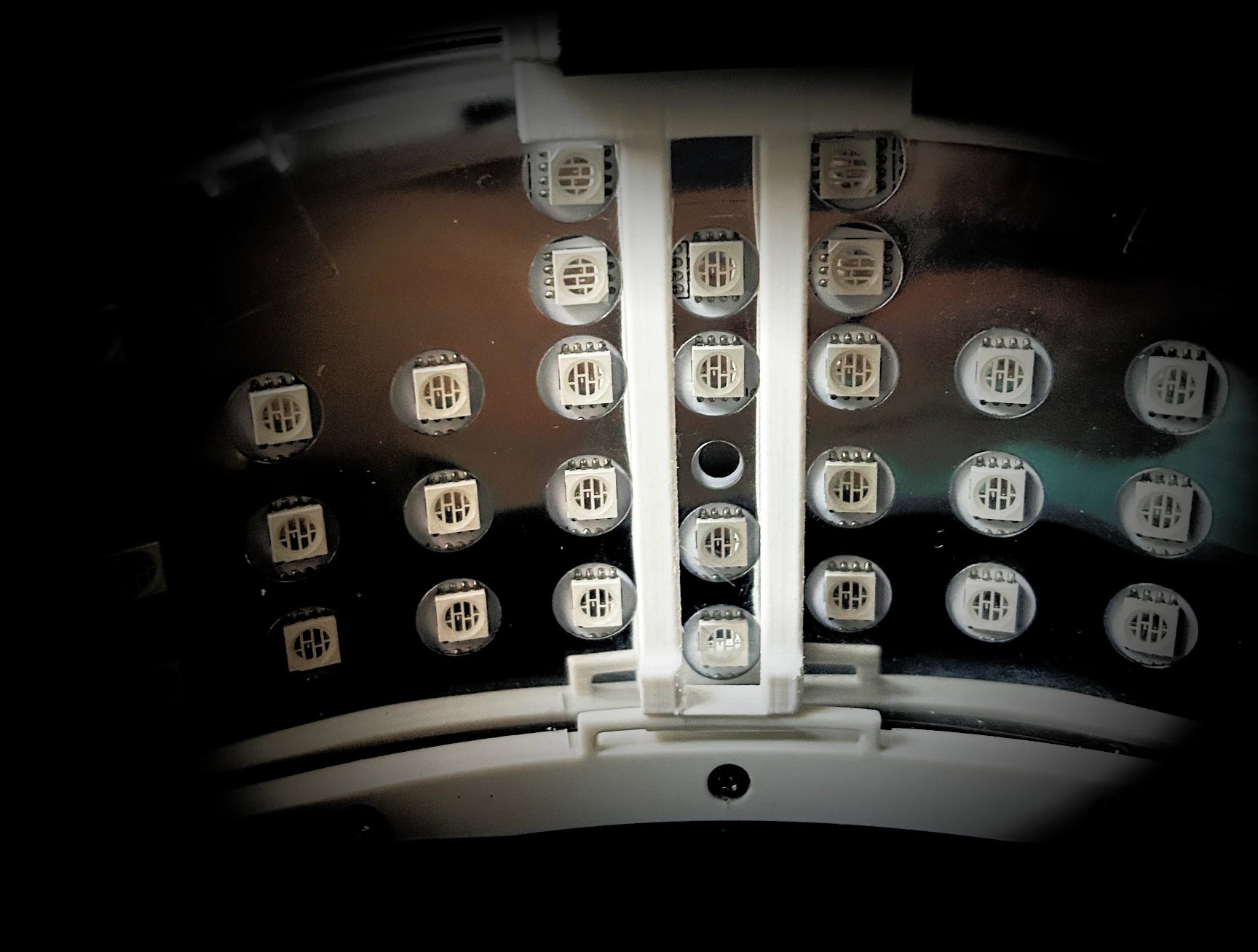 What I designedThe strap adapter in place
- My own design, 3D-printed piece
- With your monogram on request
 BetaRotate the product


LED Light Therapy Mask
-
 Biodance bio-collagen maskOne piece in the box, the same one that's also in our shop.free
- White satin storage pouchWith the dermastamp.hu logo. The folded mask fits inside.free
-
 3D-printed strap adapterI design it and I print it. With your monogram, if you want it.free
- Printed routine guideHow long, how often, which button gives which mode, and which mode works at which wavelength. Alongside it, what you can do for your skin besides the mask, and the contraindications.free
- 2-year warrantyOn the LED panel, the battery and the strap. I repair it or replace it.comes with it

Mit kapsz a pontokért?
We currently ship within the European Union only.
So you cannot order this product right now, and prices are shown in Hungarian forint.
 Free
FreeEight LED masks passed through my hands. This is the one that stayed. I've been using it every other day for half a year, and I made the strap fit even better with 3D printing.
Marci · dermastamp.hu
Founder, cosmetology student.
8 reviews for our shop and the Dermastamp
 Verified by Judge.me
Independent, third-party platform. Only those who actually ordered from us get the "verified buyer" label.
Reviews translated from Hungarian.
-
Edit✓ verified buyer2026. 07. 24.
The parcel arrived on the third working day after my weekend order 😊 The product matches the description, using it is practically painless, afterwards there is a mild burning feeling and redness. I can report on the effect later, I trust that I have reason to hope. Before use I disinfected not only the stamp but the skin as well, with a spray made specifically for this. I found a face mask as a gift in the parcel, I am really glad about it, thank you!
Special thanks for the detailed description :)
Wishing you much success, kind regards: Edit -
Mariann Szabó✓ verified buyer2026. 06. 19.
Very good quality product, less painful than the roller. The seller is very fair and kind, one detail was missing from my order and he handled it in a very humane way😊
-
B.Eszter2026. 06. 08.
Very professional product and seller. After the 4th time, other people noticed too that my skin is much nicer. Thank you!
-
Névtelen2026. 05. 18.
Everything arrived fine. I had my doubts that the site was a scam, but no. I got what was promised. After a 0.5 mm CIT pen (which was quite good, but is not available anymore) and cosmetic mesotherapy (which is expensive, and my skin protested against it so much after the 4th time that I stopped), I am now waiting for this treatment with curiosity. Thank you for the work you put into it!
-
Schnell Fruzsina✓ verified buyer2026. 05. 14.
Really great, easy to use. Much better than the derma roller I used before.
Reply from the shopKöszi szépen a visszajelzést!
– Marci -
Névtelen✓ verified buyer2026. 05. 03.
Great little device , I am on the second one now. I use it on my face and on my scalp too. It is not a spa treatment, but the pain is minimal and you get used to it.
Reply from the shopKöszönöm szépen a visszajelzést!
– Marci -
Névtelen✓ verified buyer2026. 04. 14.
I am satisfied with the quality of the product, I use it on my face and on my scalp too.
Reply from the shopKöszi a visszajelzést, örülök, hogy bevált! Ha bármi kérdés felmerül menet közben, írj nyugodtan a marci@dermastamp.hu-ra.
– Marci
-
Névtelen✓ verified buyer2026. 04. 14.
Great!
Reply from the shopKöszi! Örülök, hogy bevált. Ha bármi kérdés felmerül a használat vagy az utóápolás körül, írj nyugodtan a marci@dermastamp.hu-ra.
– Marci
How far the light reaches
The current trend with LED masks is maximum facial coverage. That has a price rarely written down: the light gets closer and closer to the eye. Coverage alone isn't a quality benchmark.
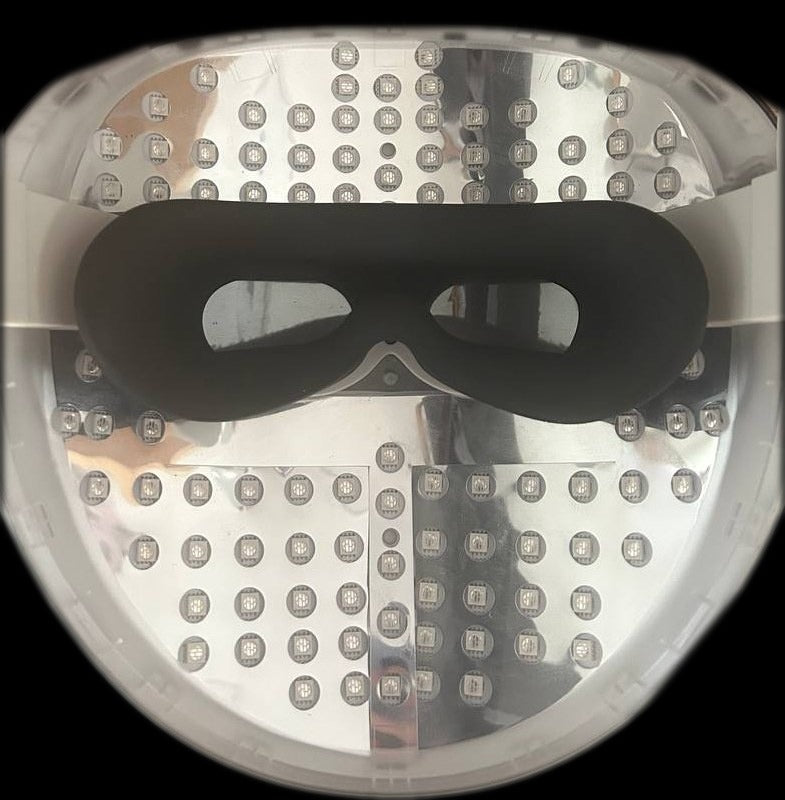
Not a single LED faces your eye. The matrix breaks at the eye line, and a padded silicone covering closes around the eye.
Why does eye protection matter?
In 2020, a case was published where, after blue light between 460 and 470 nm from an open-eye-cutout mask, damage to the retinal pigment epithelium remained even at the four-week follow-up. The mask's blue mode is 450 ± 10 nm according to the manufacturer, directly below it, touching its tolerance range. This carried the most weight in deciding which of the eight masks I tried I would bring to market.
The limit: the retina damage is a single published case, not a study. It only shows that the phenomenon exists. And the covering only protects if the mask is sitting in its place.
What's known about eye exposure, and what isn't
In the case, a 37-year-old woman used an open-eye-cutout mask for twenty minutes every other day, for one month. At the four-week follow-up, her visual disturbance and the photoreceptor layer on the OCT scan had improved, but the damage to the retinal pigment epithelium remained.
I'm not aware of a published case like this for near-infrared, but that's not a zero-risk band either. People taking photosensitising medication and people with an existing eye condition shouldn't use it without medical consultation.
Source: Kim et al., 2020. Photochemical retinopathy induced by blue light emitted from a light-emitting diode face mask. PMC7302677. The device studied was an open-eye-cutout mask from another manufacturer. The reference is to the phenomenon itself.
Use
| Sessions | Between 3 and 5 a weekThe printed guide's recommendation. |
|---|---|
| Per session | Up to 10 minutesJust because the device keeps going doesn't mean it's worth running longer. |
| Automatic shut-off | 30 minutesThe device switches itself off. |
| Daily maximum | 30 minutes |
| Level | 2 is the default, can be dropped to 1The star button switches between the two. |
More isn't better
Overdoing it isn't good either. One light-therapy review found that on tissues with high mitochondrial activity, the trials that showed no effect failed more often from too much light than too little; the same review places skin in the low-activity group, so it doesn't speak directly to this. That's why the benchmark is the printed guide's 10 minutes, not the device's 30.
Zein et al., 2018, PMID 30550048. I haven't studied this device myself.
Buttons and sound
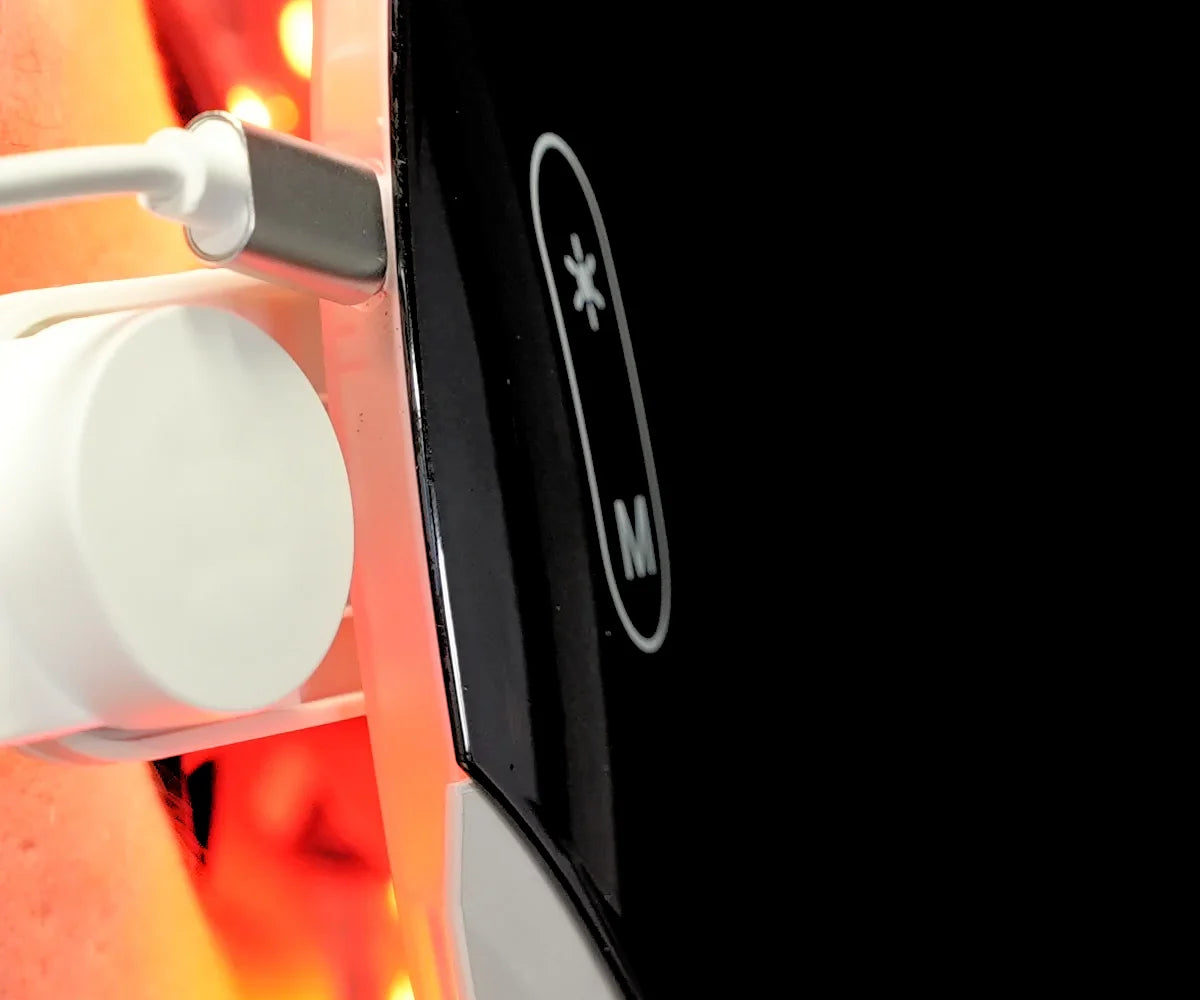
Two buttons on the side of the mask, set into the glossy casing. The star switches the level: level 2 is the default, one press takes you to level 1, the next press back. M steps through the seven light modes, the eighth press turns the panel off. The power button sits at the back, on the strap module: you hold it for two seconds.
Sound: every button press is confirmed with a recorded sound, so even inside the mask, with your eyes closed, you know you've switched.
The light you choose
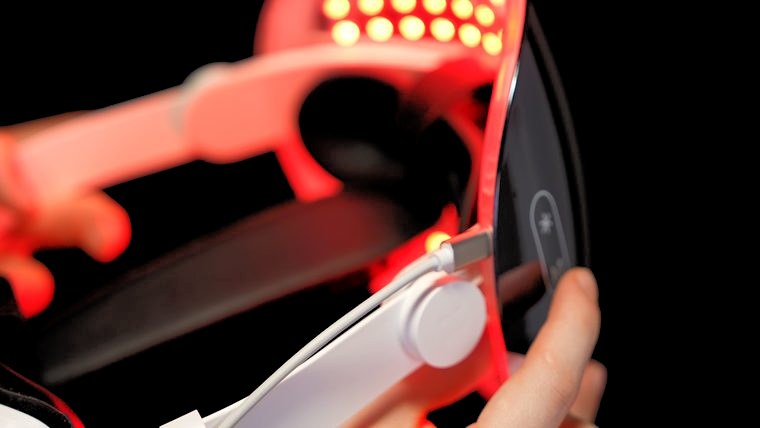
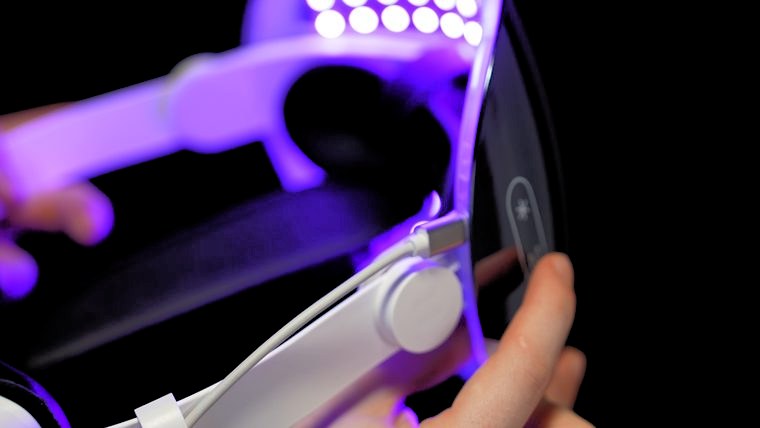
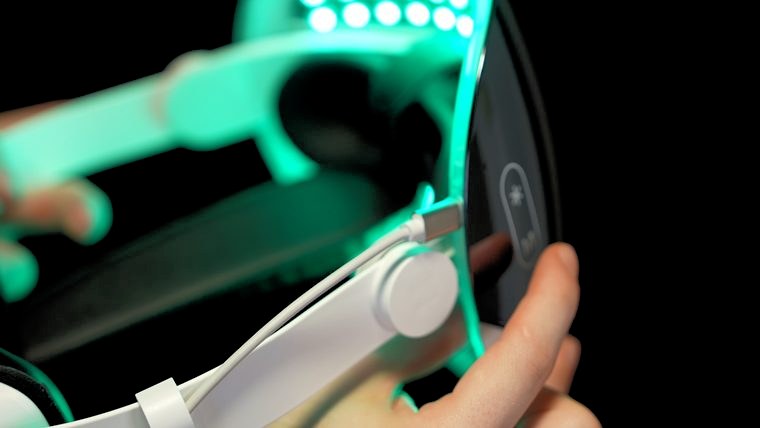
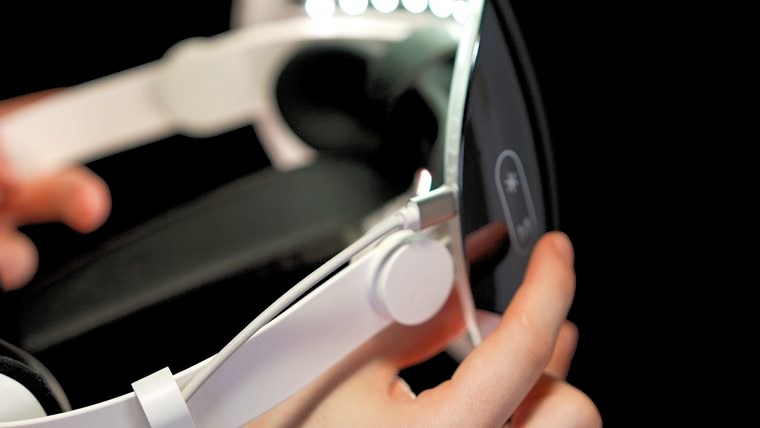
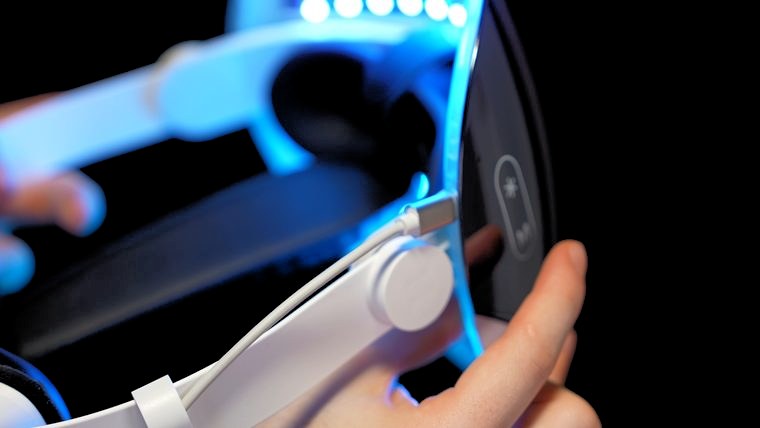
On the mask, you step through modes with one button. You can't set a nanometre value on it, so here are the seven real modes, in the order the device steps through them. Pick one: the photo, the number, the axis and the research behind it all change together.
Two modes are within the studied range. Purple peaks at 415 nm, per the manufacturer's measurement: this is the wavelength of most of the blue-light acne studies. Red is 634 nm, per the manufacturer's measurement: within the studied band for red devices. They were studied with other devices, there's no study on this mask.
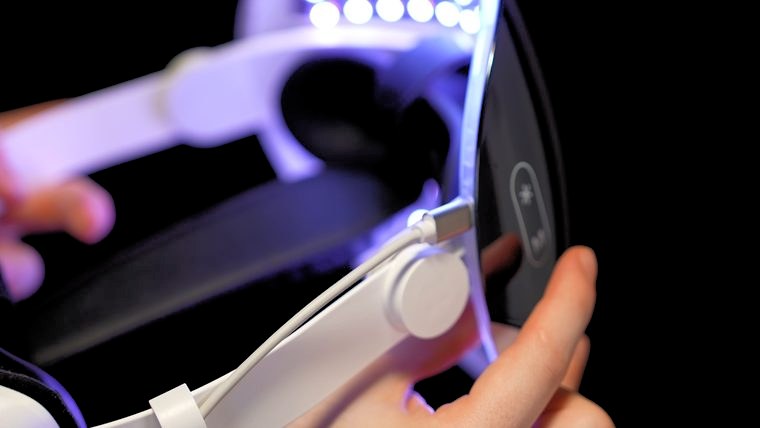
What was studied at this wavelength
Wavelength is the distance between two consecutive wave crests, and it decides what colour you see. A shorter wave leans toward blue, a longer one toward red. The 850 nm near-infrared is the longest wavelength in this mask, it runs in every mode, and it's the only one your eye can't see. I don't cite a study for this wavelength on this page.
What light is, and why I talk about wavelength
Light is an electromagnetic wave, from the same family as radio waves or X-rays. What sets them apart is the wavelength: the distance between two consecutive wave crests. For light, this is measured in nanometres, a millionth of a millimetre.
Your eye reads wavelength as colour. The shortest one you can still see looks violet, the longest looks red. What's longer than red is infrared: the mask's 850 nm chips give off light like that, which is why you don't see it when they're on. The shorter the wave, the more energy each particle of light carries. That's why violet can excite a molecule that red can't.
So wavelength isn't strength, and it isn't dose. It tells you which molecule can absorb the light. Devices are designed around this number, and studies measure on it too.
What's the point of colours lighting up your face
Light only does something where a molecule absorbs it. What isn't absorbed gets reflected or scattered, and nothing happens. Different molecules absorb different wavelengths, so the colour decides which molecule gets the energy.
Two examples that have been studied. The bacterium linked to acne produces porphyrins, whose main absorption peak sits between 400 and 415 nm: the purple mode, at 415 nm per the manufacturer's measurement, sits at the edge of this. Red and near-infrared light are absorbed by the mitochondrial chromophores of skin cells; the red devices in the at-home acne LED review worked between 630 and 670 nm.
That's why the mask has seven modes instead of one strong white light. Absorption is the first step. What happens in the skin after that was measured in other devices' studies: you read it above, per mode, along with the limits.
Sources: porphyrin absorption: Biomedical Optics Express, 2024, PMID 38855662; mitochondrial chromophores: Avci et al., Seminars in Cutaneous Medicine and Surgery, 2013, PMID 24049929; the studied bands: JAMA Dermatology, 2025, PMID 40042878.
Context you rarely see on product pages
Zero. That's how much high-certainty evidence exists for the effect of any acne treatment included in the review, from the data of 40,910 people. Cochrane's 2024 review processed six systematic reviews, drawn from 275 trials. Its conclusion, verbatim: We found no high-certainty evidence for the effects of any therapy included. If that's the truth even for the standard over-the-counter basics, then the modest claim I make about myself isn't sugar-coating either.
Cochrane Database of Systematic Reviews, 2024, PMID 39440650.
What's in the box
Everything you unbox, item by item. The photo shows the full contents, the list is below.
documentation behind the mask
Open any of them. There's the certificate itself, and next to it, exactly what was tested, and what wasn't.
CEmarking
CE means that whoever places the product on the market declares, on their own responsibility, that the device complies with the relevant EU directives. This is not a regulatory approval, and it is not an effectiveness study.
Compiling and keeping the technical documentation behind the CE marking for ten years is the obligation of the party placing it on the market.LVDin hand
 Teljes meretben
Low Voltage Directive, 2014/35/EU. It tests whether the device is electrically safe: electric shock, overheating, fire.
Certificate: ENC2404034GZ58-2 · issued 2024-04-03 · EN 60335-1, EN IEC 60335-2-113, EN 62233EMCin hand
 Teljes meretben
Electromagnetic compatibility, 2014/30/EU. It tests that the device doesn't interfere with other electronics, and that its surroundings don't interfere with it either.
Certificate: ENC2404034GZ58-1 · issued 2024-04-03 · EN IEC 55014-1, EN IEC 55014-2, EN 61000-3-2, EN 61000-3-3The most important thing to know about these
These markings certify electrical safety and electromagnetic compatibility. None of them is an effectiveness study, and none of them says anything about what the light does to your skin. Anyone who presents these as proof of results is misleading you.
I've blacked out my supplier's name and address on the documents. That's business data, and it isn't for public disclosure. What the document proves stays readable regardless: the certificate number, the directive, and the list of tested standards.
Questions and answers
Does it have to be with closed eyes?
There's no LED in front of your eye, and the covering closes around the eye, so it doesn't blind you. You can keep them open too. The covering only protects if the mask is sitting in its place, so don't push it up onto your forehead while using it.
Under or over skincare?
Onto clean, dry skin. Your creams come after. The panel doesn't touch your face, so it won't smear what you've applied, but you still don't want a layer in the light's way.
Which mode should I use?
The device steps through seven modes with one button, and the 850 nm near-infrared runs in every one of them. I don't recommend a mode. The studies I cite on this page were done with other manufacturers' devices, with small numbers: that's not enough to responsibly match a mode to a skin type. Which wavelength has what studied behind it, you can read at the light picker, opened up per mode.
How much power does it use?
It runs off USB-C, from a 5 V / 2 A source. That's roughly the same as a phone charger. The manufacturer's spec is 5 V / 2 A, so that's what I state everywhere: I haven't measured what happens to the brightness with a weaker source.
How do I clean it?
Wipe it with a damp cloth, including the silicone covering around the eye. No disinfectant needed, and no need to take it apart.
Can I get more of the printed adapter?
Yes, as many as you want. I design it and I print it myself, so you don't have to wait for a part: just say the word, and the next one goes out, even in a different colour.
What if the battery or the LEDs wear out?
It has a two-year warranty, and within the warranty, a fault in the battery, the LEDs or the strap is my responsibility too: I repair it or replace it. The rear module and the controller are screwed together, not glued, so it can be opened. Even beyond the warranty, get in touch before buying a new mask: I offer battery-module replacement here at home.
With glasses or contact lenses?
Glasses don't fit under the covering, so take them off. Contact lenses are fine, but if anything feels uncomfortable, take the mask off.
When will I see anything?
I don't give a timeframe for this, because I have no measurement that would let me read one out. What I'd suggest: photograph yourself in the same light before the first session, and again the same way after three months. Your own eye is the worst measuring instrument for day-to-day change.
Price and warranty
No crossed-out price, and no recurring cost behind it. Flexible silicone masks sit in the same price range, the difference is in the construction.
Hungarian shop, Hungarian customer service
The LED light mask carries a statutory mandatory warranty, and at this price, that's two years. You'll receive the warranty card electronically.
Within the warranty, a fault in the battery, the LED panel or the strap is my responsibility too: I repair it or replace it.
Put it on, switch it on, run it through a full programme. That's normal use for trying it out, and it doesn't affect your refund.
I disinfect it, refurbish it, and sell it on refurbished, at a lower price. That's why I don't need to build a markup into the price.
The LED panel runs off a 5 V / 2 A USB-C source. If the module wears out years from now, the mask still works.
The exact terms
Warranty. Under Government Decree 151/2003, a mandatory warranty applies, and its length is tied to the sale price. You'll receive the warranty card electronically by the day after handover at the latest. It doesn't cover damage from improper use, from not following the guide, or from normal wear.
Returns. On top of the statutory 14 days, I accept returns for a total of 30 days. The extension requires the original box and the complete set of accessories, and it doesn't affect your statutory 14 days. I may deduct for depreciation from use beyond trying it out, and I document any deduction with photos.
Power. The manufacturer's spec is 5 V / 2 A, so this isn't a detail I can leave out. Battery-module replacement within the warranty is a service I provide.
The device is a cosmetic, at-home light device. It is not a medical device and not a medicine.
Still have questions?
LED mask knowledge baseArticles on eye safety, timing, contraindications and wavelengths. Facts, the decision is yours.