

Female hair loss: before you buy anything, let's find out which type you have.
In women, two types of hair loss get mixed up, and for one of them the Dermastamp is not the answer. If you buy it for the wrong type, that's money wasted. Let's start by finding out which one is yours.
14,990 Ft 8 reviews See the Dermastamp
Two very different things, two different answers
If it started suddenly, within weeks, and sheds evenly across the whole scalp, it's likely telogen effluvium. This is the medical name for when a trigger (childbirth, illness, severe stress, iron deficiency) causes many hairs to enter the resting phase at once, and a few months later they fall out together. There's no evidence for microneedling in that case.
More details
Telogen effluvium is always started by a trigger, and the shedding typically appears 2–3 months later, though this window can range from 1 to 6 months: childbirth, severe stress, high fever, surgery, drastic dieting, iron deficiency, thyroid dysfunction. The body sends many hair follicles into the resting phase at once, it's not a lack of stimulation.
Most sudden-onset telogen effluvium resolves on its own once the cause is treated. That's why the first step is a blood test. It's worth asking for two values: ferritin, which shows how much iron is stored in your body, and thyroid function (shown on the lab report as TSH and T4).
Discuss this with your GP or dermatologist, the lab work starts with them. And yes: the two can occur together, the blood test still comes first.
For details, triggers, and workup: telogen effluvium.
On iron stores, ferritin, and what a hair vitamin can do: hair loss and vitamins.
If it's telogen effluvium (sudden onset, even shedding across the whole scalp): don't buy a stamp from us for this. Ask for a blood test (ferritin, meaning your iron stores, and thyroid values: TSH, T4), and look for the trigger. That's worth more to you right now than anything we could sell you.
Widening part, hairline stays put
This is female pattern hair loss: it thins along the part, over years, but the hairline stays put at the front. This is the main difference from male pattern baldness. (You'll find it labeled FPHL on medical reports and international sites. This stands for female pattern hair loss, which is literally the same thing, just the English abbreviation.)
More details
Female pattern hair loss starts down the same path as male pattern baldness. Behind it is a hormone called DHT (full name dihydrotestosterone, which the body produces from testosterone), which shrinks genetically sensitive hair follicles over years. In women, estrogen softens this effect, which is why the process is slower, why the hairline stays put, and why the follicles tend to thin rather than disappear completely.
Important, and often misunderstood: in most cases, blood androgen levels are normal. You don't need a hormonal imbalance to have female pattern hair loss, and a normal lab result doesn't rule it out.
It often first appears around menopause: as estrogen drops, hair follicles become more sensitive.
What the needle does on the scalp, and what it doesn't
The needle penetrates 0.5–1.0 mm. It doesn't reach the hair bulb, it triggers a regenerative response in the skin around the follicle. Anyone who claims otherwise is overstating the evidence.
More details
Microneedling opens temporary microchannels in the skin's outer barrier layer: it triggers a local regenerative response around the follicle. In the studies, minoxidil was added alongside this, not because the stamp "delivers" it. Whether the stamp affects minoxidil absorption at all is something no one has measured.
This mechanism works not through male hormones. That's why it can be relevant even when your androgen levels are normal, and that's exactly the common case in female pattern hair loss.
What we DON'T know: whether a 1 mm at-home stamp affects minoxidil absorption at all. No one has measured it. If you see a percentage for this anywhere, it's a made-up number.
Here's a randomized trial conducted specifically on women (known as an RCT in the literature), about microneedling, not about our device.
In women, for female pattern hair loss, measured over 24 weeks, and hair follicle diameter increased only in the microneedling group. The study's needle depth was 0.7–1.0 mm: the same range our device works in, but the study wasn't done with our device or at home (in a clinic, every 2 weeks).
More details
This study compared three groups: minoxidil alone · minoxidil + spironolactone (a prescription drug also used for hair loss in women) · minoxidil + microneedling. The microneedling group produced the largest increase in hair density, and only in this group did the diameter of the hair follicle and the thickness of the epidermis (the skin's outermost layer) increase. ⚠️ The hair shaft itself, however, thickened in all three groups, with no difference between groups here. So this study did not show a "thicker strand" in favor of microneedling.
The honest part: in the study, needling was done every 2 weeks, in a clinic, not weekly at home.
And there's ANOTHER, larger study, also in women, that found no added benefit at all. It was published in 2026 in JAAD, one of the most prestigious dermatology journals (international identifier: PMID 42190753). 245 women took part, all with mild to moderate female pattern hair loss. (The paper describes this as Savin D3–D6: the eight-grade Savin scale classifies crown density, and D3–D6 is its mild-to-moderate range.) In this study, microneedling added on top of minoxidil 2% gave no added benefit over 24 weeks: all three groups improved, but equally.
Two studies, two different results, and this is the REAL difference: the minoxidil dose (5% in the positive one, 2% in the null one) and the device. ⚠️ What can NOT be cited as a difference: the schedule and the setting. The null study also tested the 2-week schedule (with both a monthly and a biweekly arm), and neither showed a benefit, and that too was done in a clinic, at a single center. Nor is it an excuse that it was an "open-label" study (meaning both the participant and the investigator knew which treatment was given). This kind of design usually biases results in favor of the treatment, so if there was still no added benefit even under those conditions, that actually strengthens the null result. We're not sugarcoating this, and that's why the grade is B, not A: there are two directly relevant studies, and they contradict each other.
And the device, honestly in both directions: neither study was done with our 1 mm hand stamp. The positive one used a clinical motorized device, the null one a 36-needle needle cartridge (a swappable needle head that clicks into a motorized device). ⚠️ The null study's needle length was 0.5–0.55 mm (the paper states it in 500–550 micrometers, a thousand micrometers make up a millimeter), which falls within the range we also recommend (0.5–1.0 mm). So this cannot be used to discount the null result. This does not imply that ours is better.
- For female pattern hair loss there is a rigorous randomized trial conducted on women (120 randomized participants, 115 completed, 24 weeks). This is about microneedling, not about our device.
- Minoxidil + microneedling: +30.33 hairs per square centimeter. Minoxidil only: +9.95.
- Hair follicle diameter increased only in the combined group.
- There's another, larger study in women (245 participants) that found no added benefit alongside minoxidil. The two contradict each other.
- That's why it's grade B, not A.
Evidence level · FEMALE PATTERN HAIR LOSS
B Supported
What this grade means: There's a study on it, but something is missing: the sample is small, or the result was mostly self-assessed by the participants, or the microneedling was combined with another treatment. The grade describes the level of evidence, not what will happen for you.
This page stands at grade B.
These studies are about microneedling itself, typically with a clinical device (pen, roller, RF device), we have no study of our own.
The honest balance, what it actually measures
This is how the number of hairs per square centimeter increased over 24 weeks, in women, for physician-confirmed female pattern hair loss. p<0.001 is a statistical measure: it shows how likely it would be to see a difference this large even if the treatment did nothing at all. The smaller the number, the less likely it is that we'd see a difference this size from an ineffective treatment. In science, values below 0.05 are usually taken seriously. The study's needle depth was 0.7–1.0 mm, the same range as our device, but with a different device, in a clinic.
PMC9309533 · randomized trial: 120 women were randomized into the groups, 115 completed, and results were assessed by three dermatologists blinded to group assignment · the best AVAILABLE data, and it's about women, but not done with our deviceOnly in the microneedling group did the diameter of the hair follicle and the thickness of the epidermis (the skin's outermost layer) increase, not in the other two. ⚠️ The hair shaft itself, however, thickened in all three groups, with no difference between groups here. So this study did not show a "thicker strand" in favor of microneedling.
same study · change measured with an instrument on ultrasound imaging of the scalp tissue, not self-reported by participantsFor sudden-onset, evenly-distributed shedding across the whole scalp (medically called telogen effluvium), there's no evidence for microneedling. There, a blood test is the first step, not a device. We won't sell you anything for this.
distinguishing the two (female pattern hair loss or telogen effluvium): see the decision tree aboveWhat we DON'T know / what wasn't measured
This is a single study, and it's not ours. We have no study of our own; we cite other people's research. One study, however good, is not yet science. That requires multiple, mutually confirming results.
And the most important thing we don't leave out: there's a larger study, also conducted in women, that produced a null result. According to the 2026 randomized JAAD study (PMID 42190753), adding microneedling alongside 2% minoxidil gave no added benefit over 24 weeks. This is the same patient group (mild-to-moderate female pattern hair loss), just a larger sample than the positive study above. We're not carrying this over from men: microneedling for hair is disputed, in women too.
We also don't know whether a 1 mm stamp affects minoxidil absorption at all, no one has measured it. The percentages circulating online are made up.
And: in the study, needling was done every 2 weeks, in a clinic. The at-home routine differs from that.
The weak point in this evidence
A well-informed reader would say: "you can't build a product on a single study." They'd be right, and since then a larger study, also conducted in women, has come out, which found no added benefit. Two studies, two results.
Who it's for, and who it's not
Female pattern hair loss (widening part, hairline stays put), alongside minoxidil. For this, there's a randomized trial in women on microneedling, where results were assessed by dermatologists blinded to group assignment.
Without minoxidil? The study measured it in combination, there's less data on it alone.
Sudden-onset, evenly-distributed shedding across the whole scalp (telogen effluvium): there's no evidence for it. A blood test is the first step, not a device.
Finasteride in women: PROHIBITED during childbearing age, because it can harm the fetus. I don't recommend it, I don't even sell it, and this is a decision only a doctor can make.
The most common mistake: minoxidil on the same day
The protocol that produced the measured results: no minoxidil on the day of treatment, and you resume only 24 hours later.
More details
The milestone study's methodology, verbatim: "not to apply Minoxidil on the day of procedure and to resume its application only 24 h after" (Dhurat 2013).
The "you can reapply after half an hour" advice circulating on forums is a community habit. There's no clinical data behind it. 24 hours is the conservative, safe approach.
If you're allergic to minoxidil: never with the Dermastamp, increased penetration would make things worse.
If you go for it, do exactly this
Blood test: ferritin (your iron stores) and thyroid (TSH, T4). Useful even if it turns out you have female pattern hair loss, because iron deficiency worsens both types.
0.5–1.0 mm. In the randomized trial conducted on women it was 0.7–1.0 mm, our device is 1 mm. For the exact technique: the 1 mm guide.
At home, 1× weekly. (In the study it was every 2 weeks, in a clinic, 12 sessions, the at-home routine differs from this.)
Not on the day of treatment. You start again 24 hours later.
24 weeks. That's how long the study measured. Before that, there's nothing to evaluate.
Open wounds, active inflammation. If allergic to minoxidil: never. Pregnancy/breastfeeding: consult a doctor.
The pharmaceutical side
In women, minoxidil is the active ingredient for which an officially approved hair loss medication exists. Oral DHT blockers are in a different situation for women. According to finasteride's official drug information (summary of product characteristics and patient leaflet), the drug is not for use in women, and is specifically prohibited in women who are pregnant or able to become pregnant, because it can endanger the development of a male fetus. They should not even handle a broken or crushed tablet. This is a medical question, discuss it with someone who is one.
How do I know whether I have female pattern hair loss, or <a href="/pages/telogen-effluvium">telogen effluvium</a>?
The speed and the pattern give it away. Telogen effluvium: started within weeks, evenly across the whole scalp, lots of hair in the comb and the drain, and there was a trigger 2–4 months ago (childbirth, illness, surgery, severe stress, dieting). Female pattern hair loss: develops over years, along the part, and the hairline stays put at the front.
The two can occur together, and even then the blood test is still the first step. And the definite answer comes from a dermatologist, not a website.
I'm pregnant / breastfeeding. Can I use it?
In this situation, don't start anything on your own, neither a device nor an active ingredient. Both minoxidil and finasteride are medical questions during this period (finasteride can harm the fetus in women of childbearing age). Most postpartum shedding is telogen effluvium, which resolves on its own in most cases. Talk to a doctor.
It started around menopause. Is this female pattern hair loss?
Often yes: as estrogen declines, hair follicles become more sensitive to the hormone DHT, and this is often when thinning first appears. But look at the pattern: is it thinning along the part, or evenly across the whole scalp? And ask for a blood test too, because the thyroid also often shifts during this life stage.
I can't even get to my scalp because of my hair.
This is exactly why we recommend a stamp for the scalp, not a roller: the roller catches and rolls up the hair, while the stamp presses straight down onto the scalp, working part by part. It works with long hair too, just more slowly.
Does it hurt?
The scalp is less sensitive than the face. Mild stinging and temporary redness are typical. According to the literature, redness is strongest with the stamp among the four device types studied (stamp, motorized pen, roller, and radiofrequency device) (PMC11993440), this isn't hidden, it's the trade-off. If you feel sharp pain, you're pressing too hard.
Roller or stamp?
For the scalp we recommend the stamp: the roller catches and rolls up the hair, making it hard to work evenly, while the stamp presses straight down, working part by part.
Where the stamp comes off worse, though: the same comparative review that favors the stamp (fewer track-like surface marks, fewer post-treatment pigment spots) also states that redness was strongest specifically with the stamp, statistically significant (PMC11993440). That's the price of the stamp.
And most importantly: the positive male study was done with a roller, not a stamp. The case for the stamp rests on scalp anatomy and safety, not a dedicated study of its own.
A thinning follicle is still alive, there's something to work with. But first find out which type you have, even the best device is useless for the wrong type. The decision is yours.
You're in a better position today than you'll be tomorrow.


Dermastamp (1 mm)
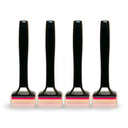
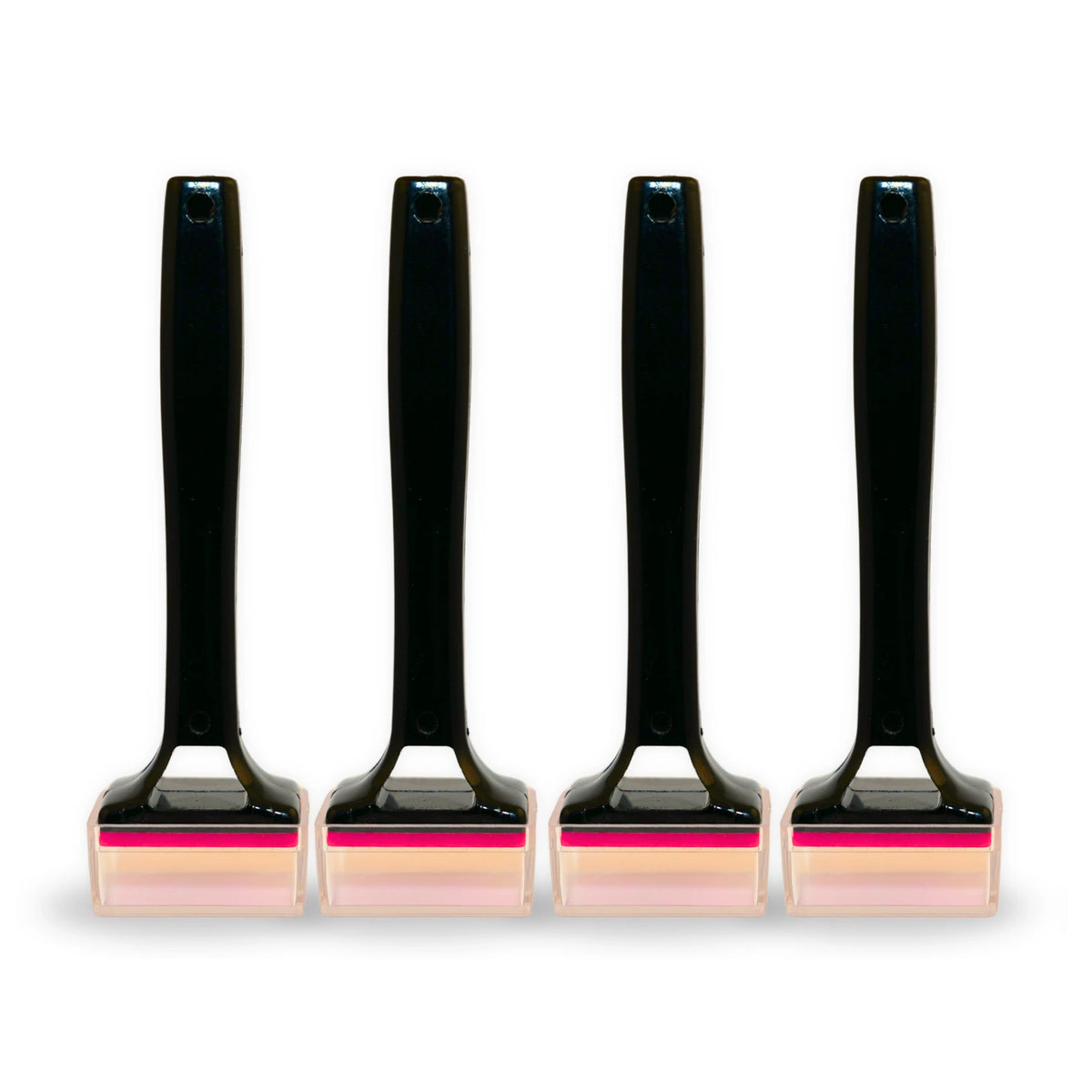
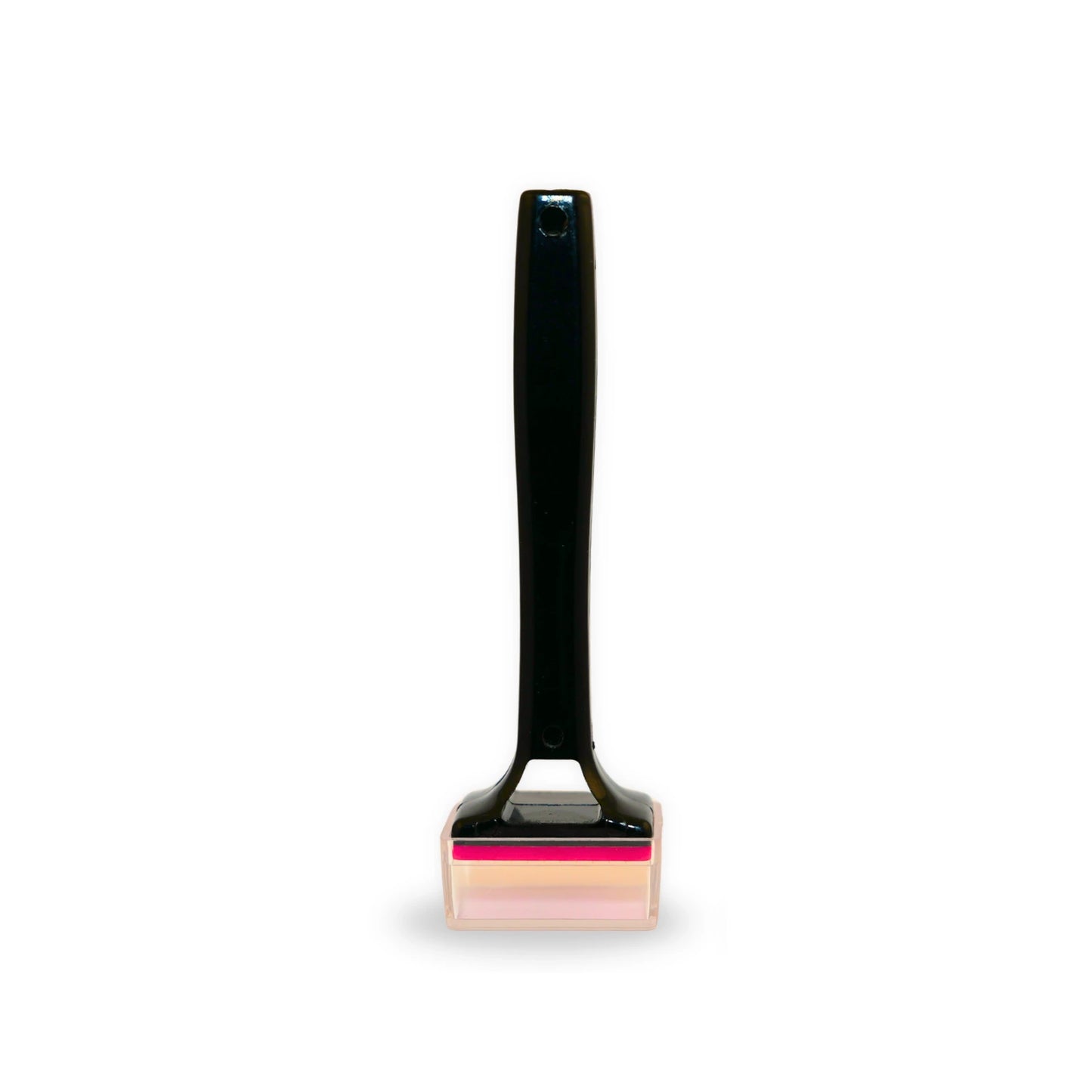
EU-registered It's on the market as a medical device (EU-MDR 2017/745, Class I), and it's listed in EUDAMED, the EU's official database: UDI-DI 06976567878014. As the importer, I'm registered too: HU-IM-000051605. This is traceability, not approval: being registered doesn't mean anyone has confirmed that it works. , Single-use One stamp equals one treatment: according to the manufacturer's instructions, it can't be cleaned or reused after use (registered under EU-MDR Class I). You start every treatment with a new device, factory-treated with an electron beam and disinfected by you before use. This is the most hygienic way to do microneedling at home. microneedling device with detailed instructions for use; How long does one package last? The calculation for the four single-use stamps is based on 1 use per week on the scalp, or 1 use every two weeks on the face. You use a new, unopened stamp for every treatment: no reuse, no carried-over contamination. The 1-pack variant is enough for one treatment.
We currently ship within the European Union only.
So you cannot order this product right now, and prices are shown in Hungarian forint.

I'm training to be a cosmetologist, and I found microneedling because of my own hair loss and skin problems. I want to bring this mechanism home as safely as possible, for you too. I stamp my own scalp weekly, and my face every 2–3 weeks.
Marci · dermastamp.hu
Usage on video
- 1DisinfectionSoak the stamp in medical alcohol for 1-2 minutes.
- 2Cleansing or hair washWash the area you're treating with your favorite cleanser.
- 3StampingGo over the desired area evenly, 4 times on each part. About 8-10 minutes.
- 4AftercareLet your skin rest right after the treatment. We've put together the recommended and best-avoided ingredients for face and scalp separately: Tips and ingredients →
Watch it on video too:
What else do I need to buy?
- 1Medical alcohol: for disinfectionBefore stamping, the stamp needs to soak in medical alcohol. It's available at any pharmacy, not a big expense, but necessary for hygienic use. I show the process on video in the "Usage on video" section, and I also detail it in the instructions in the box.
- 2SPF 50 sunscreen: if you use it on your faceStamped skin is more sensitive to UV radiation, so sunscreen is required. We'll soon have both chemical and mineral sunscreen too. Until then, use your own.
Why is it single-use?
- 1This is a manufacturer requirementThe device is registered as single-use (EU-MDR Class I): according to the manufacturer's instructions, one treatment, one person, and after that it can't be cleaned or reused. This is a requirement.
- 2Every session is a clean startThis way, you start every treatment with a new device, factory-treated with an electron beam and then disinfected by you before use.
- 3Less guesswork at homeYou don't have to wonder how many times you've used it, how clean it stayed, or whether the needles have degraded. One treatment equals one stamp: a simpler, more consistent, more hygienic routine.
Guarantee and returns
If you change your mind, here are your options.
- 30-day money-back guaranteeTry the first stamp. If, within 30 days of receiving it, you decide it's not for you after all, send an email and we'll refund the full price of the package. You don't even need to send anything back. This also applies to the first package of a subscription.
- 30-day return, offered voluntarilyYou can return an unopened, undamaged dermastamp within 30 days of receiving it. We offer this beyond our legal obligation.
- 14-day right of withdrawal, by lawAs a consumer within the EU, you can withdraw from the purchase within 14 days of receiving it, without giving a reason, if the packaging is unopened and undamaged.
Important: the dermastamp is a skin-penetrating hygiene product, so we don't accept opened packaging back. For the money-back guarantee, though, you don't need to return anything. The exact terms are in the refund policy.
Verified by Judge.me
Independent, third-party platform. Only those who actually ordered from us get the "verified buyer" label.
Reviews translated from Hungarian.
-
Edit✓ verified buyer2026. 07. 24.
The parcel arrived on the third working day after my weekend order 😊 The product matches the description, using it is practically painless, afterwards there is a mild burning feeling and redness. I can report on the effect later, I trust that I have reason to hope. Before use I disinfected not only the stamp but the skin as well, with a spray made specifically for this. I found a face mask as a gift in the parcel, I am really glad about it, thank you!
Special thanks for the detailed description :)
Wishing you much success, kind regards: Edit -
Mariann Szabó✓ verified buyer2026. 06. 19.
Very good quality product, less painful than the roller. The seller is very fair and kind, one detail was missing from my order and he handled it in a very humane way😊
-
B.Eszter2026. 06. 08.
Very professional product and seller. After the 4th time, other people noticed too that my skin is much nicer. Thank you!
-
Névtelen2026. 05. 18.
Everything arrived fine. I had my doubts that the site was a scam, but no. I got what was promised. After a 0.5 mm CIT pen (which was quite good, but is not available anymore) and cosmetic mesotherapy (which is expensive, and my skin protested against it so much after the 4th time that I stopped), I am now waiting for this treatment with curiosity. Thank you for the work you put into it!
-
Schnell Fruzsina✓ verified buyer2026. 05. 14.
Really great, easy to use. Much better than the derma roller I used before.
Reply from the shopKöszi szépen a visszajelzést!
– Marci -
Névtelen✓ verified buyer2026. 05. 03.
Great little device , I am on the second one now. I use it on my face and on my scalp too. It is not a spa treatment, but the pain is minimal and you get used to it.
Reply from the shopKöszönöm szépen a visszajelzést!
– Marci -
Névtelen✓ verified buyer2026. 04. 14.
I am satisfied with the quality of the product, I use it on my face and on my scalp too.
Reply from the shopKöszi a visszajelzést, örülök, hogy bevált! Ha bármi kérdés felmerül menet közben, írj nyugodtan a marci@dermastamp.hu-ra.
– Marci
-
Névtelen✓ verified buyer2026. 04. 14.
Great!
Reply from the shopKöszi! Örülök, hogy bevált. Ha bármi kérdés felmerül a használat vagy az utóápolás körül, írj nyugodtan a marci@dermastamp.hu-ra.
– Marci
What to expect?
Does it hurt? What to expect the first time?

Personal experience
Not pleasant, but in my own experience, clearly bearable. On the image I marked how sensitive I found each zone:
- Green: easiest. Forehead, most of the face.
- Yellow: noticeable, but comfortable. Around the eyebrows, nose bridge, jaw.
- Red: more sensitive, but short-lived. Nose, under-eye area, around the mouth. Don't stamp near the eyelid or inner corner of the eye.
In my experience the scalp is less sensitive than the face. The first session feels the most unfamiliar, but based on customer feedback, most people expect it to be worse than it is.
How long does your skin stay red?


In my experience the redness on the face fades within a few hours, with little trace left by the next morning. In more sensitive zones (nose, around the mouth) it can take a bit longer. On the scalp it's less visible, mostly covered by hair, and settles faster.
Don't wear makeup the next day. Sun protection is required.
What's allowed and what isn't after stamping? →Personal experience, not a clinical study result. Individual reactions may vary.
What shouldn't you use it for?
Don't use it on irritated, sunburned, actively inflamed, or infected skin. Not recommended for open wounds, active acne, eczema, or psoriasis-affected areas. If you take blood thinners or are under dermatological treatment, check with your doctor.
You'll find the full list of contraindications in the instructions for use that comes with every package. You can review the full risk picture here: Before you buy.
How do you know it's enough? How hard should you press?
It's not about force. Work with vertical, precise motions: straight in, straight out. Go over each area several times to cover the whole zone evenly. The device's 1 mm needle length helps you avoid going deeper than needed.
The goal is even coverage and controlled technique, not force.
When will I get it, and how do I pay?
Cash on delivery too: you pay when the package is in your hands, not in advance. Card payment is also available. Delivery 990 Ft, to a Foxpost parcel locker.
Why is this device different?

Needle material
80 GOLD-PLATED STEEL NEEDLES
Medical-grade 304 stainless steel, with real gold plating, the same base material used in surgical instruments. According to independent lab tests (TÜV SÜD, SGS) and the biocompatibility tests (which assess compatibility with skin) mandatory for skin-contact medical devices (EN ISO 10993-1, -5, -10), every value for the needle came in below the limit, and it passed TÜV's heavy metal migration test (21 metals, including nickel release). If you have a known metal allergy, consult a doctor regardless: according to the instructions for use, the device should not be used in that case.
1 treatment = 1 stamp for maximum hygiene

Needle layout
I tested every model so you don't have to
I tested dozens of microneedling devices, different needle densities, layouts, and depths. The 80-needle stamp head, arranged in an even grid, gave the most uniform microchannels.
Marci · I've been microneedling my own skin for 4 years

Hygiene
Electron-beam treated (e-beam)
It undergoes electron-beam treatment during manufacturing. It is not a sterile device, disinfect it according to the instructions before every single use. It keeps its factory cleanliness until the packaging is opened.
Factory e-beam treated, single-use
*If you have a strong metal allergy, before first use it's worth trying the stamp with a few pricks on a small skin area (e.g. the inside of the forearm), and observing the reaction for 48 hours.


- E-BEAM (electron beam) treatment is a quality-assurance/hygiene boost applied during manufacturing: the packaged product is briefly exposed to an electron beam.
- This is not a "sterility promise", and the Dermastamp is not marketed as a sterile medical device.
- While unopened, the product gets an extra, documented hygiene step.
- After opening, the home environment varies, which is why the manufacturer specifies: 1 treatment = 1 Dermastamp. This is the device's declared method of use.
This approach moves closer to the clinical protocol: predictable device + consistent hygiene.