

LED mask knowledge base: what it can do, what it can't, and who it's for.
Does the LED mask work? Partly, and not for everyone. Behind the red and blue light stand several smaller studies, with other devices, mostly on skin prone to acne; for slowing skin ageing, daily sunscreen has stronger evidence, and it costs a fraction. My own mask isn't a medical device, and among the masks available in Hungary I didn't find a single one registered as one; nobody can promise you a number for your own skin.
Does the LED mask work?
If you don't have a basic routine (cleansing, moisturising, and daily sunscreen), you'll probably regret the money spent on the mask. There's more and stronger evidence for daily sunscreen slowing skin ageing than for any at-home light device, and it costs a fraction. In Hughes and colleagues' 2013 randomised trial, one half of 903 adults used sunscreen daily, the other half only occasionally, over 4.5 years: the daily users showed no additional skin ageing detected, and their degree of skin ageing was 24% lower than the occasional users'.1 This trial is about sunscreen, not about any mask. It's not exciting, you have to apply it every day. But it's worth more. Once that's in place, the mask can come last, and then it's worth talking about it.
The state of the evidence in one paragraph. On skin prone to acne, several smaller studies measured improvement in the group average, with portable or at-home light devices, and none of them promises anything for any one person's skin. In Na and Suh's 2007 trial, one half of the face of 28 people was treated with red light, twice daily for 15 minutes, over 8 weeks, and on the treated side the number of both inflammatory and non-inflammatory lesions decreased more than on the untreated side; the trial was small, and didn't use a sham device.2 In Papageorgiou's 2000 trial, 107 people were split into four groups over 12 weeks: three groups got 15 minutes of light daily (blue, blue and red together, or white), the fourth got benzoyl peroxide cream: the inflammatory lesions of the group getting blue and red light together improved by an average of 76% (confidence interval between 66 and 87%), which was better than benzoyl peroxide at week 8 and week 12, and better than white light at every measurement point, but no longer better than blue light alone by week 12.3 Ershadi and Barbieri's 2025 JAMA Dermatology review pooled six such randomised trials, 216 people in total: for inflammatory lesions, from the pooled data of five trials, at-home LED devices gave a 45.3% greater improvement compared to control, but the devices were mixed (red, blue, and combined), the blue light was between 414 and 445, the red between 630 and 670 nanometres, and the trials were small.4 A year earlier, in 2024, Cochrane, the network that produces independent medical reviews, processed six reviews from 275 trials, with 40,910 people with acne, and wrote that none of the included acne treatments has high-certainty evidence, not even pharmacy benzoyl peroxide.5 If you're thinking about a mask for wrinkles: sunscreen has stronger evidence for slowing skin ageing (the Hughes trial above), I didn't find a trial this long or this large for masks. My own mask isn't a medical device, and among the masks available in Hungary I didn't find a single one registered as a medical device. The result differs from person to person, and no manufacturer can promise you a number for your own skin.
What you can take from this: on skin prone to acne, behind the red and blue light there are a few smaller trials done with other devices; for skin ageing, sunscreen is the stronger and cheaper step; the mask is a supplement, and the decision is yours.
Who's writing this, and why should you listen?
I'm Marci. I'm training to be a cosmetologist, and my own wrinkles and acne scars are what got me seriously into skincare. Eight LED masks have passed through my hands, both silicone-sheet and rigid-frame ones, and I've worn one every other day for six months. I'm not a doctor: what you read here is a summary of other people's studies together with my own experience, and where I didn't find a study, I say so. What you can take from this: with every number, look for the source and the limitation, in this knowledge base and everywhere else too.
What is an LED mask?
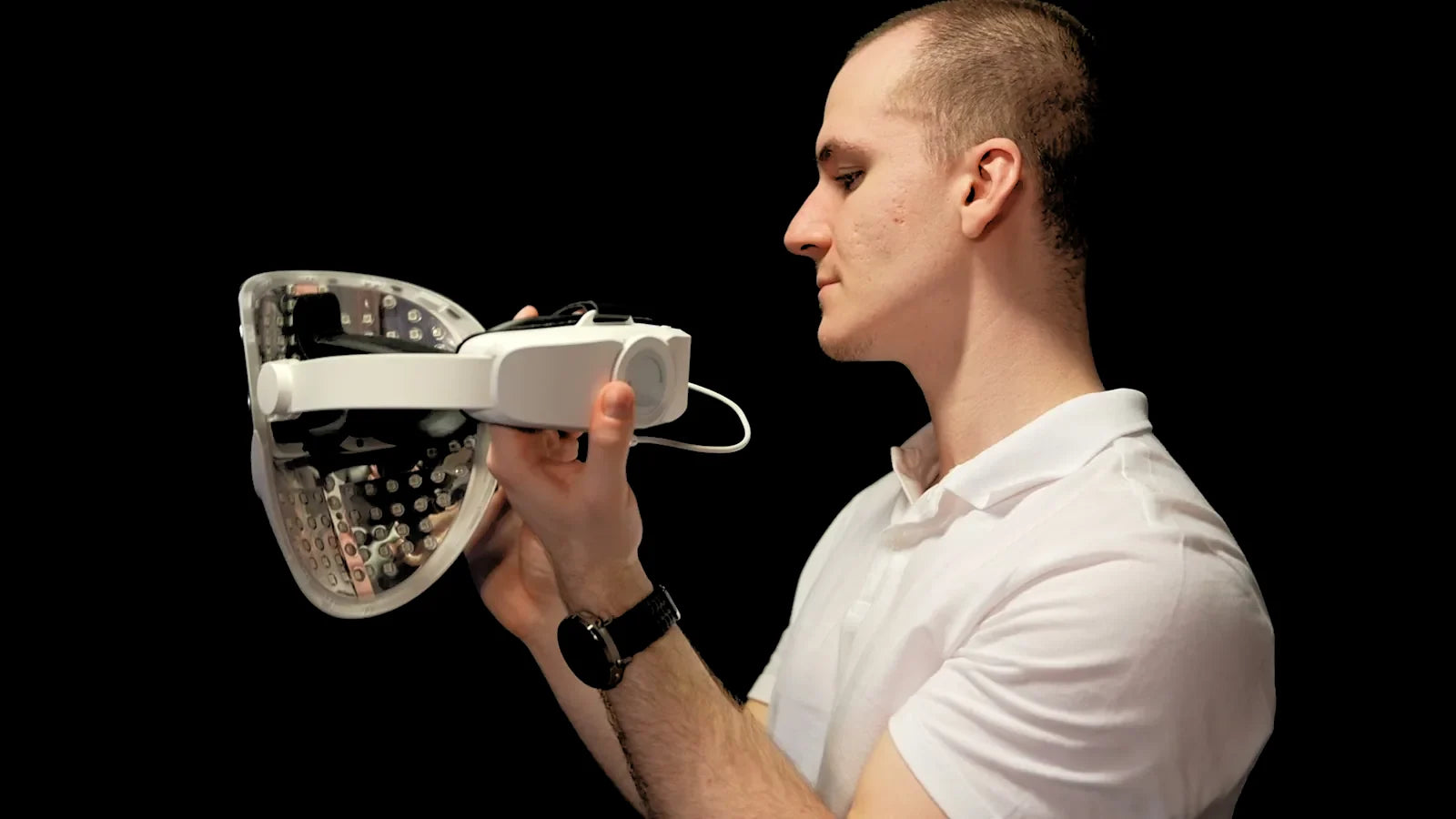
An LED mask is a device you put on your face, with a lot of tiny light-emitting diodes in it, that shines light of a specific colour, meaning a specific wavelength, onto your skin. An LED, light-emitting diode, is a tiny semiconductor that glows in a single narrow colour band when current runs through it, doesn't heat up the way a bulb does, and its colour is fixed at manufacture. Light is a wave, and wavelength is the distance between two consecutive wave crests, given in nanometres; a nanometre is a millionth of a millimetre. Blue light is a shorter wave, red is longer, near-infrared is longer still, and we can no longer see that. The photon of a shorter wave carries more energy: that's why the ultraviolet part of sunlight damages the skin, and that's why it matters exactly how many nanometres a mask shines at. The sun gives off all of this light at once; a mask gives off one or two narrow bands of it, without ultraviolet.
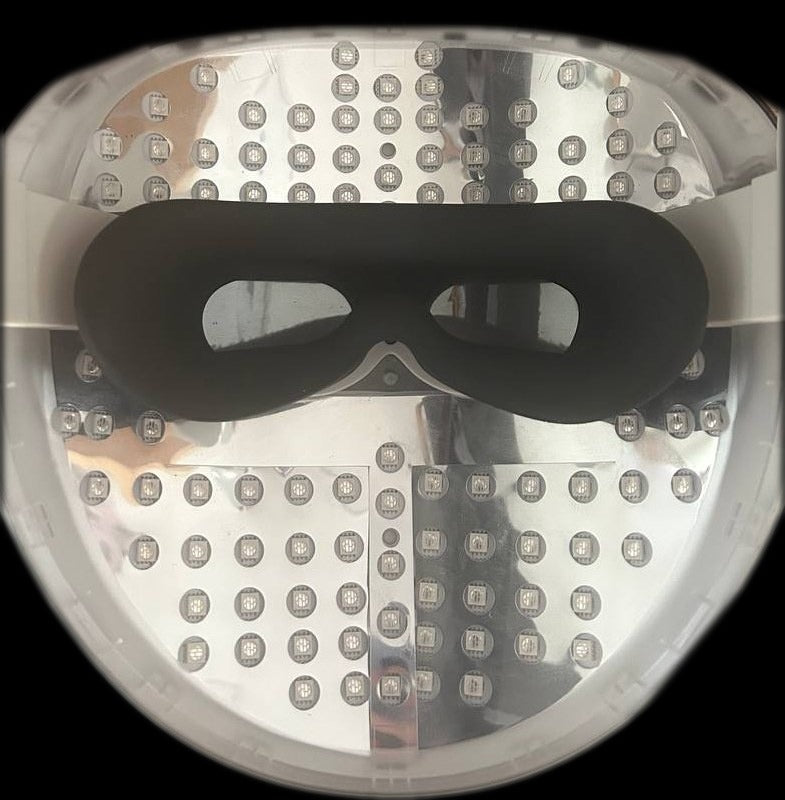
There are two main designs. One is a soft, flexible silicone sheet with the LEDs sitting in it, which you strap onto your face; it sits on you like a sheet mask. The other is a rigid, helmet-like frame that doesn't touch your facial skin, the LEDs keep a distance from the skin, and its position is the same every time you put it on. As far as I've seen, the masks on the market can essentially do the same colours, so it's hard to decide between them based on the list of colours; the design, the eye pad, the battery, and the stated wavelength differ. Look for this in the description: the exact wavelength in nanometres, instead of the colour names.
What does the light do in the skin?
Photobiomodulation means that skin cells absorb part of the light, and this changes how they function, without heat or injury. Avci and colleagues' 2013 review describes it in one sentence: the photons are absorbed by mitochondrial chromophores in skin cells.6 The mitochondrion is the cell's energy-producing part, and the chromophore is the molecule inside it that absorbs the light; for red and near-infrared light, this is an enzyme called cytochrome c oxidase. According to Huang and Hamblin's 2011 review, in neuron cultures, low light doses measured more cell energy (ATP), higher doses less, so here more light doesn't mean more effect.7 Blue light works elsewhere: the Cutibacterium acnes bacterium that lives in pimples produces pigment molecules called porphyrins, which absorb light between 400 and 415 nanometres most strongly, and the excited porphyrin produces reactive oxygen that damages the bacterium itself.8 That's why blue-light trials use 414 or 415 nanometres, and that's why it's a question whether a 450-nanometre blue can do the same; I didn't find an acne trial for this wavelength on its own. This mechanism is the evidence, and no specific mask's result follows from it: what happens on your own skin can't be read off from any description. What you can take from this: red and infrared work on the cell's energy production, blue works on the bacterium's pigment; the exact nanometre decides which mechanism the light lands on.
Who might it be worth it for, and who not?
Three groups, based on the evidence and my own experience. None of these is a diagnosis, and none is a promise.
Might be worth it: if you've had your basic routine (cleansing, moisturising, daily sunscreen) in place for months, your skin is prone to acne, and you can genuinely fit in three to five short sessions a week. The acne trials measured between 8 and 12 weeks, don't expect anything sooner than that; the acne trials dosed more often than that, daily, so your mask's instructions set the ceiling.
Maybe: if you're thinking about it for wrinkles or a tired-looking complexion. There's much less and shorter trial evidence for masks here than for sunscreen; in Bragato and colleagues' 2025 trial, 95 women between 45 and 60 years old were split into three groups: they got red light three times a week or twice a week for 4 weeks, and a third group got a sham treatment. On the blinded wrinkle scale there was no difference between the groups; on the blinded, software-based measurement (ImageJ), in two of the four measured regions, the wrinkle length between the eyebrows (glabella) and around the right eye (periorbital), a significant decrease was measured in the light-treated groups compared to control, and satisfaction was high, which is self-reported.9 If you already have sunscreen covered, and you know you're buying a supplement, it's your call.
Don't buy it: if you don't have a basic routine (do that first), if you're pregnant or breastfeeding, if you're photosensitive or take photosensitising medication, if you have a known eye condition, lupus, dermatomyositis, porphyria, or albinism, in case of cancer, fever, infection, a clotting disorder, a tendency to scar, heart or blood-pressure conditions, or after recent filler or botox. The source of this list is the contraindications page of a printed LED mask guide; if any of these apply to you, talk to a doctor first. The sourced, detailed version: Who shouldn't use the LED mask?
What you can take from this: the mask belongs at the end of the routine, not the start; and if any item on the exclusion list applies to you, the doctor comes first, not the mask.
Is the LED mask safe for your eyes?
In short: for red and infrared light I didn't find any published eye injury from a mask, for blue light there's one documented case, and the question is more about how much the mask covers your eyes. The blue-light hazard function that the International Commission on Non-Ionizing Radiation Protection (ICNIRP) uses to weight the retina's photochemical risk peaks around 435 to 440 nanometres, right in the range of the blue modes.10 Kim and colleagues reported the case of a 37-year-old woman in 2020, who used a mask giving blue light between 460 and 470 nanometres, where the area around the eyes was open, with no protective covering, for 20 minutes every other day, over one month: she received an intravitreal bevacizumab injection into her right eye, and at the four-week check-up her visual disturbance and the photoreceptor layer improved, but the damage to the retinal pigment epithelium remained.11 This is one case, with one mask, so it can't be generalised. Silicone masks also have a silicone eye pad, just a small one, so it doesn't cover the light coming from the LEDs well enough, and because the soft sheet conforms to your face, where it covers and where it doesn't depends on your face shape. With the rigid-frame design, the pad can be bigger, because it doesn't press against the skin, and its position doesn't change. The full explanation, with a diagram: Is the LED mask safe for your eyes? Look for this: a large eye pad that closes around the eye, an LED-free strip along the eye line, and a position that doesn't depend on your face shape.
What should you check before buying?
Six questions you can ask any mask; each is unpacked in a separate article.
- How many nanometres, and with what tolerance? "7 colours" on its own says nothing; the studied blue was between 414 and 445, the studied red between 630 and 670 nanometres. If the description has no number, ask, and if there's no answer, that's an answer too. Reading the specification
- How many LEDs, and what does that mean? The LED count shows coverage, not brightness; two masks with the same number of LEDs can give very different light. Many manufacturers don't state the brightness, and saying so honestly is better than making up a number. Colours and wavelength
- Silicone sheet or rigid frame? The sheet conforms to your face, the LEDs rest on the skin; the frame keeps a distance, and stays in the same place every time you put it on. On inflamed, sensitive skin, what matters is that nothing touches it. The cheap masks
- How big is the eye pad? Almost every mask has a pad, the size differs; the question is whether it closes around the eye, and whether there's an LED on the eye line. The eyes
- Where's the battery, and is it replaceable? I didn't find failure-rate data on this, this is reasoning: a non-replaceable battery can mean the end of the mask. A battery in its own module, a replaceable one, or a mask that also runs on cable, can give years of extra life. Battery, cleaning, lifespan
- Who says "clinically proven", and for which study? Ask for the study's name, year, sample size, and whether it was done with this exact mask. None of the studies above are about any specific mask sold in a shop. What "clinically proven" covers
Look for this: a stated wavelength, a stated design, a large eye pad, an available battery, and a seller who tells you what they don't know.
How to use it, if you already have one?
The trials cited here worked with sessions between 15 and 21 minutes: Na and Suh with twice daily 15 minutes for 8 weeks, Papageorgiou with 15 minutes daily for 12 weeks. In Bragato and colleagues' 2025 trial, 95 women between 45 and 60 years old were split into three groups: they got 660-nanometre red light from a mask three times a week or twice a week, for 21 minutes, over 4 weeks, and a third group got a sham treatment. On the blinded wrinkle scale, scored by experts on photos, there was no difference between the groups; on the blinded, software-based measurement (ImageJ), in two of the four measured regions, the wrinkle length between the eyebrows (glabella) and around the right eye, a significant decrease was measured in the light-treated groups compared to control. There was no difference between the twice-a-week and three-times-a-week sessions: more didn't produce more.9 In cell and animal experiments, too much light can even reverse the effect (this is called a biphasic dose response: no response at low light, the largest at a peak, decreasing above it), but in humans, according to the 2011 review, this wasn't shown convincingly at that point, as Huang and Hamblin write.7 Just because a mask runs for 30 minutes doesn't mean it's worth running it that long; your mask's instructions set the ceiling. The frequency details: How often and for how long should you use the LED mask? The order in the routine, alongside retinol and microneedling: LED mask with retinol, vitamin C, and microneedling: what's the order? What you can take from this: short sessions, a few times a week, as per the instructions; in the wrinkle trial (Bragato, 4 weeks), twice a week produced the same result as three times a week, I didn't find an acne trial comparing frequency; and before 8 weeks there's nothing to evaluate.
What will you find in the knowledge base?
Thirteen articles, in four groups. Each is built the same way: the first paragraph answers the question, next to every number is the study's name, year, sample size, and its limitation, and every section states at the end what you can take from it.
Safety
- Is the LED mask safe for your eyes? Blue, red, and infrared at the eyes, the documented case, and the cross-section of the two eye-protection designs.
- Who shouldn't use the LED mask? Pregnancy, photosensitising medication, melasma and dark skin, children: the exclusions and what there's no data for.
Use
- How often and for how long should you use the LED mask? How long the trials ran, what the biphasic dose response is, and why the panel protocol doesn't carry over to a mask.
- LED mask with retinol, vitamin C, and microneedling: what's the order? Before or after, what can go on the same day, and why fresh microneedling gets its own day.
- Cleaning, battery, lifespan: how much does one use cost? Cleaning, the battery's lifespan, and how much one use costs projected over the mask's whole life.
What the evidence says
- Which colour of light is good for what in the LED mask? The band between 400 and 900 nanometres, which range was studied and which wasn't.
- Does blue light help with acne? The porphyrin absorption peak, the difference between 415 and 450 nanometres, and the limitations of blue-only trials.
- Sunscreen or LED mask: which has stronger evidence? The 903-person, 4.5-year sunscreen trial next to the 23- and 107-person, 8- and 12-week at-home light device trials.
- What does "clinically proven" mean on an LED mask page? What the phrase covers in ads, and what to ask when you see it.
- Why isn't the result the same for everyone? Group average versus individual result, skin type, dosing, expectation: why users see different things.
Buying
- How to read the LED mask's specification Nanometres and tolerance, LED count and brightness, and the specification lines that say nothing at all.
- Is a cheap (Temu, AliExpress) LED mask worth it? Silicone sheet and rigid frame, distance, hot spots, and what you get for the marketplace price.
- LED mask, laser, IPL, or a cosmetic treatment? What laser and IPL can do that LED can't, and when it's worth going to a cosmetologist.
If microneedling interests you too, it has its own knowledge base: Microneedling knowledge base. What you can take from this: start with the Safety group, the Buying group comes before the shop, and read the articles in the order of your own question.
The mask I sell
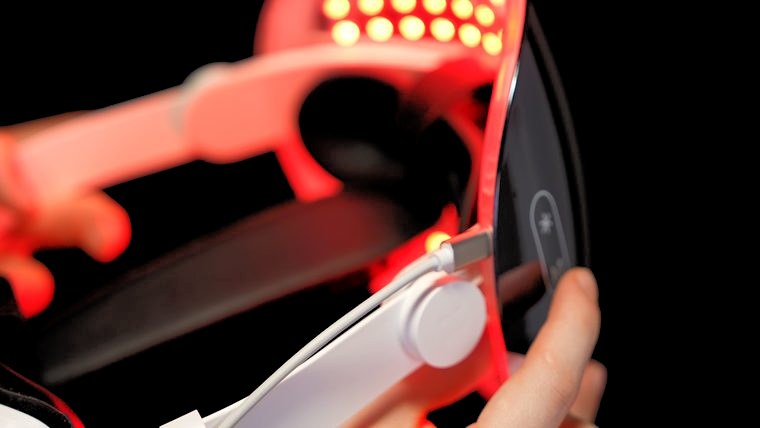
After trying the eight masks, I started to see what makes a good LED mask, and only then did I get into selling one myself. This is my answer to the problems above. It has a rigid frame, doesn't touch the facial skin, the LEDs sit about a centimetre from the skin, and its position is the same every time you put it on. There are no LEDs on the eye line, and a large, padded silicone covering closes around the eyes; I considered eye protection more important than extra coverage. It has 99 LEDs, the manufacturer's measured peaks: 634 nanometres red, 415 nanometres violet (a separate emitter), 450 nanometres blue, and 850 nanometres near-infrared, which runs in every mode. It runs on USB-C, from a 5V / 2A source; the battery is a screwed-in module sitting in the rear strap, and the mask also runs straight off a USB-C source, on cable, so a worn-out battery doesn't make it unusable. It shuts off automatically after 30 minutes, and its instructions say between 3 and 5 sessions a week, at most 10 minutes each. I designed a 3D-printed adapter for the strap connection, which comes with it, with your monogram on request. I give a two-year warranty on it and 30 days to try it out. Yes, this is what I sell: the product page also has every limitation I described above, and if after the knowledge base you decide you don't need it, that's a good decision too.
What is an LED mask?
An LED mask is a device you put on your face, with tiny light-emitting diodes in it, that give off light of a specific wavelength, without ultraviolet, onto the skin: typically red, blue, and near-infrared. It has two designs, a silicone sheet that conforms to the skin and a rigid frame that keeps a distance from the skin. It's a cosmetic, at-home light device; my own mask isn't a medical device, and among the masks available in Hungary I didn't find a single one registered as one. It's not a medicine.
What effect does the LED mask have on the skin?
Red and near-infrared light are absorbed by mitochondrial chromophores in skin cells (Avci 2013), blue light by the porphyrins of the bacterium living in pimples. The measured results came from other devices, in small trials, mostly on skin prone to acne: Na and Suh in 2007 with 28 people, Papageorgiou in 2000 with 107 people. For slowing skin ageing, daily sunscreen has stronger evidence. What happens on your own skin, no study tells you.
What do the colours mean in an LED mask?
Colour is wavelength. Blue is the shorter wave (between 414 and 445 nanometres in the at-home acne trials), red is longer (between 630 and 670), near-infrared is longer still and invisible. I didn't find an acne trial for the green, yellow, and cyan modes; white light featured as a comparison arm in the Papageorgiou trial, and was weaker than the blue-red combination at every measurement point. Instead of colour names, look at the nanometres: two "blue" masks can shine at wavelengths far apart from each other, and the studied mechanism of blue light works around 415 nanometres.
How long before you see anything?
The acne trials measured after 8 and 12 weeks: Na and Suh at 8 weeks, Papageorgiou at 12 weeks, Nestor at 12 weeks in 201612; the wrinkle trial cited here (Bragato) measured after 4 weeks (on the blinded wrinkle scale there was no difference between the groups; on the blinded, software-based measurement (ImageJ), in two of the four measured regions, the glabella and the right periorbital wrinkle length, there was a significant decrease in the light-treated groups compared to control). For the acne trials there's nothing to evaluate before that, and it's also possible you won't see a difference afterwards either: the result differs from person to person, and the trials measured a group average, not your own skin.
Can the LED mask be used daily?
Some of the trials worked with daily use (Na and Suh twice daily 15 minutes; Papageorgiou daily 15 minutes), but in Bragato's 2025 trial there was no difference between twice-a-week and three-times-a-week sessions. Your own mask's instructions set the ceiling; the printed guide cited above states between 3 and 5 sessions a week, at most 10 minutes each. In this one measurement (Bragato 2025, wrinkles, 4 weeks), more didn't produce more.
Who shouldn't use the LED mask?
During pregnancy and breastfeeding, with photosensitivity and photosensitising medication, with a known eye condition, lupus, dermatomyositis, porphyria, albinism, cancer, fever, infection, a clotting disorder, a tendency to scar, heart or blood-pressure conditions, or after recent filler or botox. The printed guide lists these as prohibitions. If any of these apply to you, talk to a doctor first; the mask isn't a treatment.
Is the LED mask worth it?
If you don't have a basic routine, no: there's more and stronger evidence for daily sunscreen (Hughes 2013, 903 people, 4.5 years), and it costs a fraction. If the routine is in place, your skin is prone to acne, and you're buying it as a supplement, then there are a few smaller trials with other devices behind it, and the decision is yours. Nobody can promise you a number for your own skin.
How much does a good LED mask cost?
The flexible silicone masks from the big brands are typically between 80 and 200 thousand forints, the marketplace, unbranded sheets go for a fraction of that. The price alone says nothing about the light: what decides it is the stated wavelength, the design, the size of the eye pad, and the availability of the battery, and a non-replaceable battery can mean the end even of the expensive mask. Projected per use, durability matters; the cleaning, battery, lifespan article works that out.
Is the LED mask safe for your eyes?
For red and infrared light, I didn't find any published eye injury from a mask. For blue light, one case is known (Kim 2020): with that mask, the area around the eyes was open, with no protective covering; an intravitreal bevacizumab injection was given into the right eye, and at the four-week check-up the visual disturbance improved, but the damage to the retinal pigment epithelium remained. Silicone masks also have an eye pad, just a small one, and where it covers depends on face shape. Look for a large, enclosing pad and an LED-free eye line, and keep your eyes closed.
What if my skin got worse from the mask?
Glass's 2023 review found no clinical trial data that photobiomodulation carries a significant adverse event, but it was written for an oncological safety question, and it doesn't rule out skin reactions.13 If your skin got worse after starting the mask, skip it for a week or two. If it doesn't settle back, the cause could be something else: a new product, a hormonal background, or fungal folliculitis, which looks like acne, and which is treated with an antifungal14. That's for a dermatologist.
Can it be used alongside retinol or microneedling?
For retinol and vitamin C, I didn't find a trial that measured them together with LED; in practice, the mask goes on clean, dry skin, the active ingredient after. I didn't find a human trial on light after fresh microneedling, so for me the two go on separate days. The order details are in the retinol, vitamin C, and microneedling article.
What if I skip days?
No problem, if you skip days within your own mask's 3–5 sessions a week framework: the acne trials worked with daily sessions (Na and Suh twice daily, Papageorgiou daily), the sufficiency of twice a week was measured by a single wrinkle trial (Bragato 2025), over 4 weeks, where twice a week produced the same result as three times a week. The rest of the routine, daily sunscreen and moisturising, matters more; don't skip those.

Sources
The cited studies were done with other devices, none of them about the mask sold here; the numbers describe the group average, not your own skin.
- Hughes MC, Williams GM, Baker P, Green AC. Sunscreen and prevention of skin aging: a randomized trial. Annals of Internal Medicine, 2013. PMID 23732711.
- Na JI, Suh DH. Red light phototherapy alone is effective for acne vulgaris: randomized, single-blinded clinical trial. Dermatologic Surgery, 2007. PMID 17903156.
- Papageorgiou P, Katsambas A, Chu A. Phototherapy with blue (415 nm) and red (660 nm) light in the treatment of acne vulgaris. British Journal of Dermatology, 2000. PMID 10809858.
- Ershadi S, Barbieri JS. At-Home LED Devices for the Treatment of Acne Vulgaris: A Systematic Review and Meta-Analysis. JAMA Dermatology, 2025. PMID 40042878.
- Yuan Y, Wang Y, Xia J et al. Topical, light-based, and complementary interventions for acne: an overview of systematic reviews. Cochrane Database of Systematic Reviews, 2024. PMID 39440650.
- Avci P, Gupta A, Sadasivam M et al. Low-level laser (light) therapy (LLLT) in skin: stimulating, healing, restoring. Seminars in Cutaneous Medicine and Surgery, 2013. PMID 24049929.
- Huang YY, Sharma SK, Carroll J, Hamblin MR. Biphasic dose response in low level light therapy: an update. Dose-Response, 2011. PMID 22461763.
- Serrage HJ, Eling CJ, Alves PU et al. Spectral characterization of a blue light-emitting micro-LED platform on skin-associated microbial chromophores. Biomedical Optics Express, 2024. PMID 38855662.
- Bragato EF, Paisano AF, Pavani C et al. Role of photobiomodulation application frequency in facial rejuvenation: randomized, sham-controlled, double-blind, clinical trial. Lasers in Medical Science, 2025. PMID 40167796.
- ICNIRP. Guidelines on limits of exposure to incoherent visible and infrared radiation. Health Physics, 2013; 105(1):74-96, Table 2.
- Kim TG, Chung J, Han J et al. Photochemical retinopathy induced by blue light emitted from a light-emitting diode face mask: a case report and literature review. Medicine (Baltimore), 2020. PMC7302677.
- Nestor MS, Swenson N, Macri A et al. Efficacy and tolerability of a combined 445nm and 630nm over-the-counter light therapy mask with and without topical salicylic acid versus topical benzoyl peroxide for the treatment of mild-to-moderate acne vulgaris. Journal of Clinical and Aesthetic Dermatology, 2016. PMID 27354885.
- Glass GE. Photobiomodulation: a systematic review of the oncologic safety of low-level light therapy for aesthetic skin rejuvenation. Aesthetic Surgery Journal, 2023. PMID 36722207.
- Chalupczak NV, Lipner SR. Malassezia folliculitis: an underdiagnosed mimicker of acneiform eruptions. Journal of Fungi, 2025. PMID 41003208.