

Is the LED mask safe for your eyes? Blue, red, infrared, and the coverage that matters.
I haven't found a published eye injury report for a red or near-infrared LED mask, but I found one for blue light, from a mask that had no protective covering around the eyes. So for your eyes, two things decide: what colour of light reaches them, and how much the mask covers. Coverage varies a lot from mask to mask, and you can check it on any product photo.
Before we talk about the eyes, one sentence about order. If you don't have a basic routine (cleansing, moisturising, daily sunscreen), you'll probably regret the money spent on a mask. There's more and stronger evidence for daily sunscreen slowing skin ageing than for any at-home light device: in Hughes and colleagues' 2013 randomised trial, 903 people took part over 4.5 years, and daily sunscreen users showed no detectable additional skin ageing, 24% less than occasional users.1 Sunscreen costs a fraction of a mask. Once that's in place, on to the eyes.
Why is blue light a different question for the eyes than red?
Light is a wave, and its wavelength gives it its colour. Wavelength is the distance between two consecutive wave peaks, measured in nanometres, and a nanometre is a millionth of a millimetre. The shorter the wavelength, the more energy each particle of light, the photon, carries. Blue light is the short, high-energy end of the visible range, red is the long, lower-energy end, and near-infrared is already beyond the visible range, your eye doesn't even see it.
This difference matters to the eye. The retina, the light-sensitive layer at the back wall of the eye, has beneath it the pigment epithelium, a dark layer of cells that nourishes the light-sensing cells. ICNIRP, the International Commission on Non-Ionizing Radiation Protection, describes in its 2013 guideline that for exposures lasting from seconds up to one or two hours, photochemical retinal injury is tied to the absorption of short-wavelength light between 380 and 520 nanometres in the pigment epithelium and choroid, and this is called the blue-light hazard.2 Photochemical means the light's energy triggers a chemical reaction in the cell, without heat. That's why harm can happen without you feeling anything: no warmth, no pain, the process is silent.
Red light falls entirely outside this band. That doesn't mean zero weight, though: the ICNIRP table also gives a value for red between 600 and 700 nanometres, 0.001, a thousandth of the blue peak value.2 Near-infrared is beyond even that: above 700 nanometres, the standard doesn't even define this photochemical weighting function, it only examines the thermal effect. That doesn't mean the risk is zero: the ICNIRP guideline examines the thermal effect for infrared, and near-infrared is invisible, so you don't squint, you don't turn away from it, your eye doesn't signal anything. This is my own reasoning, not a measurement. I haven't found a published eye injury case for a red or near-infrared LED mask. For blue light I did find one, that's what the next section is about.3
What to take from this: for your eyes, the blue and violet modes are the sensitive ones, so judge a mask's eye protection by its blue mode, not its red.
The ICNIRP blue-light hazard weighting function, B(λ): the peak is between 435 and 440 nanometres, and 415 and 460 nanometres receive the same weight. The curve describes the eye's sensitivity, not the risk of a given mask on its own.
What happened in that one published case?
Kim and colleagues published a case in the journal Medicine in 2020.3 A 37-year-old woman came to them with distorted vision. She had been using an LED face mask in blue mode for a month, for skincare, every other day for 20 minutes. On the mask, the area around the eyes was open, with no protective covering, the light's wavelength fell between 460 and 470 nanometres, and the patient used it with her eyes open, following the manufacturer's recommendation, while carrying on her usual daily activities. The fundus photo showed a yellowish lesion, and OCT (optical coherence tomography, a cross-sectional image of the retina's layers) showed injury to the pigment epithelium next to the centre of vision, and she was treated with an intraocular injection.
The outcome has two parts, and both need to be stated. After four weeks, the distorted vision improved, and the layer of light-sensing cells also improved on the image. The site of the pigment epithelium injury, however, remained depressed.3 According to the authors, this is the first described case in which prolonged use of blue LED caused photochemical retinal injury in a human, and their conclusion is that the eyes need to be covered when using an LED face mask.
This is one case, with one mask, so it can't be generalised to mean that every blue mask is dangerous, or that all silicone masks are like this. What it does pin down: where the LED shines directly at the eye and nothing catches it, blue light can reach the retina.
What to take from this: the question is the same for every mask, is there something between the blue LED and your eye.
Does it matter whether the blue is 415, 450, or 460 nanometres?
Masks' blue mode isn't all the same: some are 415 nanometres (you'll often see this as violet), some are 450, and some are 460. For the eye, the ICNIRP table gives a reference point, assigning a weight to every wavelength: this tells you how much the same amount of light at that colour loads the retina. The peak is at 435 to 440 nanometres, where the weight is 1.000. At 415 nanometres it's 0.800, at 450 it's 0.940, at 460 it's 0.800, at 470 it's 0.620.2 In other words, 415 and 460 get the same weight for the eye, and 450 is closer to the peak than either. So a 460 blue is not gentler on the eye than a 415, even though it sounds further from violet.
There's one exception where the two numbers diverge: the lens-less, aphakic eye. If someone has no implanted intraocular lens after cataract surgery, or is otherwise entirely without a natural lens, ICNIRP gives a separate, stricter function for them: there, the weight of 415 nanometres is 1.20, and 460 is 0.80.2 For this group, the shorter blue is worse. This group is rare today, because cataract surgery patients almost always receive an intraocular lens. ICNIRP prescribes this stricter function exclusively for the lens-less eye and for children under two years old; the usual number above applies to the lens-implanted eye. Whether the intraocular lens filters short wavelengths the same way the natural lens does, ICNIRP doesn't say.2
On the skin side, the picture is different. The at-home acne-LED trials collected in Ershadi and Barbieri's 2025 JAMA Dermatology review (6 randomised trials, 216 participants) used blue devices operating between 414 and 445 nanometres,4 and the highest blue tested was the 445 nanometres of Nestor and colleagues' 2016 mask.5 I haven't found an acne trial done with only 450 or 460 nanometre blue light. So a 460 blue is not gentler on the eye, and there's less research on it for the skin.
Look for this: the exact nanometre number of the blue mode in the description, and the coverage next to it. The number alone doesn't make either blue safe for the eye.
Is it enough to close your eyes?
A recurring question in Reddit's LED mask threads is whether to wear it with eyes open or closed, and whether you're "missing something about eye protection?". Closed eyes solve two things. The LED's light doesn't reach the retina directly through the pupil, and you're not looking straight into the diode, which is the worst situation for the eye. They don't solve two things, though. The eyelid is thin skin, and some of the light gets through it: you know this if you've ever turned your closed eyes toward the sun and seen a reddish glow. And the eyelid doesn't stay closed on its own until the programme ends: you blink, you open it if the phone rings, you doze off and it half-opens. In the published case, the patient used the mask with her eyes open, precisely on the manufacturer's recommendation, while carrying on her daily activities; the authors' takeaway: cover the eyes.3
Closed eyes are therefore the second line of defence, which comes alongside coverage. With a mask where the LED shines freely in front of the eye, closed eyes reduce the light getting in, but don't bring it to zero, and I don't have measured data on how much gets through the eyelid.
What to take from this: wear it with your eyes closed, but choose a mask that covers even without closed eyes.
How do the three designs you'll come across cover the eyes?
What you see in shops falls into three groups, and the difference is exactly at the eyes.
The first is the flexible silicone sheet. This is a soft, bendable sheet with the LEDs sitting in it, which you press onto your face with a strap, so it lies on you like a silicone face mask sheet. These also have an eye-protecting pad, also made of silicone, around the eye socket. It's just small, so it doesn't cover enough of the light coming from the LEDs sitting next to it, and some of the light shines into the eye. And since the sheet conforms to the face, where the pad covers and where it doesn't depends on your face shape: it sits differently on a deeper-set eye than on a flatter face. One Reddit question is exactly this: "does anyone else feel like some LED masks are too bright around the eyes?".
The second is the rigid-frame mask with sealed eye coverage. Here the LEDs sit in a shape-holding, hard frame that floats in front of the face and doesn't rest on the skin. In front of the eyes there's a sealed, padded section that's part of the frame, so it's always in the same place, whatever your face shape. Because of the rigid frame, the pad can be bigger, since it doesn't need to conform to the skin. With this type, the question is whether there are LEDs behind the covering at the eye line, or whether the LED row breaks there.
The third is a separate pair of goggles. For some masks, and for the large panel lamps, dark protective goggles are included or recommended, which you put under the mask or in front of the light. This works if you actually put them on every time, and if they fit under the mask. In my view, there's no room for goggles under the moulded silicone sheet, because the sheet lies on the skin; there is room under the rigid frame.
The two mask designs in cross-section, at the eye line: with the moulded silicone sheet, the LED shines into the eye next to the small pad; with the rigid frame, the sealed covering is part of the frame, and the LED row can break at the eye.
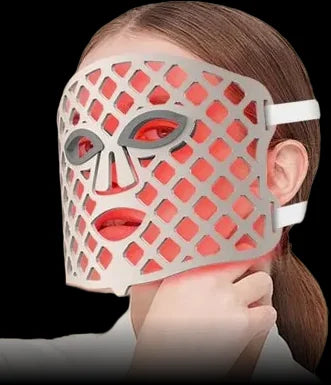
Look for this: the model's eyes in the product photos. If the mask in the image is lit in blue mode, and you see lit LEDs where the eyes are, or the eyes are visible in the light, then you know the light is going into the eyes there. If there's a sealed, dark surface in front of the eyes, then there's something catching it.
Can you use it with glasses or contact lenses?
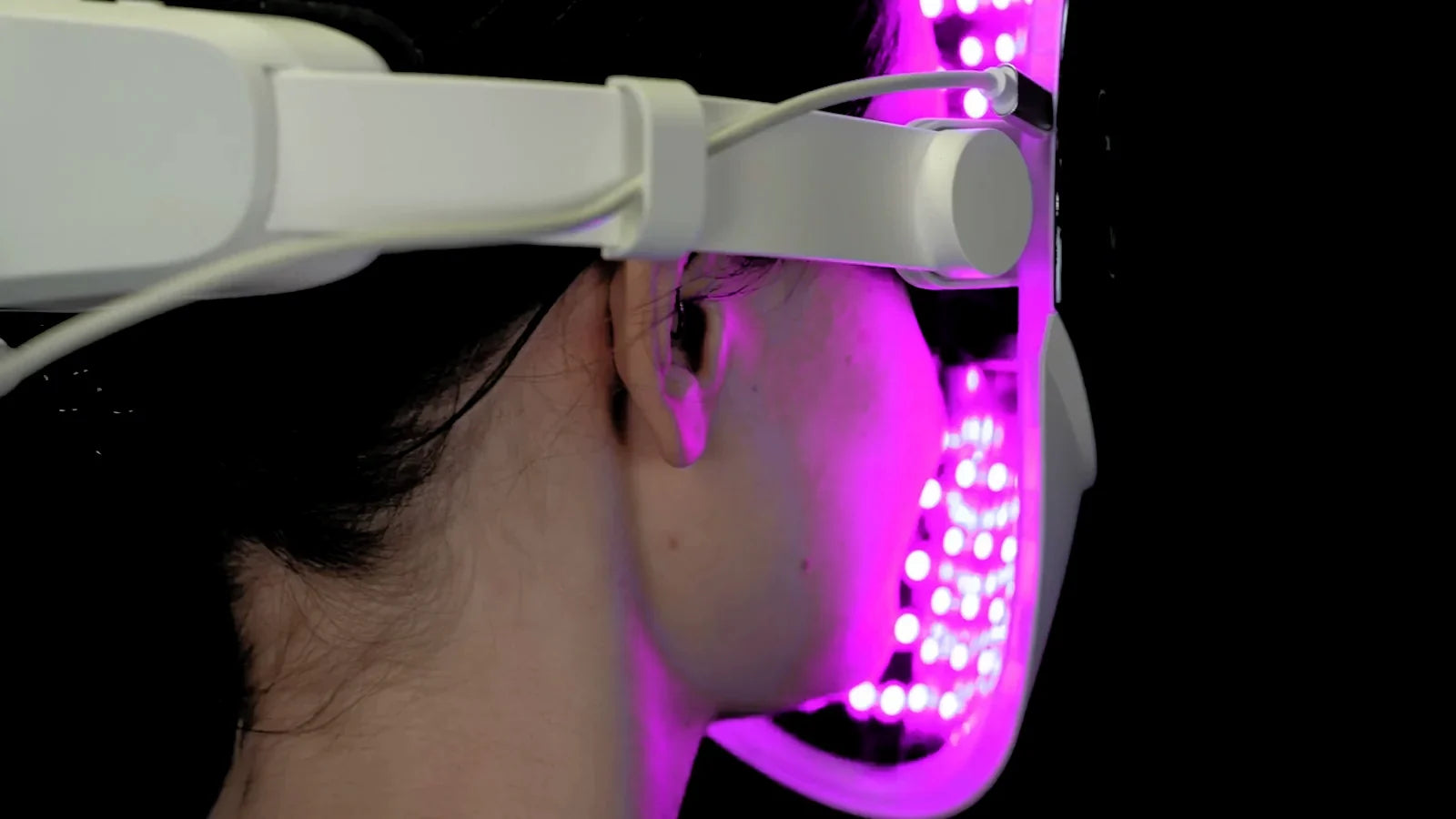
My own IFU asks you to take off your glasses and contact lenses before use. For glasses, the reason is practical: they don't fit under a mask worn on the face, and the frame presses on the eye covering, so it doesn't seal. For contact lenses, my own IFU doesn't give a reason. I haven't found a study on this, and my own reading is that behind a sealed covering, the lens doesn't change anything as far as the light is concerned, but the guide's word is what counts, because it's responsible for the device. If you can't see without glasses, there's a solution: start the programme first, then put the mask on, and masks usually switch off on a timer, so there's nothing to look at on them in the meantime.
What to take from this: without glasses and contact lenses, and if you can't manage without one, set the programme first, then put it on.
Who shouldn't use it because of their eyes, and when should you ask an ophthalmologist?
There are two groups where you need to consult a doctor before using the mask, and a proper guide will spell this out: people taking photosensitising medication, and people with an existing eye condition. A photosensitising medication is one that makes the skin or eyes more sensitive to light. There are many such medications, and whether yours is one is stated in the patient information leaflet, under the word photosensitivity. For an existing eye condition (macular degeneration, previous retinal injury, an intraocular lens after cataract surgery, and anything you see an ophthalmologist for) this is for the ophthalmologist to decide, since they can see your retina. Anyone without a lens in their eye, that is, aphakic, or an infant, has a separate question around short blue light because of the ICNIRP function above; ICNIRP prescribes this stricter function exclusively for the eye left without a lens and for children under two years old, it doesn't apply to the usual, lens-implanted eye.2 I'm not a doctor, these are the two groups where the decision belongs to the ophthalmologist.
If you see a spot, distortion, or a lasting afterimage during or after use, stop, and go to an ophthalmologist. The symptom in the published case was distorted vision, and the patient reached a doctor after a month of use.3
What to take from this: with photosensitising medication or an existing eye condition, see the ophthalmologist first, then the mask. The rest of the contraindications are covered in a separate article, linked below.
For the eyes, the blue mode is the sensitive one, and coverage is what decides. I haven't found a published eye case for a red or near-infrared mask, which is not the same as zero risk.
What if it shone right into my eye, or I feel it's too bright?
If you're dazzled after one session, that can be an afterimage from the light, like when you've looked into a strong lamp, and it fades within minutes. If the distortion, spot, or blur lasts for hours or into the next day, that's already a question for an ophthalmologist, and put the mask down until then. If you feel the mask is too bright around the eyes while using it, that's information in itself: the light is reaching your eye there, and the pad isn't covering enough. In that case, closed eyes and dark goggles are the quick fix, the lasting one is using a mask with sealed coverage in front of the eyes.
What to take from this: dazzling fades, a lasting spot means an ophthalmologist, and the feeling of "too bright around the eyes" is a shortcoming of the mask.
What did I look for in my own mask because of the eyes?
I tried eight LED masks before I started selling my own, and the eyes were the factor that ultimately decided it. Here's how I answered the questions above for my own mask. The LED matrix breaks at the eye line: there's no lit diode in front of the eyes, because I considered eye protection more important than extra coverage. In front of the eyes there's a sealed, padded silicone covering, which is part of the rigid frame, so it's not a removable accessory, and it sits in the same place regardless of face shape. Its blue mode is 450 nanometres, violet is 415, so the weighting function above applies to it in exactly the same way: of the three wavelengths discussed, 450 nanometres has the highest retinal weight, B(450)=0.940, closest to the peak, and I likewise haven't found a 450-nanometre blue-only acne trial. The same standard applies to it as I applied to the competitors above, and the covering protects the eyes.
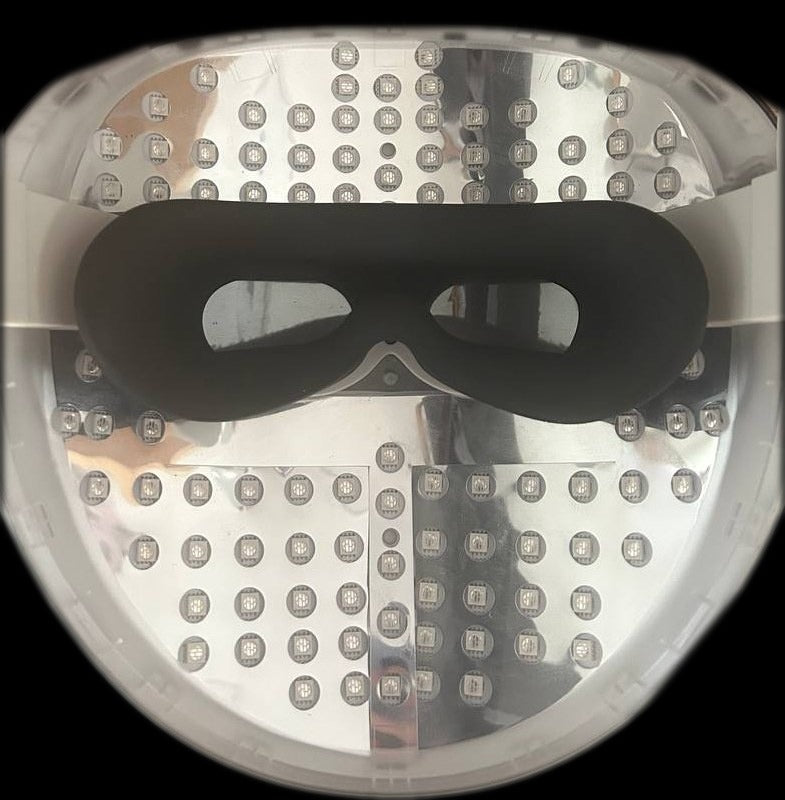
Does the LED mask damage the eyes?
It depends on what colour of light reaches your eyes, and whether there's coverage. There's one published case for blue light: in 2020, Kim and colleagues described photochemical retinal injury in a 37-year-old woman, after using a mask that had no protective covering around the eyes, which she used with her eyes open on the manufacturer's recommendation.3 I haven't found a published case for a red or near-infrared mask. With sealed eye coverage, blue LED light doesn't directly reach the eye.
Is red light safe for the eyes?
Red light falls entirely outside the 380 to 520 nanometre band that ICNIRP ties to photochemical retinal injury. That doesn't mean zero weight, though: the ICNIRP table also gives a value for red between 600 and 700 nanometres, 0.001, a thousandth of the blue peak value.2 I haven't found a published eye injury report for a red LED mask. The thermal effect comes in alongside this: with a strong, close light source this matters too, so it's worth wearing the red mode with closed eyes and behind coverage as well.
Is blue light safe for the eyes in an LED mask?
Blue light is the sensitive band: the peak of the ICNIRP blue-light hazard function is at 435 to 440 nanometres, and 415 and 460 nanometres receive the same, 0.800 weight.2 That's why it's only worth using blue mode in a mask with sealed coverage in front of the eyes and no lit LED at the eye line. Closed eyes alone aren't enough, because some of the light gets through the eyelid.
Should you use the LED mask with eyes closed or open?
With eyes closed. Closed eyes stop light from going straight through the pupil into the diode, but the eyelid is thin, some of the light gets through it, and your eyes won't stay closed on their own until the programme ends. In the published case, the patient used the mask with her eyes open, precisely on the manufacturer's recommendation. The authors' takeaway: cover the eyes,3 so closed eyes are the second line of defence alongside coverage.
Do you need separate eye protection for the LED mask?
It depends on what the mask itself covers. If there's sealed, padded coverage in front of the eyes and no LED at the eye line, I haven't found a measurement of how much a separate pair of goggles would add, and my own IFU doesn't ask for one for this design either. If LEDs are lit around the eyes and the pad is small, then dark protective goggles help, but in my view there's no room for them under a moulded silicone sheet. The lasting solution is choosing the right coverage.
Does a silicone LED mask have eye protection?
Yes: silicone masks also have a silicone eye-protecting pad around the eye socket. It's just small, so it doesn't cover enough of the light coming from the LEDs sitting next to it, and since the soft sheet conforms to the face, where it covers and where it doesn't depends on face shape. Look at the model's eyes in the product photo: if you see lit LEDs where the eyes are, the light is going into the eyes there.
Can I use the LED mask with contact lenses?
My own IFU asks you to take off both your contact lenses and your glasses before use. I haven't found a study on the relationship between contact lenses and LED light, my own reading is that behind sealed coverage, the lens doesn't change anything as far as the light is concerned, but the guide is responsible for the device, so its word is what counts.
Which blue is better for the eyes: 415 or 460 nanometres?
Neither is, for the eye: in the ICNIRP table, 415 and 460 nanometres receive the same 0.800 weight, and 450 receives 0.940, closer to the 435 to 440 nanometre peak.2 For a lens-less, aphakic eye, 415 is worse (1.20 compared with 0.80); ICNIRP prescribes this stricter function exclusively for the lens-less eye and for children under two years old, not for the usual, lens-implanted eye after cataract surgery. On the skin side, blue devices in acne trials operated between 414 and 445 nanometres.4
What if I have an intraocular lens, or I've had cataract surgery?
ICNIRP gives a separate, stricter function exclusively for the eye left without a lens, the aphakic eye, and for children under two years old: there, the weight of 415 nanometres is 1.20, and 460 is 0.80, instead of the usual 0.80-0.80.2 If you received an intraocular lens during cataract surgery, the usual number applies to you; whether the intraocular lens filters short wavelengths the same way the natural lens does, ICNIRP doesn't say. This group is rare today, because cataract surgery patients almost always receive an intraocular lens. If you don't have a lens, you'll know it, and this is the group that should ask an ophthalmologist before using the mask.
What should I do if I see a spot or a distorted image after using the LED mask?
If the glare fades within minutes, that's the light's usual after-effect. If the spot, distortion, or blur lasts for hours or into the next day, put the mask down and go to an ophthalmologist. The symptom in the published case was distorted vision, and the patient reached a doctor after a month of use; her vision improved within four weeks, but the pigment epithelium injury remained.3
Does infrared light harm the eyes in the LED mask?
Near-infrared falls outside the blue-light hazard band, and I haven't found a published eye case from an LED mask. It's invisible, so your eye doesn't signal anything, you don't squint at it, so I don't consider it zero risk, this is my own reasoning. In the at-home masks I've tried, infrared often runs in every mode, so coverage applies to it too.

Sources
The cited sources are about the effect of blue light on the eyes, a published case, and the evidence for sunscreen; none of them were done with this mask.
- Hughes MC, Williams GM, Baker P, Green AC. Sunscreen and prevention of skin aging: a randomized trial. Annals of Internal Medicine, 2013. PMID 23732711.
- ICNIRP. Guidelines on limits of exposure to incoherent visible and infrared radiation. Health Physics 105(1):74–96, 2013. Table 2 (the blue-light hazard and aphakic weighting functions).
- Kim TG, Chung J, Han J, Jin KH, Shin JH, Moon SW. Photochemical Retinopathy induced by blue light emitted from a light-emitting diode Face Mask: A case report and literature review. Medicine (Baltimore), 2020. PMID 32541484, PMC7302677.
- Ershadi S, Barbieri JS. At-Home LED Devices for the Treatment of Acne Vulgaris: A Systematic Review and Meta-Analysis. JAMA Dermatology, 2025. PMID 40042878.
- Nestor MS, Swenson N, Macri A, Manway M, Paparone P. Efficacy and Tolerability of a Combined 445nm and 630nm Over-the-counter Light Therapy Mask with and without Topical Salicylic Acid versus Topical Benzoyl Peroxide for the Treatment of Mild-to-moderate Acne Vulgaris. Journal of Clinical and Aesthetic Dermatology, 2016. PMID 27354885.