

How often and for how long should you use the LED mask? The concept of dose, the biphasic curve, and what the trials actually did.
In these five trials that masks cite, everything from twice-daily use to twice a week occurred, and the first reported difference appeared at week 4, where a result was reported for that time point, and the longest trial was 12 weeks. More minutes doesn't automatically mean more effect: in cell and animal experiments too much light can even reverse the response, but this hasn't been shown in human skin, though the possibility isn't ruled out either. The ceiling is your own mask's printed user guide, and it's not worth going beyond that.
Before we talk about minutes and sessions, one thing is worth clarifying. If you don't have a basic routine, meaning cleansing, moisturising, and sunscreen every day, you'll probably regret the money spent on the mask. There's more and stronger evidence for daily sunscreen slowing skin ageing than for any at-home light device: in Hughes and colleagues' 2013 randomised trial, 903 adults took part over 4.5 years, and among those using daily sunscreen, no additional skin ageing was detected, skin ageing was 24% less than among occasional users.1 Sunscreen also costs a fraction of a mask. From here on, this article is about the mask, on the assumption that this foundation is already in place.
What does dose mean for a LED mask?
Dose is the amount of light that reaches one square centimetre of your skin during one session. It's made up of three things. The first is power density, in other words irradiance: it tells you how much light the mask emits onto one square centimetre of skin at a given moment, measured in milliwatts per square centimetre (mW/cm²). A milliwatt is a thousandth of a watt, and a watt is the unit of power, the same one you see on a light bulb. The second is time, in seconds. The third is the product of the two, energy density, given in joules per square centimetre (J/cm²), which phototherapy articles call the dose. A joule is the unit of energy: one watt of power delivers one joule of energy in one second.
So the formula is this: power density (mW/cm²) multiplied by seconds, divided by a thousand, gives the dose in J/cm². Dividing by a thousand just converts milliwatts to watts. This leads to something that causes a lot of confusion with masks: the same number of minutes on two different devices is two different doses. A mask that shines with twice the power density delivers twice the dose in the same number of minutes. A minute on its own isn't a dose, just one of the factors.
This light is absorbed in the skin: according to Avci and colleagues' 2013 review, photons, meaning particles of light, are absorbed by the mitochondrial chromophores of skin cells.2 The mitochondrion is the cell's energy-producing part, and the chromophore is the molecule within it that absorbs light of a given wavelength. So the dose is about how much light these molecules receive during one session.
What to take from this: if a mask's page only lists minutes, with no power density next to them, you know nothing about the dose, and it's not worth carrying another mask's routine over to your own.
Why can't a light panel's protocol be carried over to a mask?
What you find about usage routines on Hungarian forums and blogs is often written for a light panel. A panel is a flat board packed with LEDs, held much further from the skin, and its instructions give the minutes for that distance. A mask sits a few millimetres from the skin or directly on it. Light intensity decreases with distance, because the same amount of light spreads over an ever larger area as you move away from the source. A panel at its typical usage distance and a mask directly on the skin are two completely different power densities, even if the same LEDs sit inside them.
There's another difference that matters for masks. A LED is a point. If the panel sits directly on the skin, each LED lights up a small spot strongly, and the light is weaker between the spots. From a distance, the LEDs' cones of light overlap, and the skin receives the light more evenly. This is my own reasoning from physics, not a measurement, and I haven't found a study that compared the LED-to-skin distance for masks.
What to take from this: don't carry the panel's centimetres and minutes over to the mask. The mask's own instructions belong to the mask, and if a mask's page shows a panel protocol, that's the two devices being mixed up.
Can there be too much light? What does the biphasic dose response show?
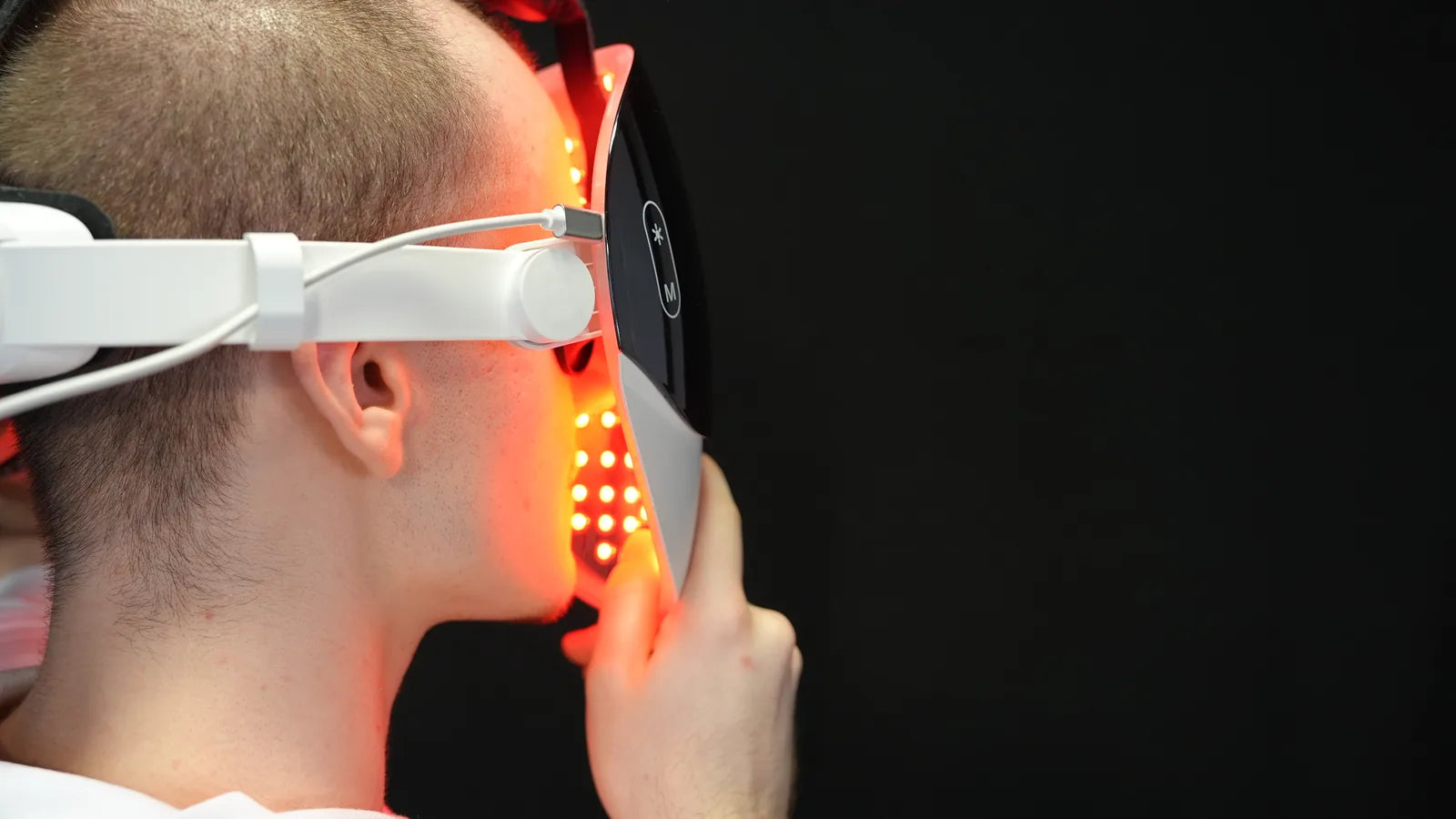
The biphasic dose response means the effect of light rises with dose for a while, reaches a peak, and then falls back above that peak. The phenomenon was described by Arndt and Schulz in the late 19th century, which is why it's also called the Arndt-Schulz curve. Huang, Hamblin and colleagues' 2009 review put it this way for light: if too little energy reaches the cell, there's no response, because it doesn't reach the threshold; above the threshold comes biostimulation, meaning the cell's activity is stimulated; but if there's too much energy, the stimulation disappears and bioinhibition, meaning suppression, takes its place.3
The numbers this curve is built on come from cell culture and animal experiments. In mouse embryo connective tissue cells, activation of a protein called NF-κB was strongest at 0.3 J/cm², and had already decreased at 3 J/cm² and even more so at 30 J/cm².3 NF-κB is a signalling protein that switches on genes in the cell nucleus. In wound healing in mice, the peak was at 2 J/cm², while 50 J/cm² worsened healing compared with the untreated control: the wound grew larger than in the animals that hadn't received light.3 This is the strongest data for the idea that too much light can be worse than none, but it's data measured in mice, on wounds, not on human facial skin.
The biphasic curve: the effect rises with dose, reaches a peak, then falls back. The marked points come from cell culture (activation strongest at 0.3 J/cm², decreased above that) and mouse wound healing (peak at 2 J/cm², worse than the untreated control at 50 J/cm²); in humans the curve hasn't been shown, but the possibility of overdosing isn't ruled out here either.
The mechanism depends on the amount of reactive oxygen species (ROS). ROS are oxygen-containing molecules that react easily with other molecules. In small amounts they work as a signal: the low ROS level triggered by light activates proteins like NF-κB, and stimulates cell division. In large amounts they act as a poison: a high ROS level inhibits division and kills the cell.3 According to the 2009 review, a high dose of light triggers apoptosis, meaning programmed cell death, through the mitochondrion, via an enzyme called caspase-3.3 In the same group's 2011 measurement, in mouse embryo cortical neuron cell culture, ATP, meaning the cell's energy-carrying molecule, rose at lower doses and fell at higher ones, and ROS had a second, larger peak at 30 J/cm², exactly where the mitochondrial membrane potential fell below baseline.4
This curve has three limitations, without which the numbers above are misleading. The first: in the 2011 review's own words, the biphasic curve was shown in cell culture and animal experiments, and "there is currently no convincing report of a biphasic dose response occurring in patients". The same sentence, however, goes on to say that according to several randomised-trial-based systematic reviews and meta-analyses, overdosing may explain some of the ineffective trials, because they exceeded the guideline values of the professional body for laser therapy, the World Association for Laser Therapy.4 So in humans the shape of the curve hasn't been proven, but the possibility of overdosing isn't ruled out here either. The second: the only human randomised trial the 2009 review cites for varying power gave a better result with higher power, but not on facial skin. With an 830 nm laser, on the neck, directed at the ganglion beside the seventh cervical vertebra, between 60 mW, 150 mW and placebo, the greatest improvement came from the 150 mW setting, for post-herpetic neuralgia, with 3-minute sessions; the same patients received all three settings, on three consecutive days.3 The time stayed the same across all three settings, so the higher-power setting also received a higher energy density. This was laser, not LED, and it was applied to the neck, yet it argues precisely against "more is worse". The third: Zein, Selting and Hamblin's 2018 review writes that ineffective trials involving high-mitochondrial-activity cells were more often rendered ineffective by overdosing, and the same review places skin among the low-mitochondrial-count tissues, as opposed to muscle, brain, heart and nerve.5 So the sentence "overdosing explains the failure" refers to muscle and brain, and doesn't follow for skin.
What to take from this: more light isn't more effect, and in cells and animals too much light can reverse the response. In human skin the shape of the curve hasn't been shown, but the possibility of overdosing can't be fully ruled out either. The practical limit is your mask's instructions for minutes and sessions, and it's not worth going beyond that.
What did the studies that masks cite actually do?
On mask makers' pages, the minutes and sessions stand without a source. I'm highlighting these five from the literature on at-home LED devices; none of them was done with the specific mask you see in the shop.
In 2000, Papageorgiou and colleagues split 107 people with mild to moderate acne into four groups: blue light only (415 nm), mixed blue and red light (415 and 660 nm), white light, and 5% benzoyl peroxide cream. The light was delivered with a portable light source, 15 minutes daily, over 12 weeks; this is what the original summary states. A 2021 review describes it as a lamp, and gives a power density of 4.23 mW/cm² at a distance of 25 centimetres, along with a dose of 320 J/cm².13 In my own reading, this 320 J/cm² works out for the entire 12-week course, 4.23 mW/cm² multiplied by 15 minutes, multiplied by 84 days, not for a single session. The number of inflammatory lesions in the mixed arm fell by an average of 76% (95% confidence interval 66 to 87%), and this was significantly better than the blue-only arm at week 4 and week 8, but no longer at week 12.6 The original summary doesn't report the blue-only arm's own percentage; the 2021 review gives a figure of 63% inflammatory improvement for it.13
In 2007, Na and Suh treated one half of the face on 28 volunteers with a portable red-light-emitting device, the other half was the control. The device ran twice daily for 15 minutes, over 8 weeks. On the treated side, both inflammatory and non-inflammatory lesion counts fell significantly more than on the control side, and the value measured on the visual analogue scale improved from 3.9 to 1.9.7 This is a small, single-blind trial, and the original summary doesn't state the device's wavelength.
In 2026, Friedmann and colleagues studied an at-home device that delivered 660 nm red and 415 nm blue light together, against a blue-only 415 nm device. The target was 30 participants, 23 completed it. The device was used at home once daily, over 8 weeks. Inflammatory lesion counts fell significantly on both arms by week 4 and week 8, non-inflammatory lesion counts on neither arm, and there was no significant difference between the two arms at any time point in the reduction of lesion counts; on the physician's global assessment score at week 8, the combined arm was better.8 It was an open-label trial, with no sham-device arm, so participants knew what they were getting.
A 2025 trial enrolled 30 people to study a portable, at-home mask that delivers red (633 nm) and blue (415 nm) light together, for 10 minutes per session, four times a week, over 7 weeks; one participant dropped out early due to illness, 29 completed it. All 30 participants also received a standardised basic at-home routine, a hydrating cleanser, moisturiser, and SPF 30 sunscreen for daily use, after washing out their previous topical treatments. By week 7, both inflammatory and non-inflammatory lesion counts had fallen significantly, and 86% of participants improved by at least one grade on the physician's severity scale.9 This too was an open-label trial, with no control arm; the authors themselves describe this as a main limitation, and since everyone also received the same basic routine, the 86% and the significant reduction can't be attributed to the light alone.
In 2025, Bragato and colleagues studied 95 women aged 45 to 60 with a 660 ± 10 nm red LED mask, specifically on the question of frequency. This mask is another manufacturer's product, not ours; Bragato's own publication gives all three figures, power density, time, and dose, which is why it can be used to illustrate the dose formula above: 6.4 mW/cm² power density, 21 minutes, and a calculated energy density of 8.05 J/cm². (The Papageorgiou dose above, in my own reading, is the sum of the whole 12-week course, not of one session.) Working it back with the formula: 6.4 mW/cm² multiplied by 1,260 seconds (21 minutes), divided by a thousand, gives practically the same 8.05 J/cm² that the trial reported; a textbook example of dose calculation. Under the protocol, one group received three 21-minute sessions a week, another group two, over 4 weeks, and a third group received sham treatment. On the blinded wrinkle-assessment scale, there was no significant difference between the groups, including the sham-treated group. Computerised ImageJ measurement assessed four regions, the forehead, the glabella, and the right and left periorbital areas, and in two of these, the glabella and the right periorbital area, wrinkle length decreased significantly in the light-treated groups compared with the sham-treated group,10 and on the FACE-Q satisfaction score both active groups were also significantly better than the sham-treated group (p=0.001 and p=0.034). Between the two-per-week and three-per-week sessions, however, there was no difference either on the wrinkle scale or in satisfaction, and the authors conclude from this that two sessions a week also seems sufficient for improving satisfaction. This shows that more sessions per week didn't produce more result, even though the machine measurement was better in the light-treated groups, and FACE-Q was better in both active groups than the sham-treated one. What it doesn't show is that more would have been harmful, and four weeks is a very short time.
What to take from this: the routines studied were 15 minutes daily, twice daily for 15 minutes, once daily, four times a week for 10 minutes, and two or three 21-minute sessions a week, over 4 to 12 weeks. In two trials the summary states that it was a mask (Ablon 10 minutes, Bragato 21 minutes); Papageorgiou wrote portable light source, Na and Suh wrote portable device; Friedmann's summary doesn't state the device's form. Where the number of minutes was reported, none was 30 minutes, and none was done on your mask. If a mask's page cites a trial, look for these four pieces of data alongside it: how many people, how many minutes, how many times a day, how many weeks.
When did results show up in these trials?
In the trials above, the first reported difference appeared at week 4 (Papageorgiou, Friedmann). Measurements were also taken earlier: Na and Suh recorded lesion counts and the visual analogue scale (VAS) at weeks 1, 2 and 4, Ablon recorded lesion counts and the physician's score (IGA) at day 21, but Ablon's published results section has no result for day 21, and the Na and Suh summary doesn't report a result for these time points either (I didn't have access to the full text), so we don't know what was seen at that time. More endpoints were measured at week 8 (Na and Suh, Friedmann), the longest trial was 12 weeks (Papageorgiou), where the difference between the mixed and blue-only arms no longer reached the significance level by week 12.6 These are group averages: a percentage coming out of a lesion count, which holds true for the group as a whole, and says nothing about when and how much shows on a given person's face. The summaries don't report individual variation, so I also can't say how many participants saw no change at all.
What to take from this: the trials measured a difference after 4 to 12 weeks, where they reported a result for that time point, alongside regular use several times a week. Judging the mask after two weeks is premature, but after twelve weeks of regular use there's something to measure against.
Does skin get used to the light?
I looked for a trial on this question, and didn't find one. "Getting used to it" would mean that the same dose delivers less and less over time, because the tissue's response wears down from repetition; in pharmacology this is called tolerance or tachyphylaxis. I didn't find a measurement like this for phototherapy, the searches only turned up pharmacological definitions. What is in the literature is a different concept: the biphasic dose response, meaning a dosing optimum within a single session, which was discussed above.
The closest data point is a mouse experiment, for brain injury, with laser applied through the skull. The effective treatment was repeated fourteen times, daily: over the first four days, the daily-treated group improved slightly more than the single-treatment group, from the fifth day the improvement stopped, and by the fourteenth day the daily-treated mice had fallen back to the level of the untreated group; between day 16 and day 28 the daily-treated mice performed worse than the untreated ones, but according to the authors this difference wasn't statistically significant.4 The authors describe this as cumulative overdosing, not as getting used to it, and this is data measured in mice, on the brain, with laser, it doesn't speak to human skin and LED. In a cell line, two treatments a day gave a bigger increase in division than one a day or four a day,3 and the 2009 review itself states that the effect of treatment interval is unexplored.3 There's a counterexample in humans too: alongside radiotherapy and chemotherapy for oral cancer, in light treatment given against oral mucositis, daily treatment was more effective than every-other-day treatment in 16 patients, and grade 2 and 3 inflammation was more frequent in the every-other-day group.11 This is a small sample (the trial was stopped early at an interim analysis with 16 patients instead of the planned 60), with different tissue and a different purpose, but it shows that "less often is better" doesn't generalise either.
What to take from this: there's no source for "your skin gets used to it", and none for "more often daily is better" on human skin either. What there is, is that in one human trial there was no difference between two and three sessions a week, and your mask's instructions set the weekly ceiling.
What does the user guide say, and what does the 30-minute timer mean?
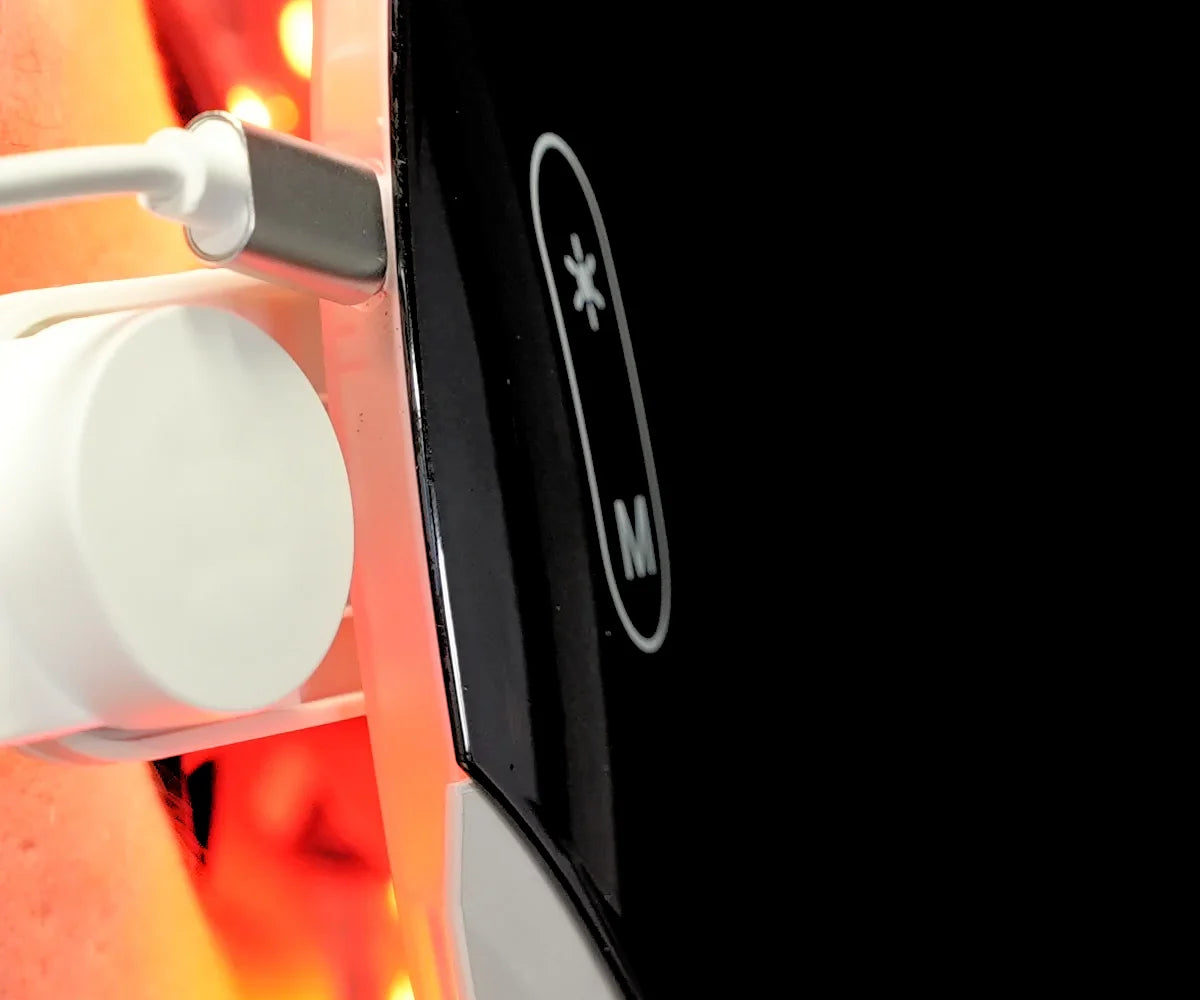
Many masks have a timer that switches the device off automatically after a set time, and many user guides give two numbers: a recommended number of minutes per session and a weekly number of sessions. The two aren't the same. The automatic shut-off is a safety limit: it tells you how long the device can run if you forget to take it off. The recommended time tells you how much is worth doing. If a mask switches off after 30 minutes, that doesn't mean it's worth wearing for 30 minutes; the trials cited used sessions of between 10 and 21 minutes where this was reported (in two of these the summary states it was a mask; Na and Suh gave two 15-minute sessions a day), and according to the biphasic curve, more isn't more. For your own mask, your printed user guide is what counts regardless: its number of minutes and sessions is what matters, not the timer.
The same is true for the weekly number: the user guide's weekly session count is a ceiling, not a target you have to reach. If your user guide gives a range, say between three and five times a week, the lower end of the range is just as much use according to the guide as the upper end.
What to take from this: look for the recommended minutes and weekly sessions in your mask's user guide, not the timer's value. If the user guide only gives a timer, with no recommendation, the cited trials' sessions of between 10 and 21 minutes, where this was reported, show the range the researchers worked within; for your own mask this isn't a recommendation, what applies to it is your printed user guide's number of minutes and sessions.
Is it better to use it in the morning or the evening?
I didn't find a trial on this. None of the five trials above describes what time of day the participants used the device, and I haven't found a trial that compared morning and evening use either. What remains is practical: the right time is whenever you can sit calmly for ten to fifteen minutes, and can keep up week after week, because in the trials it was regular use over weeks that produced the measured difference. Use it on clean, cleansed skin, and if you have a product on your skin that could be photosensitising, don't apply it right before the mask.
What to take from this: there's no evidence for time of day; the trials all measured regular use over weeks. Choose the time you can keep up.
The usage routines studied fell between 10 and 21 minutes per session where this was reported, ranging from twice-daily use to twice a week; in these five trials a difference was measured after 4 to 12 weeks where a result was reported for that time point, and more sessions per week didn't produce more result in one human trial. More light can reverse the effect in cells and animals; this hasn't been shown in humans, but the possibility isn't ruled out either. The ceiling is your own mask's user guide.
Can you use the LED mask every day?
Some of the trials worked with daily use: Papageorgiou in 2000, 15 minutes daily for 12 weeks, Na and Suh in 2007, twice daily for 15 minutes for 8 weeks, Friedmann in 2026, once daily for 8 weeks. In another trial with 95 women, there was no difference between two and three sessions a week. So daily use did occur in the trials, but more sessions per week didn't bring more, where this was measured. Your own mask's user guide's weekly session count is the ceiling.
How many minutes should the LED mask stay on?
Four trials reported the number of minutes, one didn't: Ablon in 2025, four times a week for 10 minutes (with a mask), Na and Suh in 2007, twice daily for 15 minutes (with a portable device), Papageorgiou in 2000, 15 minutes daily (with a portable light source; a 2021 review describes it as a lamp), Bragato in 2025, 21 minutes per weekly session (with a mask). For Friedmann 2026, the summary doesn't report the number of minutes, only that it was once daily. So the reported minutes were between 10 and 21 minutes. The dose, however, is made up of the minutes and the device's power density, and this latter figure rarely appears on mask pages, so these minutes can't be carried over to another device. Your own mask's user guide's number of minutes is the guide, the automatic shut-off time is not.
When does a result show up from the LED mask?
In these five trials, the first reported difference appeared at week 4 (Papageorgiou, Friedmann). Measurements were also taken earlier: Na and Suh recorded lesion counts and the visual analogue scale (VAS) at weeks 1, 2 and 4, Ablon recorded lesion counts and the physician's score (IGA) at day 21, but Ablon's published results section has no result for day 21, and the Na and Suh summary doesn't report a result for these time points either (I didn't have access to the full text), so we don't know what was seen at that time. More endpoints were measured at week 8, the longest was 12 weeks. These are group averages from lesion counts, alongside regular use several times a week; they say nothing about when anything shows up on a given person's face, and they don't report how many participants saw no change either. So a timeframe can't be promised.
Can the LED mask be overdosed?
In cell culture and mouse experiments, yes: in mouse wound healing, 2 J/cm² helped, 50 J/cm² was worse than untreated, and in cells a high dose triggers programmed cell death. In human skin, the shape of the biphasic curve hasn't been shown: according to the 2011 review, there's no convincing report of a biphasic dose response in patients, and in one human trial, higher power was better. The same review, however, also writes that according to a meta-analysis built on several RCTs, overdosing may explain some of the ineffective trials, so the possibility can't be fully ruled out in humans either. For the eyes, the situation is different. In an eye case reported in 2020, a woman used a mask for 20 minutes, every other day, for a month, in which the area around the eyes was open without any protective covering, and the blue light's wavelength was between 460 and 470 nm. The woman was also treated with a bevacizumab injection into her eye; at the four-week check, the retinal pigment epithelium damage remained, while the visual disturbance and the photoreceptor layer improved, which could partly be an effect of the injection, not only the passage of time.12 This is one case, with one mask, together with drug treatment; I write about eye protection in the eye article.
What if I skipped a few days?
I didn't find a trial on this. Among the routines studied there was also a twice-a-week one, where days passed between two sessions, and there was no difference there compared with three times a week. Carry on where you left off; don't make up skipped sessions with double the time or several sessions a day, because more light isn't more effect; this hasn't been shown in human skin, but the possibility hasn't been ruled out either, and your user guide's daily upper limit stays the same after a gap.
What if I used it twice in one day?
Na and Suh's 2007 trial worked with twice daily for 15 minutes over 8 weeks, with red light. This isn't a recommendation for another mask, it only says that this routine occurred in the literature. Check your user guide's daily upper limit: if the two sessions stayed within it, there's nothing to do, if it went over, skip the next day. If your skin turned red or felt warm, wait until this passes.
What if my skin got worse from the LED mask?
Stop, and check what else has changed: a new active ingredient, a photosensitising medication or product (these appear on user guides' contraindication lists), stronger sun exposure, a different cleanser. I didn't find a trial for the claim that skin temporarily gets worse from the LED mask and then improves; you read this sentence on forums, without a source. If redness, itching or a rash still remains after several days, see a dermatologist. I go through the contraindications in the who-shouldn't-use-it article.
What if I don't see a change after four weeks?
In these five trials, the difference appeared between week 4 and week 12, where a result was reported for that time point, so it's still early to judge after four weeks, if you've used it regularly according to your user guide. After eight and twelve weeks of regular use, though, there's already something to measure against. If you still see nothing then, it's not your fault: the trials report group averages, not individual variation. Daily sunscreen, cleansing and moisturising are worth more even then than raising the mask's number of minutes.
Is the LED mask better in the morning or the evening?
I didn't find a trial on this, and the cited trials don't report when the participants used the device either. Choose the time of day you can keep up week after week, and when you can sit calmly for ten to fifteen minutes. Use it on clean, cleansed skin; don't apply a photosensitising product right before the mask.
Does skin get used to LED light?
I didn't find a trial on this. The literature describes a different concept: the biphasic dose response, meaning that within a single session the effect of light has a peak, and falls back above that peak. This is seen in cells and animals, it hasn't been shown in humans. In a mouse experiment, daily repeated brain laser treatment brought the result back down to the untreated level by day fourteen, and then below it too; according to the authors this difference wasn't statistically significant, and they describe this as cumulative overdosing, not as getting used to it, about mouse brain, not human skin.
Should you start with a shorter time and gradually increase it?
I didn't find a trial on this; the cited trials' summaries don't describe a gradual introduction. If your user guide gives a range, starting at the lower end is a matter of comfort, and is just as much use according to the guide. What's worth watching for in the first sessions is your skin's reaction: in case of redness, warmth or itching, skip a day.
Do the blue and red modes need a different number of minutes?
The trials didn't give the colours a different number of minutes: in Papageorgiou 2000, the blue-only and the mixed blue-red arms both received 15 minutes daily, and user guides also give a single time for every mode. I haven't found a trial for a colour-specific dosage on human skin. The difference between the colours is in the wavelength, I write about this in the article on colours.
What does it mean that the mask switches off after 30 minutes?
The automatic shut-off is a safety limit: this is how long the device can run if you forget to take it off. The recommended usage time is the user guide's other number, and in the cited trials it was between 10 and 21 minutes where reported (in two of these the summary states it was a mask; Na and Suh gave two 15-minute sessions a day). The fact that the mask runs for 30 minutes doesn't mean it's worth wearing for 30 minutes; according to the biphasic curve, more light isn't more effect, and in cells and animals too much can reverse it. This hasn't been shown in human skin, but the possibility hasn't been ruled out either, which is why the user guide's number of minutes counts, not the timer.
What does my own mask's user guide say?
I tried eight LED masks, and their usage routines were given differently in almost every one: some had only a timer, and some had minutes with no power data next to them. This is what shaped what I was looking for in my own: a user guide that gives minutes and weekly sessions, and a timer that's a safety limit. Only after that did I dare start selling my own LED mask. My mask's printed user guide states 3 to 5 sessions a week and up to 10 minutes per session, the daily upper limit is 30 minutes, and the device switches off automatically after 30 minutes. The 30-minute shut-off is the safety limit, the 10 minutes is the recommendation. For the seven colours, the user guide gives a cosmetic description; this article doesn't answer which mode to use, because the mask isn't a medical device, and the trials above weren't done on this mask. If you'd like to take a look after this, the limitations are there on the product page too.

Sources
The sources are about light's dose response, trials of at-home LED devices, and sunscreen; none of them was done with this mask, and none of them says anything about your skin.
- Hughes MC, Williams GM, Baker P, Green AC. Sunscreen and prevention of skin aging: a randomized trial. Annals of Internal Medicine, 2013. PMID 23732711.
- Avci P, Gupta A, Sadasivam M, Vecchio D, Pam Z, Pam N, Hamblin MR. Low-level laser (light) therapy (LLLT) in skin: stimulating, healing, restoring. Seminars in Cutaneous Medicine and Surgery, 2013. PMID 24049929.
- Huang YY, Chen AC, Carroll JD, Hamblin MR. Biphasic dose response in low level light therapy. Dose-Response, 2009. PMID 20011653.
- Huang YY, Sharma SK, Carroll J, Hamblin MR. Biphasic dose response in low level light therapy - an update. Dose-Response, 2011. PMID 22461763.
- Zein R, Selting W, Hamblin MR. Review of light parameters and photobiomodulation efficacy: dive into complexity. Journal of Biomedical Optics, 2018. PMID 30550048.
- Papageorgiou P, Katsambas A, Chu A. Phototherapy with blue (415 nm) and red (660 nm) light in the treatment of acne vulgaris. British Journal of Dermatology, 2000. PMID 10809858.
- Na JI, Suh DH. Red light phototherapy alone is effective for acne vulgaris: randomized, single-blinded clinical trial. Dermatologic Surgery, 2007. PMID 17903156.
- Friedmann DP, Verma KK, Gidwani KA, Nguyen M, Gharibvand L. Comparing a Red and Blue Light-Emitting Diode Light Device With an Existing Blue Light Device for At-Home Treatment of Inflammatory Acne: An Open-Label Randomized-Controlled Trial. Dermatologic Surgery, 2026. PMID 41886698.
- Ablon G. A 7-Week, Open-Label Study Evaluating the Efficacy and Safety of 415-nm/633-nm Phototherapy for Treating Mild-to-Moderate Acne in Adolescents and Adults. Journal of Clinical and Aesthetic Dermatology, 2025. PMID 41416031.
- Bragato EF, Paisano AF, Pavani C, Motta LJ, Varellis MLZ, Chiedde M, da Silva GA, Bussadori SK, Mesquita-Ferrari RA, Fernandes KPS. Role of photobiomodulation application frequency in facial rejuvenation: randomized, sham-controlled, double-blind, clinical trial. Lasers in Medical Science, 2025. PMID 40167796.
- Oliveira FM, Borges MM, Malta CE, Moura JF, Forte CP, Barbosa JV, Silva PG, Dantas TS. Comparison of a daily and alternate-day photobiomodulation protocol in the prevention of oral mucositis in patients undergoing radiochemotherapy for oral cancer: a triple-blind, controlled clinical trial. Medicina Oral, Patología Oral y Cirugía Bucal, 2024. PMID 38615257.
- Kim TG, Chung J, Han J, Jin KH, Shin JH, Moon SW. Photochemical Retinopathy induced by blue light emitted from a light-emitting diode Face Mask: A case report and literature review. Medicine (Baltimore), 2020. PMC7302677.
- Diogo MLG, Campos TM, Fonseca ESR, et al. Effect of Blue Light on Acne Vulgaris: A Systematic Review. Sensors (Basel), 2021. PMID 34696155.