

Who is the LED mask not for? The guide's exclusion list, explained item by item, and what study is (or isn't) behind each one.
The safety leaflet in the box prohibits use in nine situations: photosensitising medication, an eye condition, pregnancy and breastfeeding, cancer, a photosensitivity-related condition, infection or fever, a blood clotting disorder or a tendency to scar, heart disease or uncontrolled blood pressure, and filler or botulinum toxin treatment on the treated area. Behind most of these prohibitions, I haven't found an LED-mask study, either showing harm or confirming safety. The article states this for five items. Four items are exceptions: for the eye condition, there's a reported case (Kim 2020); for cancer, a review of red and near-infrared phototherapy (Glass 2023, at a low level of evidence); and for the infection-or-fever item and the heart-disease/blood-pressure item, I don't state it separately. And if you don't have a basic routine (cleansing, moisturising, daily sunscreen), you'll probably regret money spent on the mask: there's more and stronger evidence for daily sunscreen slowing skin ageing than for any at-home light device, and it costs a fraction of the price.
Who does the printed guide prohibit use for?
Before we get into the list, one sentence about the order. In Hughes and colleagues' 2013 randomised trial, 903 adults took part over 4.5 years, and those using daily sunscreen showed no further detectable skin ageing, with 24% less measured than in occasional users. 2 This is about sunscreen, not the mask, and that's exactly why daily sunscreen is the first step, and the mask a possible add-on.
The safety leaflet in the box starts with a "Don't use if" list, and names nine situations. 1 I'm adding what each item means in plain language after it, because the guide is necessarily terse.
You're taking photosensitising medication. A medication that makes your skin react more strongly to light than usual. There's a separate section on this further down, because this is the most-asked-about item on the list.
You have an existing eye condition. Any eye condition that's present today. The eyes got their own article in the knowledge base, which I link at the end of this section.
You're pregnant, or breastfeeding. There's a separate section on this too, because Hungarian sources contradict each other here.
You have or have had cancer, especially skin cancer. Here the guide treats past cancer as a prohibition too, with skin cancer singled out.
You have a photosensitivity-related condition: lupus, porphyria, dermatomyositis, albinism. Lupus is an autoimmune disease whose skin symptoms can flare up with light. Porphyria is a metabolic disorder of blood pigment precursors (porphyrins), and porphyrins are activated by light specifically. Dermatomyositis is an inflammatory disease affecting the skin and muscles, also with light-sensitive skin symptoms. In albinism, there's little or no melanin in the skin, which is the natural filter against light. I haven't found an LED-mask study with this patient group.
You have an active infection or fever. This applies both to a skin infection (for example, a pus-filled spot on the face) and to a general feverish state.
You have a blood clotting disorder or a tendency to scar. By tendency to scar, I mean abnormal, overgrown scarring, such as keloid; the guide doesn't go into more detail than this. I haven't found an LED-mask study with this patient group.
You have heart disease or uncontrolled blood pressure. The short leaflet uses the word "uncontrolled", the online guide (/pages/ifu) uses the stricter "abnormal blood pressure". If in doubt, your doctor decides which applies to you.
Filler, dermal filler or botulinum toxin treatment has been done on the treated area. The guide doesn't give a time window, so it doesn't say how many weeks until it's allowed. So this has to be decided by the professional who did the treatment.
The online guide's (/pages/ifu) full Hungarian text also has a "Who it's not recommended for" list, and this doesn't exactly match the nine items above; the two lists partly overlap. This list has three additional situations. Abnormal pain sensitivity. During dental or oral treatment, in which case get medical advice first. Blood-forming organ, internal organ or severe skin disease, or allergic dermatitis, whether it's present now or in your medical history. Abnormal blood pressure is the same item as the heart disease and blood pressure point above, just with a stricter word. An existing eye condition, on the other hand, is missing the other way round: it's on the nine-item short list, but left out of the online guide's "Who it's not recommended for" list.
What you can take from this: look for the list in your own mask's guide, and if an item applies to you, that isn't decided at the level of this article.
If any of the nine items, or the online guide's three additional items above, applies to you, our mask prohibits use. This prohibition is our claim ceiling: the website can't loosen it.
What does photosensitising medication mean?
A photosensitising medication is an active ingredient that absorbs light in the skin, and starts cell damage or an immune reaction with the light's energy. According to Di Bartolomeo and colleagues' 2022 review, this is one of the skin's common drug side effects, and mainly comes from the interaction between UVA radiation and the drug. 3 There are two types: a phototoxic reaction is direct cell damage that resembles excessive sunburn, while a photoallergic reaction is a delayed, eczema-like immune response. Hofmann and Weber's 2021 review lists 393 drugs or active ingredients with photosensitising potential, with very varied levels of evidence, and states that the reaction can be triggered by ultraviolet or visible light. 4 Kowalska and colleagues in 2021 also name the drug classes: non-steroidal anti-inflammatories, cardiovascular drugs, psychiatric medications, antibiotics and other antimicrobial agents, lipid-lowering drugs and anticancer agents. 5
Here comes the question that makes this item not self-evident. The LED mask doesn't emit UV, and most photosensitising reactions are tied to UVA. From this, it would follow that the mask is less risky than sunlight in this situation. I can't draw this conclusion, for two reasons. One is that, according to the review, the reaction can develop with visible light too, and the mask emits exactly visible light, and in violet mode (415 nm) it's moreover close to the band where porphyrins absorb most strongly: according to the Serrage paper's introduction (citing another source), the Soret peak is 405 nm, the authors' own abstract places the Cutibacterium strains' porphyrin peaks between 402 and 413 nanometres, their results section between 389 and 416 nanometres; 415 sits at the upper edge of the wider band. 6 The other is that I haven't found a study on using an LED mask and a photosensitising medication together. Where there's no measurement, our own guide's prohibition stands.
What you can take from this: look for the word "photosensitivity" or "sunlight" in your medication's patient information leaflet. If it's there, the mask, according to the guide, isn't for you to use, and only your treating doctor can override this.
The guide prohibits use alongside photosensitising medication. Whether the mask's visible light actually triggers a reaction is not something there's a study on, and this isn't decided by trying it at home.
Can it be used during pregnancy and breastfeeding?
According to our guide, no: pregnancy and breastfeeding are on the prohibited list. 1 This isn't consistent across the Hungarian market: some brands prohibit it, some recommend checking with a doctor. The difference doesn't come from one of them knowing something the other doesn't. I haven't found a study done on pregnant or breastfeeding LED-mask users, either one describing harm or one confirming safety. Clinical trials routinely exclude pregnant participants from the outset, so this data will likely be missing for a long time.
Where there's no data, there are two paths: the manufacturer prohibits it, or the manufacturer leaves it to the user and their doctor. We chose the first, and that's what's printed. This doesn't mean we know of a harm. It means we don't know anything, and we don't want to put that not-knowing on you.
What you can take from this: if you're pregnant or breastfeeding, the mask can wait, and sunscreen and moisturising are worth more in the meantime.
Our guide prohibits use during pregnancy and breastfeeding. There's no study in either direction, and we treat the missing data as a prohibition.
What about melasma and darker skin?
Melasma is a patchy, brownish discolouration of the skin, typically on the face, that worsens with hormonal influence and light. The question that keeps coming up on Reddit and with me too: can the LED mask's light make it worse? I haven't found a paper studying an LED mask on melasma-affected skin. What I found is about visible light in general. In 2010, Mahmoud and colleagues illuminated twenty volunteers' lower backs with two sources: UVA1 (340–400 nm) and broadband visible light (400–700 nm), on Fitzpatrick skin types IV–VI, meaning from medium-brown to very dark skin, and measured pigmentation over two weeks at seven time points. 7 Both lights induced pigmentation, but the visible light's was darker and lasted longer. On light, type II skin, in a separate irradiation, there was no pigmentation. The authors themselves write that this may be relevant to treating light-worsened pigment disorders.
This study wasn't done with an LED mask, not on the face and not on people with melasma, and it delivered the entire visible range at once, not a narrow band at a time. So from it, only an open question follows for the mask, not an answer: if visible light can trigger pigment on darker skin, then on a melasma-affected face, the mask's light could, in principle, matter. This hasn't been measured on melasma-affected skin and specifically on Fitzpatrick IV–VI skin with an LED mask; the only LED-mask pigmentation data I found is from an acne, mixed-skin-type group (Ablon), and there, not a single grade of hypo- or hyperpigmentation got worse. 11 I haven't found a study on whether the mask's heat plays a role on its own either. Our guide excludes "pigmentation disorders" by name from what the device is suitable for. 1
What you can take from this: for melasma, sunscreen is the measured tool, the mask is the unmeasured one. If your skin is darker and you have known melasma, discuss the mask with a dermatologist, and if you use it, watch whether the patches darken.
Open question for melasma and darker skin. Visible light can trigger pigment on Fitzpatrick IV–VI skin; this hasn't been measured on melasma-affected skin and specifically on Fitzpatrick IV–VI skin with an LED mask, the only LED-mask pigmentation data is from an acne, mixed-skin-type group (Ablon), where no worsening was seen.
Can it be used with rosacea?
Rosacea is a skin condition with persistent facial redness, dilated blood vessels and often pimple-like lesions. I haven't found a paper studying an LED mask on rosacea-affected skin. There are two things I can say for certain. One is that our guide excludes rosacea by name from what the device is suitable for: the descriptions attached to the light colours are cosmetic suggestions, the device isn't suitable for treating diseases, rosacea included. 1 The other is that according to the safety leaflet, mild warmth and dryness after use is normal; I myself count heat among the things to watch for as a rosacea trigger, though I'm not citing a measurement for this. This doesn't mean the mask causes harm, only that the feeling of warmth isn't beside the point here.
What you can take from this: with known rosacea, the mask isn't a treatment, and your dermatologist decides whether it fits into your routine. If you use it, the feeling of warmth is the first sign to watch for.
No study for rosacea, and the guide excludes it as a treatment purpose. The mask's warmth is the thing to watch here.
Is the LED mask dangerous with epilepsy?
There's science on epileptic seizures being light-triggered, just not about LED masks. The studied danger is flickering light and repeating patterns. According to the Epilepsy Foundation of America's expert consensus (Harding and colleagues, 2005), a flash counts as a meaningful danger if the luminance changes by at least 20 cd/m² in two opposing directions. A flash sequence isn't recommended if there are more than three flashes within one second (their summary describes this as at least 3 Hz), and the flashes together occupy more than 0.006 steradian in the eye, which is a quarter of the central 10-degree visual field. One, two or three flashes within one second is acceptable according to the consensus. According to the consensus, regardless of luminance, a transition to or from saturated red also counts as a risk; this statement is made among the flash rules, and a single transition isn't addressed separately. 8 On the role of colour, the consensus's rationale states that colour is a further important factor in the response to a light stimulus, but its role wasn't considered measured enough to give a recommendation on it.8 The companion review's abstract names red as a factor alongside pattern sensitivity. 9
According to the review from the same working group (Fisher and colleagues, 2005), 15–25 Hz is the most provocative range, the full band being 1–65 Hz. The same review states that an abnormal EEG response to light or pattern occurs in 0.3–3% of the population; this is an EEG finding, a separate figure exists for seizures: the estimated occurrence of light-triggered seizure is roughly one in ten thousand, one in four thousand among those aged 5 to 24. People living with epilepsy have a 2–14% chance of a light- or pattern-triggered seizure. 9 I'm citing these thresholds from the 2005 documents, and the same organisation, the Epilepsy Foundation, updated the consensus in 2026 with a new, international expert panel: there, the advice for media designers names strong flickering patterns in the 10 to 20 Hz band, repeating colour flashes, and oscillating or static stripes of roughly 1 to 8 cycles per degree of visual angle as things to avoid; this is design advice, and the authors themselves write that they didn't carry out a formal systematic review. I didn't have access to the 2026 document's full text, only its abstract, so I don't know what it says about the 2005 15–25 Hz band. 10 These figures were derived for TV screens, games, and public-space lighting.
Harding discusses static, patterned light as a separate, less provocative class, with its own thresholds, which apply if the pattern occupies more than 0.006 steradian in the eye, the brightest stripe's luminance exceeds 50 cd/m², and the pattern is visible for at least half a second: the pattern can be dangerous if it contains more than five light-dark stripe pairs, and the stripe of concern can be parallel or radial, curved or straight, or can consist of a row of repeating elements, such as dots; if the pattern is static, eight stripe pairs give the same theoretical risk, because a constant pattern is generally less provocative. 8 An LED matrix is, up close, a repeating row of dots; I haven't found a measurement of whether a mask crosses these thresholds. For spatially even, patternless, constant light, I haven't found a criterion in the 2005 consensus's full text or in the other two documents' abstracts, and I haven't found an LED-mask study on people with epilepsy. So the practical difference is whether your mask shines continuously, or has a pulsing mode. Epilepsy doesn't appear on our own mask's guide's exclusion list; I'm noting this because an earlier, never-published draft of our product-page text still listed it, and so the two texts didn't match.
What you can take from this: if you have epilepsy, check your mask's guide for whether it has a pulsing or flickering mode, and if it does, don't switch it on without your neurologist. There's no criterion for patternless, even light, and there too, it's the doctor's call.
For epilepsy, the measured risk is flickering light (at least 3 Hz) and repeating patterns. There's no criterion for patternless, even light; for a pulsing mode, the neurologist has the answer.
Can a child or teenager use it?
I haven't found data on a child age limit for LED masks, and our guide doesn't give an age limit either: it only says the device is for facial care only. 1 The only study I found with teenagers is the Omnilux Clear mask's 2025, seven-week, open-label study (Ablon): 15 men and 15 women, aged 14 to 45, four times a week, never more than once daily. No local or systemic adverse event probably or possibly related to the device was reported. Four events not attributed to the device were reported in three participants, one of whom left the study early because of this. The study was funded by the mask's manufacturer, GlobalMed Technologies. 11 This is a different mask, with 415 and 633 nm at once, with no control arm, and the 14-year-old lower limit is a study enrolment criterion, not a safety recommendation.
What you can take from this: the mask on a teenager's face is unresearched territory, and for teenage acne-prone skin, the first step is clarifying the cause, not a device. A child's eyes are largely the same question as an adult's (for children under two, ICNIRP gives a separate, stricter weighting function 12, see the eye article), it's just that the covering fits worse on a smaller face.
No data for children and teenagers, the guide gives no age limit. One open-label study enrolled 14-year-olds, with a different mask.
Why does the guide prohibit use for an eye condition?
An existing eye condition is the second item on the exclusion list, and the only one with a reported case. Kim and colleagues described a 37-year-old woman in 2020, who used a three-source mask, whose blue mode was between 460 and 470 nm, every other day for 20 minutes, over a month, with her eyes open, according to the manufacturer's recommendation; she had had LASIK surgery on her right eye 10 years earlier, no other eye or systemic condition was known. On the mask, the area around the eyes was open, without a protective covering, and her retinal pigment epithelium (the cell layer under the retina that nourishes the photoreceptors) was damaged. 13 The damage appeared in her right eye, the one that had had LASIK; her left eye stayed intact, even though the mask's light reached it too. The manufacturer doesn't disclose the blue LED's output, so the paper can't give a dose. She received a bevacizumab injection into her eye, so the improvement measured at the four-week check-up didn't come purely on its own: her visual disturbance and photoreceptor layer improved, but the damage to the pigment epithelium remained. This is one case, with one mask, so it can't be generalised from, and it's worth noting that silicone masks have an eye pad too, just a small one, so where it covers depends on face shape.
The full eye question (blue, red, infrared, and what the covering's size means) is in a separate article, which you'll find below among the related articles. What you can take from this: with an existing eye condition, the mask isn't for you to use, according to the guide; for healthy eyes, the covering's size is one thing worth checking.
The guide prohibits use for an existing eye condition, and the only reported injury is about the eyes too. For healthy eyes, the covering's size is one thing worth checking.
What side effects did the studies describe?
Less than you'd expect, and this is partly because the Friedmann abstract doesn't detail it, while the Omnilux Clear full text does. Glass's 2023 focused systematic review specifically looked at oncological safety, meaning whether red and near-infrared light can start or feed a tumour. 14 Alongside clinical-trial safety data, it also included cell and animal data, and its conclusion is that there's no clinical-trial data linking phototherapy to any significant adverse event, including a new or recurrent tumour, and no evidence that people previously treated for cancer should avoid it. The same abstract's preclinical section is more cautious: the question of invasive potential is undecided, and animal tumour models gave mixed results, without a clear pattern. The author himself rates this as safe, but only at a low, level-4 level of evidence; we phrase this more strictly by comparison, as a lack of data. Two things need to be added. "No data linking it" means missing data, not proven harmlessness. And our own guide lists cancer as a prohibition, which is stricter than what this review says; we're holding to the stricter one.
For the acne studies: the abstract of Friedmann's 2026 at-home, open-label, randomised, controlled trial (23 people completed it, once daily, over eight weeks) doesn't name a single side effect, only reporting the effect data; I didn't have access to this study's full text, only its abstract. 15 According to the Omnilux Clear's full text, no side effect probably or possibly related to the device was reported; four events classified as unrelated to the device were reported in three participants, and one of them left the study early because of this. The investigator carried out a tolerability assessment at the three study visits (days 0, 21 and 49), grading six items separately: redness, oedema, dryness, flaking, hypopigmentation and hyperpigmentation. Table 4 reports the status at day 0 and day 49, not day 21, so the participant-level comparison sets these two time points side by side, for 29 people (one of the 30 enrolled left early). For redness, before treatment began, at day 0, 52% was mild, 45% moderate, 3% (one person) severe; around day 49 (±3 days), 38% was symptom-free, 59% mild, 3% moderate, no severe case remained. For hyperpigmentation, the share at the mild grade rose from 79% to 90%, because most of the moderate cases (from 18% to 3%) moved into mild. Not a single tolerability grade got worse. The study was funded by the mask's manufacturer, GlobalMed Technologies. 11 One contradiction, though, needs to be stated. The same safety section reports, from the tolerability self-assessment questionnaire, that 1 person (3%) noted mild stinging and 2 people (7%) noted mild itching at the day-0 visit, which, according to the paper's stated sequence, was before the first treatment; the discussion, though, calls this same trio "mild, transient, treatment-related" events. The paper doesn't resolve this contradiction, so the "no device-related side effect" statement doesn't hold up on its own. 11 Our own safety leaflet states that mild warmth and dryness after use is normal, and that use should stop in case of strong discomfort or an unusual sensation. 1
What Reddit brings is a report, not a measurement, and should be read that way too: some describe increased facial hair, some a wave of breakouts after starting, and some simply that their skin got worse. No one has measured either the frequency or the cause of these, and in some of the reports, a new cream or a season change also feature alongside the mask. Anecdotes worth knowing, and ones that can't be turned into a number.
What you can take from this: the measured side-effect data is thin, our own guide calls the feeling of warmth and dryness normal, and anything beyond that is a reason to stop.
The studies describe few and mild side effects. Of the two studies, only the Omnilux Clear's full text gives tolerability data by type; the Friedmann abstract names none. The Reddit reports are anecdotes, not data.
What if...? The questions that keep coming up on Reddit and with me
I used the mask during a course of doxycycline. What should I do now?
Doxycycline is an antibiotic, so it belongs to the drug class that reviews list among photosensitising agents (Kowalska and colleagues, 2021). 5 I couldn't tell from the abstracts exactly which wavelength it sensitises to. After one use, watch for redness, stinging, or a mark; if there's none, there's nothing to do, but until the course is over, the mask isn't for you to use, according to the guide. Mention it to your treating doctor.
I used it while pregnant, before I knew I was. Is that a problem?
I haven't found a study describing pregnancy harm after LED mask use, nor one confirming safety. The guide's prohibition comes from the missing data, not a known harm. Mention it to your doctor at your next check-up, and set the mask aside during pregnancy. 1
My face got red after the mask. Is that normal?
According to the safety leaflet, mild warmth and dryness after use is normal; persistent, strong redness, stinging or an unusual sensation, though, is a reason to stop, and belongs with a doctor. 1 According to the Omnilux Clear's full text, no side effect probably or possibly related to the device was reported, yet the same discussion calls three complaints "mild, transient, treatment-related" events; the paper doesn't resolve this contradiction. The investigator carried out a tolerability assessment at the three study visits (days 0, 21 and 49), grading six items separately, redness included; Table 4 reports the status at day 0 and day 49, not day 21, for 29 people. Before treatment began, at day 0, 52% was mild, 45% moderate, 3% (one person) severe; around day 49 (±3 days), 38% was symptom-free, 59% mild, 3% moderate, no severe case remained, and not a single tolerability grade got worse. 11 If it's still there after one session, don't wait for the next session to find out it's getting stronger.
My skin got worse because of the mask. Is that possible?
There are such reports, no measurement. The Reddit posts describing worsening skin are anecdotes: no one has examined their frequency or their cause, and in some of the reports, a new cream or a season change also feature alongside the mask. What you can do: stop, and if the old state returns after a two-week break, the mask is a suspect; if not, something else is the cause. It's worth telling a dermatologist this sequence.
I read about increased facial hair on Reddit. Is that a side effect?
There are reports, no LED-mask facial-hair study. Posts like these are individual observations, without control or measurement, so I can neither confirm nor rule it out. If this question matters to you (for example, you have hormonal hair growth), don't try the mask on the lower half of your face first, and watch for change. No more than this can be drawn from this missing data.
Can I use it alongside retinol or isotretinoin?
Retinol is a cosmetic, and the order question is covered by a separate article in the knowledge base (LED mask alongside retinol and microneedling). Isotretinoin is a prescription drug; look for photosensitivity in its patient information leaflet; if it's there, the mask isn't for you to use during the course, according to our guide. 1 I haven't found an LED-mask study on the combination of the two.
How long after Botox or filler is it allowed?
The guide lists filler, dermal filler or botulinum toxin treatment on the treated area as a prohibition, and gives no time window. 1 I haven't found a study on the combined effect of an LED mask and filler or toxin. The time window is for the doctor or cosmetologist who did the treatment to tell you, because they know what substance went where.
I had skin cancer, but it's cured now. Can I use it?
Here our guide and the scientific literature don't say the same thing. According to Glass's 2023 review, there's no evidence that people previously treated for cancer should avoid red and near-infrared phototherapy, but the author himself puts this at a low, level-4 level of evidence, and missing data isn't the same as proven harmlessness. 14 Our guide lists past cancer as a prohibition too, and we're holding to the stricter one. 1 If you have a suspicious mole on your face, have it checked first, independently of the mask too.
I have a fever or a cold, should I skip it?
Yes, according to the guide, the mask isn't for you to use during an active infection or fever. 1 This applies both to a skin infection (a pus-filled spot on the face) and to a general feverish state. One skipped week won't spoil anything. More isn't better.
I have a pacemaker. Does that fall under the heart-disease item?
The guide lists heart disease and uncontrolled blood pressure as a prohibition; it doesn't name a pacemaker specifically. 1 I haven't found a combined study of an LED mask and a pacemaker. The mask is a low-voltage, battery-powered device, but someone living with a pacemaker is living with heart disease, so the prohibition applies to them too, and only a cardiologist can lift it.
Can I use it with glasses or contact lenses?
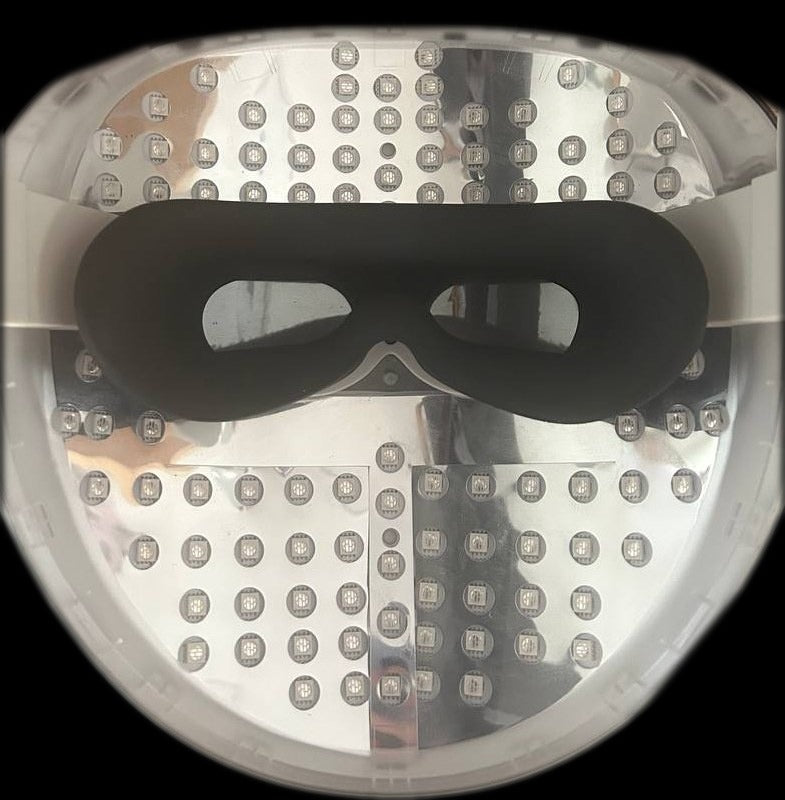
According to the guide, glasses and contact lenses must be removed before use, the built-in eye covering must not be removed, and you must not look into the LEDs. 1 Glasses don't fit under the rigid-frame mask anyway.
What happened with the Neutrogena mask in 2019?
According to Health Canada's notice, Johnson & Johnson GmbH voluntarily recalled the NEUTROGENA Light Therapy Acne Mask device and its activator on July 2, 2019, at the wholesale level, also covering the retail level for global logistics consistency, with a Type II hazard classification, and the notice's stated reason is just this: "Out of an abundance of caution". 16 The eyes or a photosensitising medication don't appear in the official text; whatever else circulates in the press beyond that, I couldn't confirm from an official source.
What does our own mask's guide say about this?
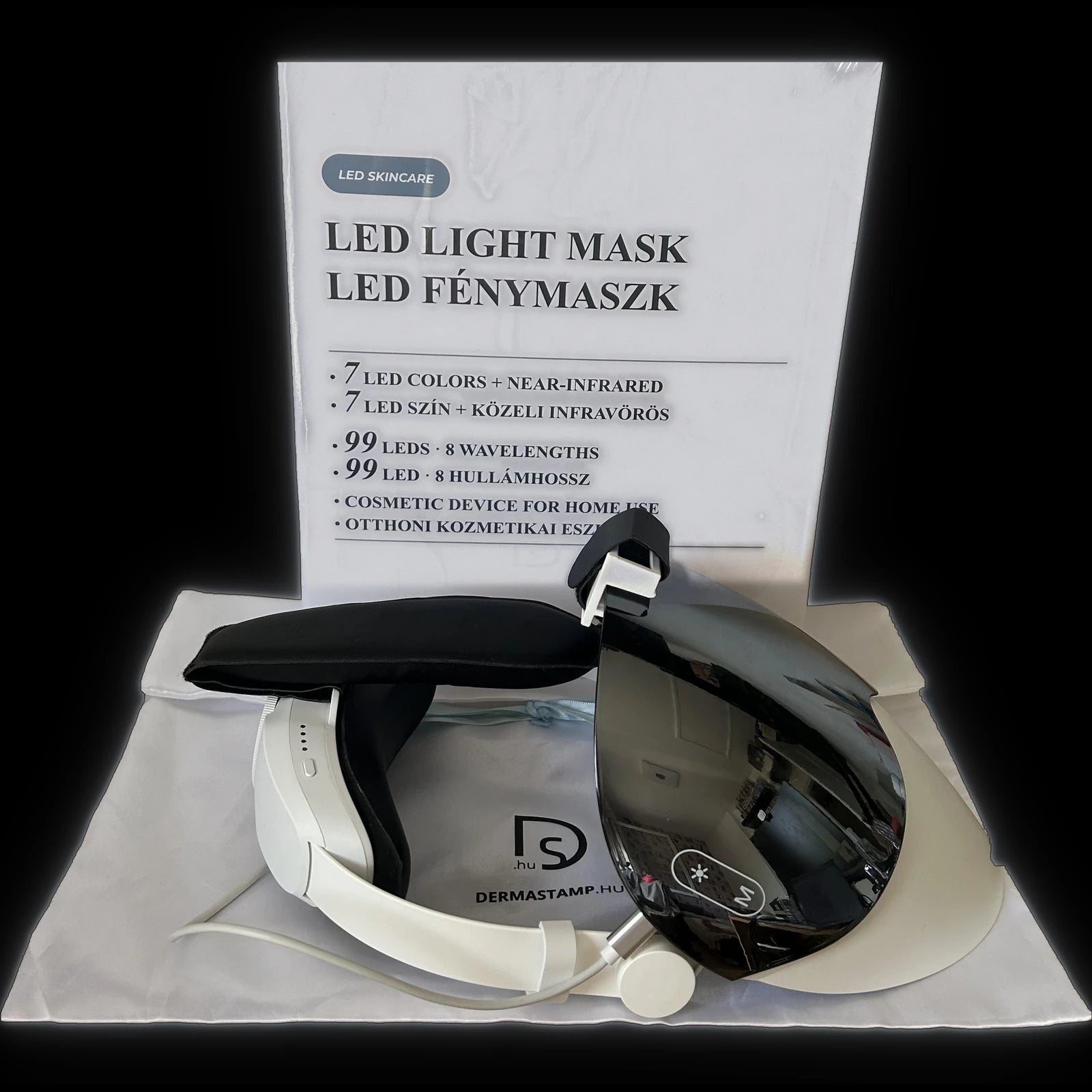
I tried eight masks before I started selling my own, and the user guides were where I saw the biggest difference: some didn't write a single line about who it's not for. For our mask, alongside the 12-page Hungarian guide, a short safety leaflet also comes in the box, in the local language, carrying the nine-item exclusion list above, the rule on the eyes (don't remove the built-in eye covering, don't look into the LEDs, take off glasses and contact lenses), and the timing: up to 10 minutes per session, 3 to 5 sessions a week, up to 30 minutes a day, and the device switches itself off after 30 minutes. 1 More isn't better, the guide states this in so many words. The short safety leaflet is available in all 23 languages from the QR code on the box and on the /pages/ifu page; the same page also has a longer, Hungarian-language guide text, with the three additional items above. Whether this matches the printed booklet in the box word for word, I can't confirm.
Whatever isn't on either the short leaflet's nine items or the online guide's full list (epilepsy, a pacemaker, a child age limit), this article states that there's no data for it. I sell the mask on dermastamp.hu, with the limitations on the product page too.

Sources
The sources are about photosensitising medications, visible light's pigment effect, the link between flickering light and seizures, the oncological safety of phototherapy, and two at-home acne studies; none of them were done with this mask, and our own guide is the claim ceiling.
- Dermastamp.hu LED mask (A097): printed user guide (12 pages) and the safety leaflet in the box, 2026.
- Hughes MC, Williams GM, Baker P, Green AC. Sunscreen and prevention of skin aging: a randomized trial. Annals of Internal Medicine, 2013. PMID 23732711.
- Di Bartolomeo L, Irrera N, Campo GM et al. Drug-Induced Photosensitivity: Clinical Types of Phototoxicity and Photoallergy and Pathogenetic Mechanisms. Frontiers in Allergy, 2022. PMID 36238932.
- Hofmann GA, Weber B. Drug-induced photosensitivity: culprit drugs, potential mechanisms and clinical consequences. Journal der Deutschen Dermatologischen Gesellschaft, 2021. PMID 33491908.
- Kowalska J, Rok J, Rzepka Z, Wrześniok D. Drug-Induced Photosensitivity: From Light and Chemistry to Biological Reactions and Clinical Symptoms. Pharmaceuticals, 2021. PMID 34451820.
- Serrage HJ, Eling CJ, Alves PU et al. Spectral characterization of a blue light-emitting micro-LED platform on skin-associated microbial chromophores. Biomedical Optics Express, 2024. PMID 38855662.
- Mahmoud BH, Ruvolo E, Hexsel CL et al. Impact of long-wavelength UVA and visible light on melanocompetent skin. Journal of Investigative Dermatology, 2010. PMID 20410914.
- Harding G, Wilkins AJ, Erba G, Barkley GL, Fisher RS; Epilepsy Foundation of America Working Group. Photic- and pattern-induced seizures: expert consensus of the Epilepsy Foundation of America Working Group. Epilepsia, 2005. PMID 16146438.
- Fisher RS, Harding G, Erba G, Barkley GL, Wilkins A; Epilepsy Foundation of America Working Group. Photic- and pattern-induced seizures: a review for the Epilepsy Foundation of America Working Group. Epilepsia, 2005. PMID 16146439.
- Fisher RS, Wilkins A, Takahashi Y et al; Epilepsy Foundation Working Group. Visually-provoked seizures: Consensus of the Epilepsy Foundation Working Group. Epilepsia, 2026;67:565–581. PMID 41283196.
- Ablon G. A 7-Week, Open-Label Study Evaluating the Efficacy and Safety of 415-nm/633-nm Phototherapy for Treating Mild-to-Moderate Acne in Adolescents and Adults. Journal of Clinical and Aesthetic Dermatology, 2025. PMID 41416031.
- ICNIRP. Guidelines on limits of exposure to incoherent visible and infrared radiation. Health Physics, 2013;105(1):74–96.
- Kim TG, Chung J, Han J, Jin KH, Shin JH, Moon SW. Photochemical Retinopathy Induced by Blue Light Emitted from a Light-Emitting Diode Face Mask. 2020. PMC7302677.
- Glass GE. Photobiomodulation: A Systematic Review of the Oncologic Safety of Low-Level Light Therapy for Aesthetic Skin Rejuvenation. Aesthetic Surgery Journal, 2023. PMID 36722207.
- Friedmann DP, Verma KK, Gidwani KA, Nguyen M, Gharibvand L. Comparing a Red and Blue Light-Emitting Diode Light Device With an Existing Blue Light Device for At-Home Treatment of Inflammatory Acne: An Open-Label Randomized-Controlled Trial. Dermatologic Surgery, 2026. PMID 41886698.
- Health Canada. NEUTROGENA Light Therapy Acne Mask, Light Therapy Acne Mask Activator: recall (2019-07-02). recalls-rappels.canada.ca, accessed 2026-08-31.