

After microneedling: what to put on your skin, and what not to
Microneedling aftercare, step by step: what to do that evening, what the next morning, and when retinoid, acids and vitamin C can come back. Where a number isn't backed by a measurement, we say so.
How long does the skin stay open?
After the puncture, tiny channels remain in the skin, and while they're open, whatever is on your skin can get in through them. The effect and the risk both come from the same open gateway.
You'll see two kinds of numbers. The difference mostly comes down to whether the skin was covered during the measurement. Measured with the same method (electrical impedance): on skin left uncovered, the barrier recovered within two hours, across every needle geometry tested. On covered (occluded) skin, it was much slower. In the same study, closure under occlusion took between 3 and 40 hours, and in another study where the skin was covered the whole time, group averages fell between 44 and 67 hours. So the two covered-skin measurements don't even agree with each other, meaning the literature hasn't settled this question. At-home use is closer to uncovered skin. An important limit: neither measurement was done on the face (they measured on the forearm and upper arm), with other devices.
In that same covered-skin study, closure time also varied by ethnic group: longest for Black participants, shortest for Asian participants. Makeup in principle covers the skin the same way and could keep the channels open, but there's no measurement for that. The detailed risk picture is on the Before you microneedle page.
For the timing after microneedling (when retinol, vitamin C, or makeup can come back), there's no threshold measured by a study. The sequence below is our protocol: nothing that evening, a simple routine from the next morning, then retinoid and vitamin C, and finally exfoliating acids. Retinoid and vitamin C: the user guide says 24 hours for retinoids, I wait 48 hours to be on the safe side. Acid exfoliants (AHA/BHA): at least one week, a published review recommends this. Every skin is different, find out what works for you.
Aftercare starts with what you puncture with.
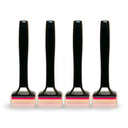
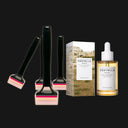
 See the Dermastamp
The first 24 hours
The first day after microneedling is when the skin is most vulnerable. Skip makeup, the pool, the sauna, tanning beds and strong sun for 24 hours. This is what the Dermastamp guide requires too.
Put nothing on it that evening. Don't rub it or wash it off, let it dry on its own. The logic is that the less goes onto fresh skin, the less can get in through the channels. Several case reports discuss cosmetics driven into the skin, including treatment with a home device.
The next morning, foaming cleanser, Centella serum, moisturiser, and finally SPF 50. From this day on, you need sunscreen every morning.
Makeup, the pool, sauna, tanning bed, strong sun.
Nothing. Don't rub it, don't wash it off, let it dry on its own.
Foaming cleanser, Centella serum, moisturiser, and finally SPF 50. From this day on, you need sunscreen every morning.
Retinoid and vitamin C: the user guide says 24 hours for retinoids, I wait 48 hours to be on the safe side. Acid exfoliants (AHA/BHA): at least one week, a published review recommends this. Every skin is different, find out what works for you.
Not on the treatment day. In the study, it was applied 24 hours after microneedling, with a 1.5 mm roller.
When can your routine come back? (day by day)
Timing beyond the first 24 hours is a caution practice: there's no study behind it that measures an exact hour. Retinoid and vitamin C: the user guide says 24 hours for retinoids, I wait 48 hours to be on the safe side. Acid exfoliants (AHA/BHA): at least one week, a published review recommends this. Every skin is different, find out what works for you. If a product causes a burning sensation or strong redness, give it a few more days.
That evening and the next morning
That evening: nothing. Don't rub it or wash it off, let it dry on its own.
The next morning: a foaming, gentle cleanser. A fragrance-free, gentle product; micellar water isn't enough here.
Centella serum. After cleansing. Well-known skin-calming ingredients (madecassoside, asiaticoside).
Moisturiser. Gentle and fragrance-free, for example with hyaluronic acid, panthenol or allantoin. Niacinamide only at a very low concentration.
SPF 50 sunscreen. Every morning from this morning on. Stamped skin is more sensitive to the sun, so in the days after treatment avoid the strong midday sun too.
Minoxidil on the scalp, from the day after. Not on the treatment day; in the study, it was applied 24 hours after microneedling. Details: minoxidil guide.
After 48 hours
Retinol and retinal. They can come back after 48 hours.
Vitamin C serum. After 48 hours. This is the one to be most cautious with: its acidic pH can irritate the skin, and in the granuloma case reports, vitamin C serum driven into the skin appeared most often.
AHA and BHA acids. Glycolic acid, salicylic acid and exfoliants: after at least one week, a published review recommends this.
The user guide says 24 hours for retinoids and doesn't mention vitamin C; to be on the safe side I wait 48 hours for both. Every skin is different, find out what works for you.
Makeup
Light makeup. After 24 hours. Makeup covers the skin, so in the first days a light, non-covering product is better.
Full-coverage foundation. Dense, full-coverage makeup seals the skin, so wait out the 48 hours with this one.
What to skip around the treatment
Fragrance and essential oils. Fragrance getting into the fresh channels can irritate. Skip them for 48 hours.
Alcohol-based toners. Denatured and isopropyl alcohol can dry out treated skin. Skip them for 48 hours. Alcohol is only needed for the stamp's needle head.
Pool, sauna, intense exercise. Chlorine, heat, sweat: no pool or sauna for 24 hours. It's worth skipping exercise on the treatment day.
Benzoyl peroxide. A strong, irritating active ingredient, leave it out for 48 hours.
Sun exposure and tanning beds. Skipped for the first 24 hours, and in the following days avoid the strong midday sun too. Sunlight also increases the chance of discolouration (hyperpigmentation), which can be more pronounced on darker skin. SPF 50 every morning from this morning on. Summer timing has its own chapter in the 1 mm guide.
Two things worth paying special attention to
Herpes. Reactivation of herpes simplex is among the documented complications of microneedling. Active herpes on the area to be treated is a contraindication, in that case you shouldn't stamp there. If it's recurring for you, it's worth discussing with a doctor before using it on that part of your face.
Discolouration (hyperpigmentation). Post-inflammatory discolouration is among the more lasting side effects of microneedling, and the safety review names darker skin as one of the factors that increase side-effect risk. The counterpoint matters too: microneedling is often highlighted precisely because, compared to treatments that vaporize the epidermis (ablative), the risk of discolouration is lower, since the epidermis stays intact. The safety review, however, lists discolouration among both the commonly reported transient reactions and the lasting side effects. Aftercare matters a lot here: sunlight and irritating active ingredients increase the chance of it.
"Where do I buy a sterile serum?"
Store-bought facial serums are preserved with preservatives and are not sterile. Sterile, injection-grade preparations can be bought at a pharmacy as infusion or ophthalmic products, and they aren't made for cosmetic use.
In practice, what matters is what you apply. Post-treatment skin calls for a short, fragrance-free ingredient list: hyaluronic acid, panthenol, centella. What's safe on the surface of your skin isn't necessarily safe inside it. A systematic review of granuloma after microneedling gathered 15 cases from the literature. According to the authors, it's rare, but the reported cases proved hard to treat. In the known case reports, the reaction appeared days or weeks after the treatment, so the connection isn't always obvious. What the authors raised in most cases: a motorized microneedling pen and a topically applied vitamin C serum. A skin patch test, though, wasn't performed in most of the cases, so this is a hypothesis, not a proven cause. There's no separate data for a manual stamp; cases of other types of serious skin complications have also been reported after treatment with a home device. The needle's metal (nickel) has also come up as a possible antigen, and metal allergy is listed as a separate risk factor in the safety review. Details on the risk page.
Pre-treatment hygiene matters at least as much as what you apply afterwards: clean, washed skin, and a disinfected device. With the Dermastamp, this concretely means rinsing the needle head with warm water, then disinfecting it with an agent that's 70% alcohol or higher for at least 60-120 seconds, and letting it dry completely. And after use, you don't clean it and reuse it: one treatment, one stamp. If you also use a freshly opened, fragrance-free product with a simple ingredient list, and you disinfected the stamp with 70% alcohol before use, that covers the essentials.
Frequently asked questions
What should I put on my skin right after microneedling?
Nothing. That evening, don't rub it or wash it off, let it dry on its own. The next morning, foaming cleanser, Centella serum, moisturiser, and finally SPF 50. No fragrance, alcohol, retinoids or vitamin C under any circumstances for 48 hours, and no exfoliating acids for at least a week.
When can I use retinol again after microneedling?
After 48 hours. The user guide says 24 hours for retinoids, I wait 48 hours to be on the safe side. Every skin is different, find out what works for you.
When can vitamin C serum come back?
After 48 hours. Vitamin C serum driven into the skin appeared most often in the granuloma case reports. This is a hypothesis, not a proven cause, but it's enough reason not to apply it right after the treatment under any circumstances. Every skin is different, find out what works for you. The user guide doesn't mention vitamin C; I wait 48 hours.
When can I wear makeup again?
After 24 hours. In the first days light makeup is better, and with dense, full-coverage foundation, wait out the 48 hours.
Can I go to the sauna, the pool, or exercise afterwards?
Chlorine, heat, and sweat all put strain on the fresh channels, so no pool or sauna for 24 hours. Skip intense exercise on the treatment day.
When can I wash my face after the treatment?
That evening, don't wash it off, let it dry on its own. The next morning, wash your face with a gentle, fragrance-free foaming cleanser.
How long is redness normal?
Transient redness is among the most commonly reported reactions. According to the safety review, these transient effects can last up to a week and resolve on their own. According to the review comparing devices, redness was actually most pronounced with stamp-type devices. What doesn't belong here: strong pain or burning, persistent bleeding, spreading swelling. If you see increasing pain, pus, or fever, that's a medical matter.
Can I sunbathe after microneedling?
Tanning beds and strong sun are skipped for the first 24 hours, and in the following days avoid the strong midday sun too. From the next morning, SPF 50 every morning.
When can minoxidil go on the scalp?
Not on the treatment day. In the study most often cited, minoxidil was applied 24 hours after microneedling. Details of the scalp protocol are in the minoxidil guide and on the hair loss page.
Do I even need to apply anything afterwards?
Nothing that evening. From the next morning you need sunscreen, SPF 50 every morning. The Centella serum and the moisturiser are not required, but I recommend this gentle routine.
Sources
These references cover the safety profile of microneedling, skin closure, and minoxidil timing, typically from studies done with clinical devices. No separate study has been done with the 1 mm Dermastamp; we're referencing the mechanism. This is information, not medical advice.
- Granulomatous Reactions From Microneedling: A Systematic Review of the Literature. Dermatol Surg. · 13 studies, 15 patients; in most cases, the authors raised a motorized microneedling pen and topically applied vitamin C, though a skin patch test was rarely performed. The conclusion: rare, but can be hard to treat.
- StatPearls, Microneedling · among the complications: reactivation of herpes simplex; active herpes on the area to be treated is a contraindication. Also from the same source: the epidermis stays intact, so the risk of discolouration is lower than with treatments that vaporize the epidermis (ablative).
- Chu S, Foulad DP, Atanaskova Mesinkovska N. Safety Profile for Microneedling: A Systematic Review. Dermatol Surg. 2021. PMID 34448760 · the safety profile of microneedling: transient redness is among the most commonly reported reactions.
- Dhurat R, Sukesh M, Avhad G, et al. A randomized evaluator blinded study of effect of microneedling in androgenetic alopecia. Int J Trichology. 2013. PMID 23960389 · minoxidil was applied 24 hours after microneedling, with a clinical roller, on the scalp.
- Physiological Mechanisms and Therapeutic Applications of Microneedling: A Narrative Review. Cureus. 2025. PMC PMC11993440 · the physiological background of the repair response (the post-puncture signaling phase, followed by new collagen formation), and a comparison of devices: redness was most pronounced with stamp-type devices.
- Gupta J, Gill HS, Andrews SN, Prausnitz MR. Kinetics of skin resealing after insertion of microneedles in human subjects. J Control Release. 2011. PMID 21640148 · on uncovered skin, every needle geometry tested regained barrier function within 2 hours; under occlusion, however, between 3 and 40 hours, depending on needle geometry.
- Ogunjimi AT, Carr J, Lawson C, et al. Micropore closure time is longer following microneedle application to skin of color. Sci Rep. 2020. PMC PMC7609754 · group averages between 44 and 67 hours by ethnic group, measured under occlusive covering throughout.
- The 24-hour window in this article (makeup, pool, sauna, tanning bed, intense sun exposure, acid exfoliants, retinoids) and the disinfection steps come, word for word, from the official Dermastamp usage guide. There's no threshold measured by a study for the timing beyond that (reintroducing retinol, vitamin C, makeup); these are caution practices. The conflicting measurements on microchannel closure and a detailed discussion of the granuloma cases are on the Before you microneedle page.