

Microneedling for eyebrows: what it can do, what it can't, and how to do it safely near your eyes.
Many people try microneedling for thinning, patchy eyebrows. The needle stimulates the environment around the follicle. Here's how it works, how to do it carefully near your eyes, who it's not for, and what to realistically expect.
Does eyebrow hair grow back from microneedling?
The short answer: if the follicle is still alive, it may help. Microneedling opens tiny, controlled microchannels in the skin, which triggers the skin's own repair response and stimulates the environment around the follicle, meaning local blood flow and growth factors. Cureus 2025
If the follicle is still alive, just weakened or thinned, stimulating this environment can contribute to the hair growing back stronger. Where the follicle has already died or there's scar tissue in its place, microneedling won't implant new hair either. That's why it matters to know why your eyebrows thinned.
How does it affect the eyebrows?
The needle creates tiny injuries, which may switch on the skin's repair response: new collagen, growth factors, more active local blood supply. Cureus 2025 For hair, the needle targets the environment of the follicle: the micro-environment that feeds hair growth. If this environment is more active, a living follicle in theory gets better conditions.
The microchannels reach the upper layers of the skin and stimulate the area around the follicle. The needle stimulates the environment where a living follicle works.
The cited studies measured microneedling on the scalp, with a clinical device and a longer needle. Dhurat 2013 There's specifically little good-quality data on eyebrows, so here I start from the mechanism measured on the scalp.
Why do eyebrows thin out?
What matters is what's causing the thinning, because that determines whether microneedling makes sense:
- Over-plucking, over-waxing: years of repeated plucking can damage the follicle, which can scar over time, and then the hair can stop growing back permanently.
- Age and hormonal changes: hair can thin and become sparser over time.
- Thyroid problems: thinning of the outer third of the eyebrow can be a known sign, worth having checked by a doctor.
- Patchy hair loss (alopecia areata): can appear suddenly in round patches.
- Hair loss after severe stress or illness: hair can temporarily thin out.
- Microblading, tattooing, or injury to the area: scarring can permanently damage the follicle.
If the thinning is sudden, patchy, or on the outer third of the eyebrow, it's worth having a doctor investigate, since there could be an internal cause behind it. Microneedling can be considered for weakened but living follicles, not for hair loss tied to scarring or an internal condition.
The eyebrow is a thin-skinned area near the eye, so light pressure and a perpendicular motion matter here.
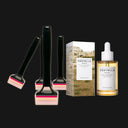
 See the Dermastamp
Technique near the eyes
The eyebrow is right next to the eye, and the skin here is thin and sensitive. The safe area is the eyebrow line, above the brow bone; the eyelid and the immediate area around the eye is off-limits.
Step by step:
- Before: wash your hands with soap. Wash the eyebrows and the area around them with a gentle foaming cleanser, with no makeup, and let it dry completely.
- The device: open it right before use, and don't touch the needles. Rinse the needle head with warm water, then disinfect it with 70% or stronger alcohol for 60–120 seconds, and wait until it is completely dry.
- Stamping: work along the eyebrow line, above the brow bone, never on the eyelid and never right next to the eye. Place the stamp perpendicular to the skin, press down gently, and lift. You don't drag it, you just press. 4–6 times per section, each time a little further along.
- That evening: don't rub it or wash it off, let it dry on its own, and don't put anything on it.
- The next morning: foaming cleanser, Centella serum, moisturiser, and finally SPF 50.
- Disposal: one stamp, one session. Put it back in its case, throw it away, closed, with your household waste, and don't lend it to anyone.
The sensation is more of a sting or prickle, and according to accounts it's typically well tolerated, but the eyebrow area can be more sensitive than the rest of the face. Mild redness and tiny pinpoint bleeding are normal. If it hurts a lot, ease off the pressure.
Which needle, which depth?
It's tempting to assume a deeper needle achieves more. The research says otherwise: according to a pooled analysis of 12 studies (631 people), needle depth (1 mm or less vs. over 1 mm) didn't meaningfully affect the hair outcome. Arch Dermatol Res 2025 In the scalp studies, the deeper needle didn't add anything extra; these were done with clinical devices.
By purpose, the literature roughly divides like this: wrinkles and ageing 0.5–1 mm; scars 1.5–2 mm (these are deeper, clinical treatments). Singh 2016
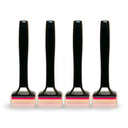
The Dermastamp is fixed at 1.0 mm, it can't be adjusted, so you can't accidentally go deeper. On the thin-skinned eyebrow area, near the eyes, what matters is light pressure and a perpendicular motion. The difference between a roller and a stamp is covered in a separate article: dermastamp or dermaroller.
Minoxidil for eyebrows?
Minoxidil is used for scalp hair loss; using it on the eyebrows falls outside the official indication (off-label), and the evidence is weaker than for the scalp. Suchonwanit 2019 Near the eyes the facial skin is more sensitive, and the product can also cause unwanted hair growth or eye irritation if it migrates towards the eyelid. If you'd want to try it, it's worth discussing with a doctor first.
I've written separately about minoxidil's effect, forms, and side effects: minoxidil guide.
How long until you see results?
Hair growth is a slow process, and eyebrows are no different. If there's a result, it typically shows up over months, and for some people it doesn't bring a meaningful change.
You're in a better position today than you will be tomorrow. A follicle that's still alive, just weakened, still has something to work with; a long-empty, scarred area doesn't anymore. Whether to continue is your call, based on the effect you see.
Frequency and aftercare
On the face, including the eyebrows, one session every 2–3 weeks, for at least 4–6 treatments, so the skin can fully heal between sessions. The dermastamp is single-use: every treatment gets a new, disinfected stamp. More frequent repetition doesn't speed up the result, it just risks irritating the skin.
That evening, don't rub it or wash it off, let it dry on its own, and don't put anything on it. The next morning, foaming cleanser, Centella serum, moisturiser, and finally SPF 50; sunscreen is needed every morning from this day on. For 24 hours, avoid makeup on the area, swimming pools, saunas, tanning beds and strong sun. Retinoid and vitamin C: the user guide says 24 hours for retinoids, I wait 48 hours to be on the safe side. Acid exfoliants (AHA/BHA): at least one week, a published review recommends this. Every skin is different, find out what works for you. The full pre- and aftercare list: risks and things to know.
Who is it NOT for?
There are cases when microneedling the eyebrows isn't recommended, and it's better to see a dermatologist instead:
- Active, inflamed acne, herpes, or an open wound in the area (the needle can spread the infection). Chu 2021
- Rosacea, eczema, active skin inflammation around the eyebrow.
- If you're prone to keloids (overgrown scars).
- During or shortly after an isotretinoin (Accutane) course.
- If the eyebrow has thinned suddenly, in patches, or on the outer third: clarify the cause with a doctor first.
On the eyebrows, microneedling can stimulate the environment of a weakened but still living follicle. If you go ahead, what matters most near the eyes is caution: light pressure, perpendicular motion, a disinfected device, and staying clear of the eyelid. Where an internal cause or scarring is behind the thinning, a dermatologist is the right direction.
If you're new to microneedling, read this first: the basics of microneedling. The method with all its documented risks and contraindications: risks and things to know.
Frequently asked questions
Does eyebrow hair really grow back from microneedling?
If the follicle is still alive, just weakened, microneedling can contribute to the hair growing back stronger by stimulating its environment. Where it's already scarred or dead, there's nothing left to stimulate. The mechanism was measured on the scalp. Dhurat 2013
Does microneedling hurt on the eyebrows?
The sensation is more of a sting or prickle, and according to accounts it's typically well tolerated, but the eyebrow area can be more sensitive than the rest of the face. Mild redness and tiny pinpoint bleeding are normal. If it hurts a lot, ease off the pressure.
What needle and what depth are right for the eyebrows?
The Dermastamp is fixed at 1.0 mm, it can't be adjusted, so you can't accidentally go deeper. Near the eyes, what matters is light pressure and a perpendicular motion; in a pooled analysis of scalp studies, a deeper needle didn't give a better hair outcome. Arch Dermatol Res 2025
Can I use minoxidil on my eyebrows?
Using it on the eyebrows falls outside the official indication, and the evidence is weaker than for the scalp. Suchonwanit 2019 Near the eyes it can also cause unwanted hair growth or eye irritation. If you're curious, I've written about this in detail in the minoxidil guide, and it's worth discussing trying it with a doctor.
Does castor oil grow your eyebrows?
There's no good-quality evidence that castor oil makes eyebrows denser or thicker. While it can nourish, condition, and make existing hair look fuller, that doesn't mean it grows a new follicle. Use it carefully near the eyes, since it can irritate, and keep it out of your eyes.
How long until something shows?
Hair growth is slow: if there's a result, it typically shows up over months. A living follicle still has something to work with; a long-empty, scarred area doesn't anymore.
Can I combine it with eyebrow tinting, HD brows, or threading?
Don't microneedle on freshly tinted, waxed, or irritated skin, and don't apply dye to freshly needled skin either. Keep the days separate: tinting, HD brows, and threading should happen on intact skin, microneedling on a different day, once the skin has calmed down. After needling, wait until the skin has recovered before tinting it.
Will over-plucked or worn-out eyebrows grow back?
It depends on what happened to the follicle. If it's just weakened, it can strengthen over time with patience, and stimulating the environment can contribute to that. But if it was repeatedly plucked for years, the follicle can scar or die, and then there's nothing left to stimulate. If you're not sure, a dermatologist can check whether the follicle is still alive.
How often should I do it?
On the face, including the eyebrows, one session every 2–3 weeks, for at least 4–6 treatments, so the skin can fully heal between sessions. The stamp is single-use, every treatment gets a new, disinfected head. More frequent repetition doesn't speed up the result, it just risks irritating the skin.
Can I use it on the eyelid or under the eye?
No. The eyelid and the immediate area around the eye are off-limits: the skin there is very thin, and eye injury is a serious risk. Stay on the eyebrow line, above the brow bone.
Do growth serums work on eyebrows?
Serum formulations vary a lot. Some contain peptides or caffeine; the evidence for these is mixed and rather weak. The most well-established active ingredient is prescription-only for eyelashes, and a matter for a doctor. For drugstore growth serums, a realistic expectation is that they nourish and condition the hair, but they're not a miracle.
What should I do after the treatment?
That evening, don't rub it or wash it off, let it dry on its own, and don't put anything on it. The next morning, foaming cleanser, Centella serum, moisturiser, and finally SPF 50; sunscreen is needed every morning from this day on. For 24 hours, avoid makeup on the area, swimming pools, saunas, tanning beds and strong sun. Retinoid and vitamin C: the user guide says 24 hours for retinoids, I wait 48 hours to be on the safe side. Acid exfoliants (AHA/BHA): at least one week, a published review recommends this. Every skin is different, find out what works for you. Full list: risks and things to know.
Sources
These studies measured the mechanism of microneedling and minoxidil, typically with a clinical device, a longer needle, and on the scalp. There's specifically little good-quality data on eyebrows.
- Chu S, Foulad DP, Atanaskova Mesinkovska N. Safety Profile for Microneedling: A Systematic Review. Dermatol Surg. 2021. PMID 34448760 · the documented risks of microneedling and the basis for safe technique.
- Physiological Mechanisms and Therapeutic Applications of Microneedling: A Narrative Review. Cureus. 2025. PMC PMC11993440 · the mechanism of microneedling: repair response, growth factors, local blood flow.
- Dhurat R, Sukesh M, Avhad G, et al. A Randomized Evaluator Blinded Study of Effect of Microneedling in Androgenetic Alopecia. Int J Trichology. 2013. PMID 23960389 · microneedling + minoxidil vs. minoxidil alone, with a clinical roller, on the scalp (not eyebrows, not our device).
- Needle-depth meta-analysis: 12 studies / 631 people; depth (1 mm or less vs. over 1 mm) didn't meaningfully affect the hair outcome. PMC PMC11890238 (2025).
- Singh A, Yadav S. Microneedling: Advances and widening horizons. Needle length by purpose. PMC PMC4976400.
- Patel P, Nessel TA, Kumar DD. Minoxidil. StatPearls. 2023. PMID 29494000 · the mechanism of minoxidil and the framework for off-label use.
- Suchonwanit P, Thammarucha S, Leerunyakul K. Minoxidil and its use in hair disorders: a review. Drug Des Devel Ther. 2019. PMID 31496654 · the official indications for topical minoxidil and off-label use, including the eyebrows.