
 Written by MarciFounder of dermastamp.hu, cosmetology student. I've been microneedling for my hair loss for 4 years, and for acne scars and wrinkles for 1 year.
The full picture on microneedling
Summer use
Microneedling isn't off-limits in summer, it just needs timing: because of the fresh microchannels, skin is more sensitive to sun in the days after treatment, and under UV it's more prone to brownish post-inflammatory patching (hyperpigmentation).
- No sunbathing or tanning beds in the first 24 hours. The Dermastamp instructions for use require this too. After the first day, still allow at least three more days before intense sunbathing.
- Actively avoid the sun in the days after treatment. It's not just the beach that counts: time spent in strong midday sun does too. Shade, a cap or a brimmed hat for the treated area, and for the scalp in any case.
- Time it so your skin gets no strong sun for a few days afterwards. The best is the evening, before bed: skin heals overnight, without sun. Don't plan a treatment for the days before a beach trip or an all-day outdoor program.
- Sunscreen in the days after treatment: physical first, then chemical. In the first two days, if you have to go into the sun, a mineral (physical-filter: zinc oxide or titanium dioxide) sunscreen belongs on the skin; chemical-filter sunscreen can come back from day three. After that, high-factor (SPF 50), reapplied daily, even if you're not going sunbathing directly.
- Don't stamp on a fresh sunburn or a fresh tan. Wait until your skin has fully settled: no redness, peeling, or sensitivity.
Clinical studies describe risks alongside the benefits. These are tied to the type of device, any active ingredients delivered into the skin, and how carefully you use it.
On this page I go through each one, with sources, so you can decide with the facts in hand.
The serious cases share a recurring pattern.
I read through the serious cases in the literature. Most of them involve at least one of the following:
- A roller or motorized pen, not a hand stamp. Tram-track scarring is a mark of the rolling motion itself: a rotating roller drags the skin, while a stamp punctures straight down, it doesn't drag. The review covering 70 studies measures the same thing: tram-track scarring and hyperpigmentation were more pronounced with the roller. Cureus 2025 Most of the 15 collected granuloma cases involved a motorized pen. Friedmann 2025 The reported viral infection from a home device was also a roller.
- Too much pressure, typically over bony areas. The authors of the detailed scarring case attributed it specifically to this.
- An active ingredient delivered into the skin, most often vitamin C serum. This is a common element in most of the granuloma cases.
- A radiofrequency (heat) device. The FDA complaint database describes burns and fat loss with radiofrequency microneedling machines, consequences of the heat energy.
That's why a hand stamp, why 1 mm, and why I don't go any deeper.
No motor. No heat. No dragging roller motion, you press straight down and release. The needle length is fixed at 1 mm: you can't "accidentally" go deeper, because there's nowhere to go. And I don't add any active ingredient.
So out of the four points above, the device itself removes three, and the fourth is on you, by not pressing in with force. This is how the recurring pattern of documented harm can be avoided.
For home use, in untrained hands, this is the most controllable, hardest-to-get-wrong form: no motor, no rotation, one press and one lift, you're in control the whole time.
The pattern isn't universal.
There is one published granuloma case where none of the four factors above were recorded: the patient denied using any product, and nothing was written about the device either. In other words, "in most cases", not "always".
- The fact that I found no documented serious case with a hand-held 1 mm stamp doesn't mean one doesn't exist. Fewer people use it, less gets published about it, reporting bias is real.
- The same review of 70 studies that attributed the scarring and hyperpigmentation to the roller also states that erythema was strongest with the stamp. Cureus 2025 Not serious, temporary, but it's there.
- According to one large pooled analysis, there is no strong evidence for any device type reducing the risk of erythema or hyperpigmentation.
The pattern of documented harm can be avoided, and the device is designed to help avoid it. This isn't a guarantee. It's the best possible starting point.
1
What it actually does
Controlled micro-injury
The needle deliberately injures the skin, with many tiny, separate punctures. The key word is "separate": intact skin remains between the punctures, and regeneration starts from there. This is why it heals without scarring, and why collagen production is triggered.
And what if no intact skin remains between them?
Then it scars. A single, deep, continuous injury has nowhere to regenerate from, so the body fills it with scar tissue. Microneedling doesn't cross that line, as long as the pressure and needle length stay where they should. In the detailed scarring case, the scars appeared over bony areas, with a roller (a roller, not a hand stamp), after two sessions, and the authors attributed it to excessive pressure.
That's why my guide states it in black and white: don't use strong pressure or a sideways motion, it won't be more effective, but it can cause injury.
The microchannels support local microcirculation, and can help topically applied products absorb better. And the wound-healing response may trigger collagen production, that's what microneedling research is about.
There is research behind the mechanism. There is none behind my device. It doesn't cure anything, and I don't know if it will work for you.
2
Where the needle reaches, and what 1 mm means
1 mm: which skin layer it reaches
On the face, the top skin layer (epidermis) is only 0.03–0.06 mm thick, beneath it the dermis is 0.76–1.97 mm. A 1 mm needle therefore easily passes through the surface, and works in the dermis, where the collagen is.
Actual penetration is less than the nominal length
Skin is elastic: the needle pushes it in rather than piercing straight through. According to the literature, the biological effect of a 1.5 mm needle reaches about 0.6 mm deep, and even a 2 mm roller only reaches the upper band of the dermis. The actual depth is decided by pressure, angle, and skin tension, not the nominal length. That's why controlling the pressure, not the force, is what matters.
PROHIBITED on the eyelid and the thin skin around the eyes.
My guide states it literally: don't use it on the eyelid, the very thin skin around the eyes, mucous membranes, mouth, or nostrils. There's an anatomical reason too: at the upper eyelid the dermis is only 0.76 mm. That's the thinnest spot on the whole face.
If you read anywhere that a 1 mm device can "treat crow's feet", that contradicts the product's own documentation.
1 mm isn't an extreme needle length.
For wrinkle and aging indications, the literature recommends the 0.5–1.0 mm range, with 1 mm at its upper edge. For comparison: the established range for scar treatment is 1.5–2 mm.
There's no evidence that deeper is better, but there's none that it isn't, either.
The most relevant data comes from a hair loss analysis (12 randomized trials, 631 people, on the scalp, given ALONGSIDE minoxidil): it found no difference in hair count between needle depths of 1 mm or shorter and longer ones. No such comparison exists for the face or wrinkles.
"Found no difference" isn't the same as "there is no difference". For me, that's reason enough not to go above 1 mm, because there's no evidence for the benefit, but there is for the risk.
In the literature, 1 mm is an in-office needle length.
The literature's "home use" category is a very short needle: the cited review states under 0.15 mm. Stores typically sell somewhat longer needles for home use, but even those are much shorter than mine.
Either way: my 1 mm is longer than both, and the literature lists it as an in-office needle length. A clinical needle length, in your own hand.
Whether 1 mm at home is riskier than a shorter needle, I DON'T KNOW.
No one has compared it to half-millimeter needles. There's no study either for or against it. What we do know: after a longer needle, the skin closes more slowly. Anyone who claims more than that, a percentage, for instance, is making it up.
3
What happens afterward
The life of a microchannel
After puncturing, open channels remain, through which anything on your skin can get in. These gradually close, and then over weeks to months new collagen is built. The benefit and the risk come from the same open gate.
How long do they stay open? I don't know exactly.
Here the literature contradicts itself. One human measurement found the skin's barrier recovers within 2 hours; another found the micropores detectable for 44–66 hours. The two measurements used different methods and different needles, and it isn't settled which one holds.
What we do know for certain: it closes more slowly after a longer needle, it takes longer on darker skin, and covering the skin (makeup, occlusion) keeps it open.
That's why my guide instructs you to avoid makeup, the pool, sauna, tanning beds, intense sun exposure, strong acid-exfoliating cosmetics, and retinoids for 24 hours after treatment. With retinoids our own caution practice is longer than that: 72 hours, and on sensitive or discoloration-prone skin, between day five and day seven. And no one can tell you that "after 3 hours you can put anything on it".
What's normal afterward, and what isn't
What's NORMAL (according to my guide), and usually resolves within a few hours to days:
- mild redness
- tiny pinpoint bleeding
- mild swelling, sensitivity
- dryness, flaking
- mild itching
What's NOT normal, stop immediately if you see this:
- severe pain or a burning sensation
- significant or persistent bleeding
- spreading swelling
If you see signs of infection, increasing pain, pus, fever, see a doctor.
4
Who it isn't for
SELF-CHECK
Does any of this apply to you?
Check off whatever applies to you. The list is based on my guide's official list of contraindications, supplemented with the literature.
In the end I might also say: this isn't for you right now. I accept that, because it's honest.
This checklist isn't a medical exam, and doesn't replace one. If you're unsure, ask a dermatologist.
5
Where and how NOT to use it
Eyelid, thin skin around the eyes, mucous membranes, mouth, nostrils, genitals.
It is prohibited to use it on these areas. No "carefully", no "just a little".
With strong pressure or a sideways, dragging motion.
My guide, word for word: "it won't be more effective, but it can cause injury". Press straight down and release, 4–6x per section. Don't drag, don't push.
If any needle is bent, crooked, damaged, or rusty, or the packaging is damaged.
In that case, the stamp can't be used. Message me, and I'll send you another one.
With a product that wasn't made for this.
There's a separate section on this below.
6
What can go wrong
Granuloma: when something that doesn't belong ends up in the skin
The immune system recognizes whatever got deep into the skin as a foreign object, and responds with nodular inflammation.
Rare, but genuinely documented: a systematic review collected 15 cases from the world literature.
- In most of them, vitamin C serum was delivered into the skin.
- In most of them, a motorized microneedling pen was used, not a hand stamp.
- In a study describing three women, two of them had patch-test-confirmed hypersensitivity to vitamin C serum.
- In one case, a home device plus vitamin E oil resulted in a necrotic ulcer.
- According to the literature, it can be treatment-resistant.
Granuloma can also occur without any serum. In one published case, the patient denied applying anything to their skin, the authors suggested the needle's metal or a particle could also have triggered it. A smaller chance, but not zero.
Don't deliver anything into the skin that wasn't designed for it. A serum that is perfectly safe on the skin's surface can become a foreign object deep in the skin, the preservative, the fragrance, the pigment, the stabilizer. Cosmetics are tested on the skin, not into it. Microneedling invalidates that test. My guide states the same: don't use it with a product that the manufacturer or a healthcare professional hasn't recommended.
15 cases collected: Friedmann DP et al., Dermatol Surg 2025 (PMID 39584690) · patch-test confirmed in two of 3 women: Soltani-Arabshahi R et al., JAMA Dermatol 2014 (PMID 24258303) · necrotic ulcer with a home device: Cutis 2025 (PMID 41363966) · serum-free granuloma: Turk CB et al., JAAD Case Rep 2026 (PMC13094480)
Scarring: it can happen. Look at what causes it.
The so-called "tram-track" scarring: regular, linear scars that trace out the roller's path on the skin.
This type of scarring comes from the rolling motion. As the roller rotates, the needle enters at an angle and exits at an angle, dragging the skin along the way. The regular, linear mark traces the roller's path. The stamp punctures straight down and lifts straight up, it doesn't drag. So practically speaking, tram-track scarring is something a roller can cause, not a stamp.
- The literature points the same way: according to the review covering 70 studies, tram-track scarring was more pronounced with the roller, not the stamp.
- Scarring can still occur regardless. The detailed case was also a scar, with a roller, after two sessions, on bony areas of the face, which the authors attributed to excessive pressure. Strong pressure over bony areas is a risk with a stamp too.
- There's no measured frequency number anywhere in the literature. The review covering 85 publications lists it among the persistent, serious side effects. Anyone who gives you a percentage is making it up.
- In exchange, erythema was strongest with the stamp in that same review. Temporary and mild, but present.
Less pressure, especially over bony areas. Don't force it in, my guide states that strong pressure isn't more effective, but it can cause injury. And don't go above 1 mm: there's no evidence that deeper would be better, but there is evidence for the risk of a deeper needle.
Chu S et al., Safety Profile for Microneedling: A Systematic Review, Dermatol Surg 2021 (PMID 34448760) · the roller-vs-stamp side-effect profile: review covering 70 studies, Cureus 2025 (PMC11993440 / PMID 40225445), "tram-tracking and post-inflammatory hyperpigmentation were more significant with the roller", and "erythema was found to be statistically significant with the stamp modality"
Hyperpigmentation (dark spots)
Inflammation can trigger melanin production, and darker spots can remain.
A real risk, and higher for darker skin types. Two data points are available, and both point the same way.
One: according to the review covering 70 studies, hyperpigmentation was more pronounced with the roller, not the stamp.
Two: in one randomized trial, hyperpigmentation appeared in 13.6% of the laser group, versus none in the microneedling group. In that trial, microneedling was done with a 2 mm clinical roller, in other words a more aggressive device than my 1 mm hand stamp. If even that didn't cause hyperpigmentation, that's reassuring rather than the opposite.
But that's an inference, not a measurement. No one has measured it with my device. And according to one large pooled analysis, there is no strong evidence for any device type reducing the risk of hyperpigmentation. Not zero: it has occurred after microneedling in other studies too.
Sun protection after treatment, my guide prohibits tanning beds and intense sun exposure for 24 hours. A more cautious start for darker skin types. If you've had post-inflammatory hyperpigmentation before, this applies to you even more.
Chu S et al., Dermatol Surg 2021 (PMID 34448760) · roller-vs-stamp: Cureus 2025 (PMC11993440) · the hyperpigmentation rate is from the Cachafeiro randomized trial (46 participants), cited by: Iriarte C et al., Clin Cosmet Investig Dermatol 2017 (PMC5556180)
Infection
Whatever is on your skin (or on the device) can enter through the open microchannels.
Documented. The most relevant published case involved exactly a home roller: the woman ran the same device over an infected area, then over her intact facial skin.
Wash your hands, clean skin, and disinfect the stamp before use (more on this below). And never, under any circumstances, share the device with anyone.
Temporary reactions: expected, not mistakes
Redness, mild swelling, pinpoint bleeding, sensitivity, dryness and flaking, mild itching.
This is the most common. My guide states the same: these usually resolve within a few hours to days.
No need to avoid it, it's part of the process itself. But if it lasts longer than a week, or a painful, pus-filled, spreading lesion appears, see a doctor.
Chu S et al., Dermatol Surg 2021 (PMID 34448760) · the product's official instructions for use
7
What you can put on it, and what you never should
What's safe on your skin isn't safe in it
Cosmetics are tested for whether they're safe on the surface of the skin. Microneedling carries them across the skin barrier, which invalidates that test. The vast majority of serums sold in stores have never been tested when delivered into the skin.
What we specifically know, and what we don't
- ✕ Vitamin C serum: the best-documented harm. This was the trigger in most of the 15 collected granuloma cases. In a study describing three women, two had patch-test-confirmed hypersensitivity.
- ✕ Vitamin E oil, essential oils: there's a documented case for vitamin E oil (necrotic ulcer, with a home device). There's no specific microneedling case for essential oils, but they're among the most common contact allergens in dermatology. That's logic, not a case.
- ✕ Retinoids, strong acid-exfoliating cosmetics: my guide prohibits them for 24 hours after treatment. The literature says one week for exfoliants, we follow the stricter rule. With retinoids our own caution practice is 72 hours, and on sensitive or discoloration-prone skin, between day five and day seven.
- ~ Niacinamide, hyaluronic acid, and most serums: zero data with microneedling. We can't say it's safe, and we can't say it's dangerous.
The rule: during and immediately after microneedling, don't put anything into the skin that wasn't specifically made for it.
8
Sterility: what "non-sterile" means
The Dermastamp is NOT sterile. Our official declaration states this too.
The EU-MDR declaration of conformity states, word for word: "Supplied non-sterile", meaning shipped in a non-sterile state. My guide says the same: "in non-sterile packaging". The device is declared this way, and the declaration of conformity says the same.
But it does go through a high-energy electron-beam (e-beam) irradiation.
During manufacturing, the product receives e-beam treatment. According to the certificate, the required dose was at least 8 kGy, the measured value was 8.11 kGy. This is an extra hygiene step in manufacturing, NOT sterile status.
The certificate is literally called "Certificate of Irradiation". Not a sterilization certificate.
Disinfection is YOUR responsibility. It's not optional.
According to my guide, in order:
- wash your hands, cleanse the skin
- open the packaging right before use
- rinse the needle head with warm water
- disinfect with 70% (or higher) alcohol, for at least 60–120 seconds
- let it dry completely
Don't touch the needles with your hands, and don't set it down on a contaminated surface.
One treatment, one person. Then you throw it away.
My guide, word for word: one Dermastamp can be used for one treatment session, on one person only. Afterward, don't try to clean or disinfect it, don't reuse it.
- A new treatment on the same area of skin at the earliest after 7–14 days, and with a new stamp.
- Anyone who says "disinfect it and it's good to go again" is contradicting the product's official documentation.
- Never share it with anyone, the literature openly calls the transmission of bloodborne pathogens via a shared device an unanswered question.
9
The device's paperwork, and what it doesn't prove
It's on the market as a medical device, with an EU representative.
EU-MDR 2017/745, Class I (Rule 1). The manufacturer holds an ISO 13485:2016 quality management certificate. EU authorized representative: Riomavix S.L. (Madrid). Model: OB-MN80. UDI: 06976567878014.
Through the representative, the Spanish medicines and medical device agency (AEMPS) has registered the device. There's a manufacturer, there's an EU-based responsible party, and there's a record with a member-state authority.
The device is listed in EUDAMED, and so am I.
EUDAMED is the European Commission's central medical device database. Manufacturers, representatives, and importers are entered here through official channels.
- The device is listed under its own identifier: UDI-DI 06976567878014, Basic UDI-DI 697656787OBM23, model OB-MN80.
- The manufacturer's registration number: CN-MF-000050259.
- The EU representative (Riomavix S.L., Madrid): ES-AR-000001202.
- I myself am registered as the importer: HU-IM-000051605, I completed the registration through OGYÉI, the Hungarian authority.
This is traceability: the device and every party in the chain can be identified in an official database. If something goes wrong, there's someone to contact, and there's a trail to follow back.
What it does NOT mean, though: EUDAMED registration is not approval. The fact that a device is listed there doesn't mean anyone has stated that it works.
The chain, and where it leaves a trace
Four parties, all identifiable in the EU database. The green box is me: the importer, who you can reach out to.
The material was tested by EXTERNAL, accredited laboratories.
SGS (independent testing lab). Biocompatibility on the microneedling device and the needle cartridge:
- Cytotoxicity (ISO 10993-5): "non-cytotoxic", meaning not toxic to cells.
- Skin irritation (ISO 10993-10): "negligible irritation".
- Sensitization (ISO 10993-10): 0% positive reaction, while the positive control was 100%, meaning the test worked.
TÜV SÜD, the materials:
- The needle's steel (SUS304 medical-grade stainless): 21 heavy-metal migration tests, every value below the threshold, including nickel release.
- The handle/housing plastic: REACH, 209 substances tested, all below the 0.1% threshold.
On the gold plating: the needle that touches your skin is gold-plated. According to the manufacturer's signed declaration, the ISO 10993 biocompatibility references in the conformity documentation also apply to the gold-plated configuration. The external labs (SGS, TÜV SÜD) measured the needle's medical-grade steel.
The limitation: the sensitization test used a guinea pig model, the irritation test rabbit skin, standard animal models, not human allergy tests.
If you have a known metal allergy: the results are reassuring (nickel release below threshold, 0% sensitization, and the skin-contact needle is gold-plated), so it's likely to be a good fit. But first, definitely do a patch test. Here's how: pick a hidden, small area of skin (for example, the inside of your forearm), and only there, carefully try the device with a few gentle punctures. Then watch it for 48–72 hours: if persistent redness, itching, a rash, or swelling appears, stop using it and see a doctor. If your metal allergy is known and severe, the safest option is to ask a dermatologist for a formal (epicutaneous) patch test.
What this paperwork does NOT mean.
- For Class I, non-sterile, non-measuring devices, conformity is declared by the manufacturer (MDR Article 52(7)), a notified body did not examine the device itself. This is standard practice, and it's the case for most home microneedling devices.
- The official registration paperwork itself states that it is not a marketing authorization, and does not certify the product's conformity. Registration, not approval.
The MATERIAL was tested by an external lab. The DEVICE's conformity was not.
This paperwork does NOT prove that it WORKS.
Every document above is about the material and the manufacturing: what the needle is made of, what leaches out of it, whether it irritates cells, what quality management it's made under. They're about the device not causing harm, not about it working. None of it is a clinical efficacy study.
No one has run a clinical study with our specific device. We have no research of our own, no RCT of our own.
10
"If the cosmetologist can't do it, why can I?"
It's not the same question
In Hungary, a separate decree regulates cosmetologists' activities (Decree 8/1968 KipM on the scope of activity of the cosmetics industry), and it genuinely prohibits skin-penetrating procedures in the salon, and even states that a cosmetologist may not even keep such a device in the salon. Interesting fact: this rule dates from 1968, back in the socialist era, and is still in force today.
The thing is, this rule governs what a service provider may do for money, with SOMEONE ELSE's skin. What you do with your own skin at home is not the same question, that falls under product regulation. And my device is in order there: it's on the market as a medical device, with a declaration of conformity and an instruction manual written for home use.
Where there's no law, and what I don't know
- I found no EU or Hungarian law that specifies, in millimeters, where the line sits between home use and professional-only needle length. What many people call a "safe home-use range" is not a law and not a professional guideline, it's trade custom.
- I found no official regulatory statement specifically about microneedling.
- The reasoning above is MY OWN READING, not a legal opinion.
11
What we know, and what we don't
There's serious research behind microneedling.
This is true of the method: there are randomized trials and pooled analyses for acne scars, wrinkles, stretch marks, and hair loss. These are what I cite.
No one has studied MY device.
I have no research of my own, no RCT of my own, no study of my own. Most of the studies, moreover, were done with clinical devices, a roller, a motorized pen, a radiofrequency machine, under medical supervision. That's not the same as a 1 mm hand stamp in your bathroom.
What we can promise: the mechanism, not the result.
My goal is to bring microneedling, the method this research stands behind, home as safely as possible. Many good effects are possible. I can't say anything for certain about any of them.
I'm not a doctor. This page is information, not medical advice. If you're unsure, ask a dermatologist.
If you've made it this far, two useful next steps: step-by-step usage: the 1 mm guide · clinic pricing and the difference: clinic or home. If you came here about hair loss: the pattern selector.
Now you can make your decision with all the relevant information, at least everything I know about this device.
The decision is yours.



Dermastamp (1 mm)
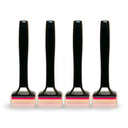
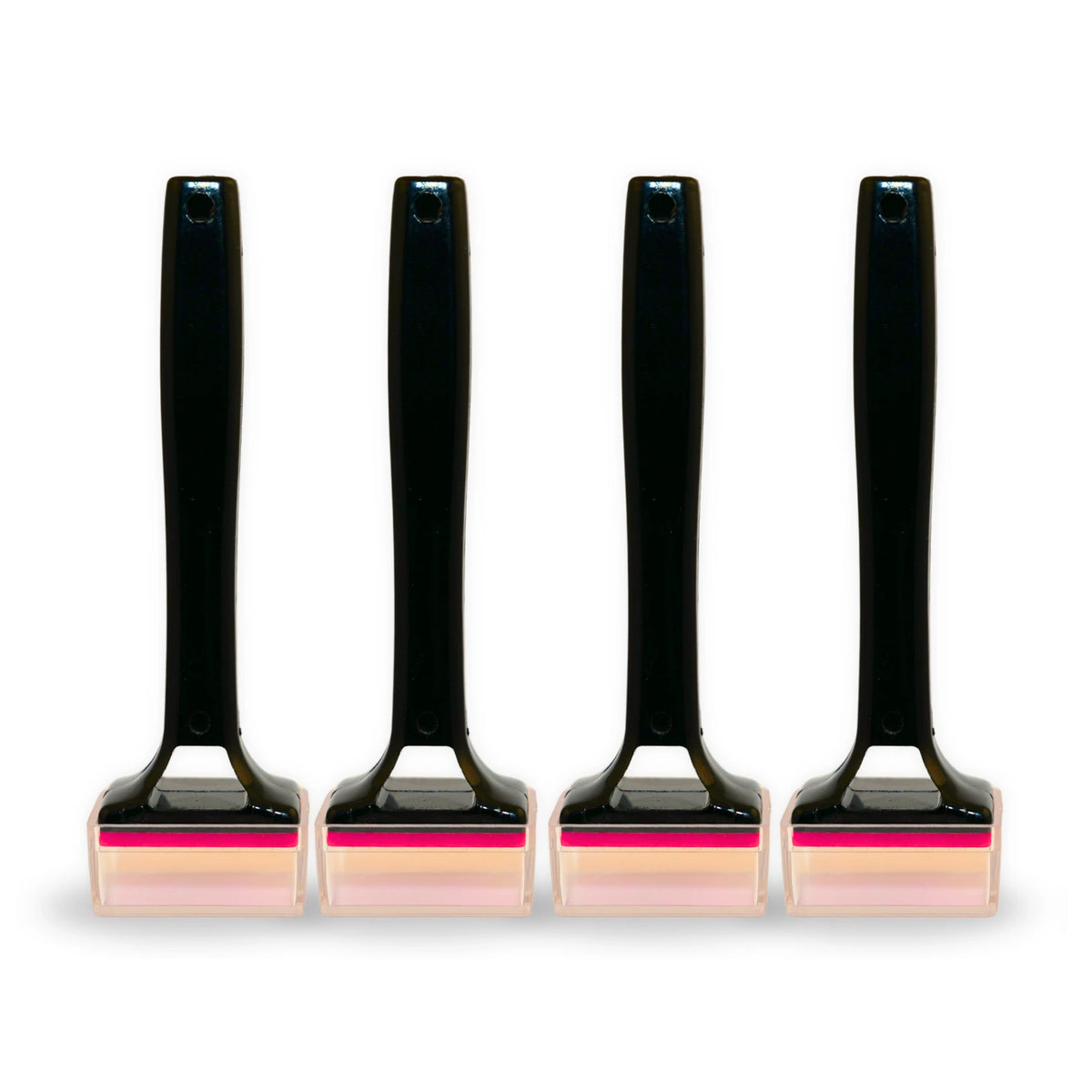
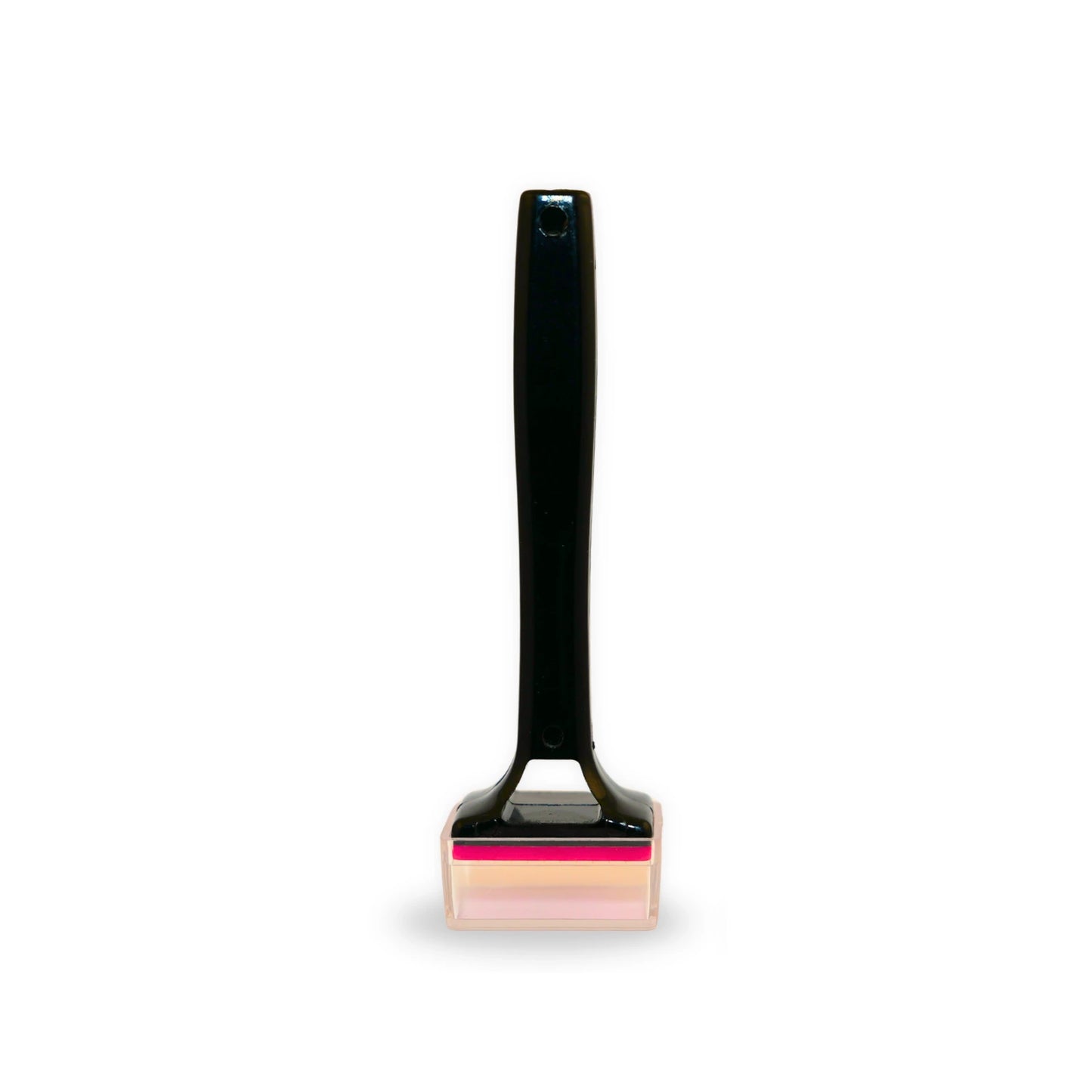
EU-registered It's on the market as a medical device (EU-MDR 2017/745, Class I), and it's listed in EUDAMED, the EU's official database: UDI-DI 06976567878014. As the importer, I'm registered too: HU-IM-000051605. This is traceability, not approval: being registered doesn't mean anyone has confirmed that it works. , Single-use One stamp equals one treatment: according to the manufacturer's instructions, it can't be cleaned or reused after use (registered under EU-MDR Class I). You start every treatment with a new device, factory-treated with an electron beam and disinfected by you before use. This is the most hygienic way to do microneedling at home. microneedling device with detailed instructions for use; How long does one package last? The calculation for the four single-use stamps is based on 1 use per week on the scalp, or 1 use every two weeks on the face. You use a new, unopened stamp for every treatment: no reuse, no carried-over contamination. The 1-pack variant is enough for one treatment.
We currently ship within the European Union only.
So you cannot order this product right now, and prices are shown in Hungarian forint.

I'm training to be a cosmetologist, and I found microneedling because of my own hair loss and skin problems. I want to bring this mechanism home as safely as possible, for you too. I stamp my own scalp weekly, and my face every 2–3 weeks.
Marci · dermastamp.hu
Usage on video
- 1DisinfectionSoak the stamp in medical alcohol for 1-2 minutes.
- 2Cleansing or hair washWash the area you're treating with your favorite cleanser.
- 3StampingGo over the desired area evenly, 4 times on each part. About 8-10 minutes.
- 4AftercareLet your skin rest right after the treatment. We've put together the recommended and best-avoided ingredients for face and scalp separately: Tips and ingredients →
Watch it on video too:
What else do I need to buy?
- 1Medical alcohol: for disinfectionBefore stamping, the stamp needs to soak in medical alcohol. It's available at any pharmacy, not a big expense, but necessary for hygienic use. I show the process on video in the "Usage on video" section, and I also detail it in the instructions in the box.
- 2SPF 50 sunscreen: if you use it on your faceStamped skin is more sensitive to UV radiation, so sunscreen is required. We'll soon have both chemical and mineral sunscreen too. Until then, use your own.
Why is it single-use?
- 1This is a manufacturer requirementThe device is registered as single-use (EU-MDR Class I): according to the manufacturer's instructions, one treatment, one person, and after that it can't be cleaned or reused. This is a requirement.
- 2Every session is a clean startThis way, you start every treatment with a new device, factory-treated with an electron beam and then disinfected by you before use.
- 3Less guesswork at homeYou don't have to wonder how many times you've used it, how clean it stayed, or whether the needles have degraded. One treatment equals one stamp: a simpler, more consistent, more hygienic routine.
Guarantee and returns
If you change your mind, here are your options.
- 30-day money-back guaranteeTry the first stamp. If, within 30 days of receiving it, you decide it's not for you after all, send an email and we'll refund the full price of the package. You don't even need to send anything back. This also applies to the first package of a subscription.
- 30-day return, offered voluntarilyYou can return an unopened, undamaged dermastamp within 30 days of receiving it. We offer this beyond our legal obligation.
- 14-day right of withdrawal, by lawAs a consumer within the EU, you can withdraw from the purchase within 14 days of receiving it, without giving a reason, if the packaging is unopened and undamaged.
Important: the dermastamp is a skin-penetrating hygiene product, so we don't accept opened packaging back. For the money-back guarantee, though, you don't need to return anything. The exact terms are in the refund policy.
Verified by Judge.me
Independent, third-party platform. Only those who actually ordered from us get the "verified buyer" label.
Reviews translated from Hungarian.
-
Edit✓ verified buyer2026. 07. 24.
The parcel arrived on the third working day after my weekend order 😊 The product matches the description, using it is practically painless, afterwards there is a mild burning feeling and redness. I can report on the effect later, I trust that I have reason to hope. Before use I disinfected not only the stamp but the skin as well, with a spray made specifically for this. I found a face mask as a gift in the parcel, I am really glad about it, thank you!
Special thanks for the detailed description :)
Wishing you much success, kind regards: Edit -
Mariann Szabó✓ verified buyer2026. 06. 19.
Very good quality product, less painful than the roller. The seller is very fair and kind, one detail was missing from my order and he handled it in a very humane way😊
-
B.Eszter2026. 06. 08.
Very professional product and seller. After the 4th time, other people noticed too that my skin is much nicer. Thank you!
-
Névtelen2026. 05. 18.
Everything arrived fine. I had my doubts that the site was a scam, but no. I got what was promised. After a 0.5 mm CIT pen (which was quite good, but is not available anymore) and cosmetic mesotherapy (which is expensive, and my skin protested against it so much after the 4th time that I stopped), I am now waiting for this treatment with curiosity. Thank you for the work you put into it!
-
Schnell Fruzsina✓ verified buyer2026. 05. 14.
Really great, easy to use. Much better than the derma roller I used before.
Reply from the shopKöszi szépen a visszajelzést!
– Marci -
Névtelen✓ verified buyer2026. 05. 03.
Great little device , I am on the second one now. I use it on my face and on my scalp too. It is not a spa treatment, but the pain is minimal and you get used to it.
Reply from the shopKöszönöm szépen a visszajelzést!
– Marci -
Névtelen✓ verified buyer2026. 04. 14.
I am satisfied with the quality of the product, I use it on my face and on my scalp too.
Reply from the shopKöszi a visszajelzést, örülök, hogy bevált! Ha bármi kérdés felmerül menet közben, írj nyugodtan a marci@dermastamp.hu-ra.
– Marci
-
Névtelen✓ verified buyer2026. 04. 14.
Great!
Reply from the shopKöszi! Örülök, hogy bevált. Ha bármi kérdés felmerül a használat vagy az utóápolás körül, írj nyugodtan a marci@dermastamp.hu-ra.
– Marci
What to expect?
Does it hurt? What to expect the first time?

Personal experience
Not pleasant, but in my own experience, clearly bearable. On the image I marked how sensitive I found each zone:
- Green: easiest. Forehead, most of the face.
- Yellow: noticeable, but comfortable. Around the eyebrows, nose bridge, jaw.
- Red: more sensitive, but short-lived. Nose, under-eye area, around the mouth. Don't stamp near the eyelid or inner corner of the eye.
In my experience the scalp is less sensitive than the face. The first session feels the most unfamiliar, but based on customer feedback, most people expect it to be worse than it is.
How long does your skin stay red?


In my experience the redness on the face fades within a few hours, with little trace left by the next morning. In more sensitive zones (nose, around the mouth) it can take a bit longer. On the scalp it's less visible, mostly covered by hair, and settles faster.
Don't wear makeup the next day. Sun protection is required.
Personal experience, not a clinical study result. Individual reactions may vary.
What shouldn't you use it for?
Don't use it on irritated, sunburned, actively inflamed, or infected skin. Not recommended for open wounds, active acne, eczema, or psoriasis-affected areas. If you take blood thinners or are under dermatological treatment, check with your doctor.
You'll find the full list of contraindications in the instructions for use that comes with every package.
How do you know it's enough? How hard should you press?
It's not about force. Work with vertical, precise motions: straight in, straight out. Go over each area several times to cover the whole zone evenly. The device's 1 mm needle length helps you avoid going deeper than needed.
The goal is even coverage and controlled technique, not force.
When will I get it, and how do I pay?
Cash on delivery too: you pay when the package is in your hands, not in advance. Card payment is also available. Delivery 990 Ft, to a Foxpost parcel locker.