

Sunscreen or LED mask: which has stronger evidence behind it? Daily sunscreen: 903 people, 4.5 years.
Daily sunscreen. In Hughes and colleagues' 2013 study, 903 adults applied sunscreen daily or only occasionally for 4.5 years, and the daily group showed no further detectable skin ageing. The three studies described in this article using at-home, portable light sources (Papageorgiou 2000, Na and Suh 2007, Friedmann 2026) involved between 23 and 107 people, ran for 8 to 12 weeks, and all were about acne-prone skin. If you don't have a basic routine (cleansing, moisturising, daily sunscreen), you'll probably regret money spent on the mask.
Which has stronger evidence: daily sunscreen or the LED mask?
Daily sunscreen. A single study settles this, because it's a size and length I haven't found for any at-home light device. Hughes and colleagues published the results of a randomised trial in the Annals of Internal Medicine in 2013, in which 903 adults under 55 from Nambour, Australia took part. Participants were randomly assigned: one group applied broad-spectrum sunscreen every day (this type protects against both UVA and UVB radiation), the other group only when they felt they needed to. Skin ageing was measured on the skin's surface microtopography (the pattern of tiny furrows in the skin, scored by evaluators who didn't know which group each person was in), between 1992 and 1996, meaning over 4.5 years. 1
The result: in the group using daily sunscreen, there was no detectable increase in skin ageing after 4.5 years. The daily group's skin ageing was 24 percent lower from the start of the study to the end than the occasional group's (relative odds 0.76, 95 percent confidence interval between 0.59 and 0.98). The confidence interval is the range within which the true effect most likely lies; here its upper edge sits close to one, meaning the "no difference" boundary, so the effect is real but not huge. The authors themselves describe the limitation too: some outcome data was missing, and the study's power to detect moderate effects was modest. 1
In the same trial, the beta-carotene tablet (the carrot's pigment, given as an antioxidant) showed no effect on skin ageing (although the authors note that they also saw associations in opposite directions among subgroups that were aged to different degrees at baseline), so the "protect your skin from the inside" supplement idea wasn't borne out here. 1 What you can take from this: the largest and longest randomised trial I found for slowing skin ageing is about a tube of sunscreen, and if you want to spend money on any one skincare step, this is the one with the strongest data behind it among the studies cited here.
The three studies using at-home, portable light sources that make up this bar worked with 23, 28 and 107 people, ran for 8 to 12 weeks, and looked at acne-prone skin. The sunscreen study measured skin ageing with 903 people over 4.5 years. The two bars compare the size and length of these three named studies and the Hughes study, not every phototherapy study that exists; they don't compare effectiveness, because the two sides measured different outcomes.
Why does the sun age skin?
Photoageing (skin ageing caused by the sun's ultraviolet radiation) is a gradual process that depends on the duration and strength of sun exposure. This definition comes from a 2021 review that gathered cell-culture (laboratory, cell-based) studies; the authors name changes in cell metabolism and oxidative stress (an excess of reactive oxygen molecules generated in the cell that damage proteins and DNA) as the main pathways. 2 Two ultraviolet bands from sunlight reach the skin: UVB has the shorter wavelength and is mainly responsible for sunburn, UVA has the longer wavelength and, according to the source, is the cause of premature skin ageing. 9 A sunscreen protects against both only if it's broad-spectrum. According to the European Commission's 2006 recommendation, the measured UVA protection should reach a third of the SPF value on the label, and the critical wavelength should be 370 nanometres. 9 The circled UVA mark is the industry's (Cosmetics Europe) seal that carries this threshold forward.
I'm not writing the exact proportion of wrinkles that can be attributed to the sun here, because I couldn't trace the commonly cited "80–90 percent" figure back to a primary measurement, and the review above is about laboratory studies on cells, not a proportion measured in people. What is available, measured in people, is the Hughes trial: for those who applied sunscreen daily, skin ageing didn't increase over 4.5 years. 1 What you can take from this: UV radiation is one documented driver of skin ageing, and the defence against it is broad-spectrum sunscreen applied daily.
What does an LED mask study look like when wrinkles are the question?
The portable light therapy tests that can be used at home, which I have found, are mostly about skin with acne, and none of them reach the size of the sunscreen test. Papageorgiou and colleagues in 2000 divided 107 people into four groups: blue light, mixed blue and red light, white light, and five percent benzoyl peroxide cream. The three light-arms used a portable light source for 15 minutes per day; the study lasted 12 weeks, and the improvement in inflammatory acne in the mixed arm was 76 percent on average (95 percent confidence interval 66 to 87). The percentage of the blue-only arm is not included in the abstract, so I do not quote it. 3 Na and Suh in 2007 28 volunteers treated one half of their face with a portable red glow device twice a day for 15 minutes for 8 weeks; the number of inflammatory and non-inflammatory lesions on the treated side improved significantly compared to the other side. This is a small, single-blind study. 4 In 2026, Friedmann and colleagues compared a device combining 660 nanometer red and 415 nanometer blue light at home with a device with only blue light: 23 people out of a target of 30 people completed the 8-week, once-a-day suitable test, the number of inflammatory lesions decreased in both arms, but the reduction in the total number of lesions was only in the red-blue arm was significant, at no time in the blue-only arm, and there was no significant difference in lesion numbers between the two arms; 8th in the overall medical score. week, the arm combining red and blue light was significantly better. This was an open study without a sham arm. 5
On the question of the wrinkle, nothing follows from these tests, because that is not what was measured. There are also tests that measure wrinkle output with other tools. I describe two because it shows how different the results of two similar tests can be. Park et al in 2025 60, 30 to 65-year-old Asians with Fitzpatrick skin type II–V studied a home mask combining 630 nm red and 850 nm infrared light on crow's feet in a two-center, double-blind, sham-controlled, 16-week period; 8th, 12th according to independent, blind evaluators. and 16. week, a significant difference was found compared to the control. The study was funded by the mask manufacturer, Y&J Bio; according to the authors, the research design, data collection, analysis, and writing took place independently of the funder, and they declare no conflict of interest. 6In the same year, Bragato et al. examined 95 women aged 45 to 60 years with another 660-nanometer red LED mask three times a week or twice a week for 4 weeks, with a sham-treated control group; no significant difference was found between the groups on the blind wrinkle scale (on which three experts scored based on photos without knowing who received the light); in wrinkle length measured with an image analysis software in two areas of the face, the groups receiving light were better than the control; the FACE-Q satisfaction index in the groups receiving light was 79.6 and 73.4 percent, significantly higher than in the sham-treated group. 7 The two studies worked with different masks, different blind scales and different results: In Park, the independent experts also found a difference, in Bragató only the software measurement and self-declaration, not on the expert scale. Both studies had a sham-treated control group, and according to the authors, participants did not know which group they were assigned to. When they refer to a wrinkle test on the side of a mask, ask who funded it and whether the difference was on a blind expert scale or just self-report.
According to the size and length of the study, the picture is as follows: for the sunscreen, 903 people and 4.5 years, for the three acne tests performed with a portable light source that can also be used at home, between 23 and 107 people and between 8 and 12 weeks, for the two wrinkle tests, between 60 and 95 people and between 4 and 16 weeks, with different outcomes. Look for this when a study is mentioned on the page of a mask: how many people, how many weeks, who funded it, who scored the results, and did you know who got the light.

What order should you build your routine in?
The strength of the evidence sets the order, and your wallet says the same thing. The first step is a cleanser that doesn't dry out your skin, the second is a moisturiser, the third is daily, broad-spectrum sunscreen in the morning. These three make up the basic routine, and of the three, sunscreen is the one backed by the 903-person, 4.5-year study. 1 If your skin can tolerate it, your dermatologist can also decide on an evening retinoid (a vitamin A derivative; whether it's right for you, at what strength and in what form, is for your dermatologist to decide, not me); I'm not citing a study for this in this article, so I'm not ranking it in the evidence order. Alongside a retinoid, I apply sunscreen even more carefully in the morning; this is my own cautionary practice, not data measured for this specific combination.
A light device comes at the end of this order, as the last layer, once your basic routine has been running for six months and you have money set aside for it. This is the order because the LED mask replaces nothing from the first three steps: it doesn't cleanse, it doesn't moisturise, and it doesn't protect against UV. Whoever starts with a mask is starting with the most expensive step, and the one backed by the weakest evidence for slowing skin ageing among the studies cited here. So the order is: cleanser, moisturiser, daily sunscreen, and only then a light device; I'm not citing a study for a retinoid in this article, your dermatologist knows what's right for you.
What does a year of sunscreen cost, and a year of LED mask?
In my shop, the 50 millilitre tube of sunscreen serum is €18.50, the LED mask is €379. So one tube of sunscreen is roughly a twentieth of the mask's price. How many tubes you go through in a year depends on how much you apply: the SPF value is measured in the lab with 2 milligrams of sunscreen per square centimetre, and if you apply that much to your face, your tube runs out faster. 10 If you went through one a month, that's €222 a year, meaning roughly 60 percent of the mask's price. In this field, flexible silicone masks also run from roughly 88 thousand up to over 200 thousand Ft (roughly €200–500), so the difference isn't specific to my own pricing.
With the mask, there's no consumable after the purchase price, but there is a battery, which loses capacity over time, and there's a use pattern of 3–5 sessions a week, up to 10 minutes each, that has to be kept up for it to have any chance of adding anything at all. What you can take from this: sunscreen is a few tubes a year, the mask is a lot once, and of the two, sunscreen is the one the evidence is about.
Sunscreen isn't an exciting product, you have to apply it every day. But the evidence for slowing skin ageing is stronger for it than for the LED mask. The mask can only come into the picture once sunscreen is already on every morning.
How much sunscreen do you need for your face?
SPF value is measured in the lab with 2 milligrams of sunscreen per square centimetre (ISO 24444 standard). 10 It follows that if you apply it more thinly than that, your actual protection can be lower than the number on the box; according to the European Commission's 2006 recommendation, if the amount applied is cut in half, the protection can drop by as much as two-thirds. 9 The same recommendation gives 6 teaspoons for an average adult's whole body (2 milligrams per square centimetre, roughly 36 grams); I didn't find a teaspoon figure specifically for the face in a primary source. 9 What's certain: apply it thicker rather than thinner, and to your ears, neck and hairline too.
Do you need SPF 30 or SPF 50?
SPF 30 filters out about 97 percent of UVB radiation, SPF 50 filters out 98 percent; this follows from the numbers, because the filtered fraction is 1 minus 1 over SPF. 8 On paper, the difference is one percent. In practice, what matters is how much you apply: if you apply it thinly, even SPF 50 gives you less than what's on the label; the European Commission's 2006 recommendation also warns that reducing the amount significantly reduces the level of protection. 9 10 That's why I choose the higher number, and apply it thicker.
Do you need sunscreen in winter too?
In the Hughes trial, the daily group applied it every day, in Australia, in sunshine stronger than Hungary's; I didn't find a study measured in a Hungarian winter for this question. 1 I apply it year-round; this is my own practice, not a measured endpoint.
Does the LED mask replace sunscreen?
No. The LED mask doesn't protect against UV radiation, because it doesn't put anything on your skin that would absorb or reflect sunlight. Sunscreen and the mask are two separate things: one addresses a documented cause of skin ageing, and there's a 903-person, 4.5-year randomised trial for it; for the other, I haven't found a study of that size. 1
Does the LED mask help with wrinkles?
The mask I sold was not tested for wrinkles. There are studies measuring wrinkle output with other tools, with different results: in the 2025 study by Park et al., 60 people, 16 weeks, funded by the manufacturer of the mask (according to the authors, the design of the research, data collection, analysis and writing took place independently of the funder) with a mask combining red and infrared light, the independent blind evaluators found a significant difference compared to the control the 8th, 12th and 16. week as well. 6 In 2025, Bragato et al.'s 95-person, 4-week study with another red LED mask, no difference was found between the groups on the blind wrinkle scale, but in the software wrinkle length measurement in two facial areas, and the FACE-Q satisfaction index was higher than in the sham-treated group. 7 If skin aging is your question, the proof is in the daily sunscreen; In this article, I will not cite a study on retinoids. Your dermatologist can tell you what is right for you. Mask tests are small, short, and give conflicting results.
What are LED masks sold for, and what do I sell mine for?
Shops often advertise it as an anti-ageing product; the evidence is modest compared to that claim. The three studies described in this article, done with at-home, portable light sources, are all about acne-prone skin, with 23 to 107 people, over 8 to 12 weeks. 3 4 5 For slowing skin ageing, the largest of the studies cited here is about sunscreen. 1 I sell my mask as an at-home cosmetic light device, not as an anti-ageing product.
Does the LED mask produce collagen?
The mechanism behind red and near-infrared light is studied with other devices. I couldn't find a collagen measurement for my own mask. If you want to slow your skin's ageing, the best-supported step among the studies cited here is daily sunscreen, because UV radiation is one documented driver of skin ageing. 1
Is the LED mask worth it over 40?
Adults under the age of 55 were included in the Hughes study, so this age group fell into the studied population; no separate age group analysis was published, the study is not intended for people over 55. 1 The Bragato study looked at women between 45 and 60 years old with a red LED mask for 4 weeks: it found no difference between the groups on the blind wrinkle scale, but it did on the software wrinkle length measurement in two facial areas. 7 The Park study looked at people between the ages of 30 and 65 with another mask combining red and infrared light for 16 weeks: independent blind evaluators at 8, 12 and 16. week, a significant difference was found compared to the control. The study was funded by the mask manufacturer, Y&J Bio; according to the authors, the research was carried out independently of the funder. 6 None of the tests were done with the mask I sell. So over forty, the order is the same: the daily sunscreen first, the mask only after that, as the last layer; In this article, I will not cite a study on retinoids. Your dermatologist knows what is right for you.
What if I start sunscreen after 50?
I haven't found a separate study for this age group; the Hughes trial enrolled people under 55. 1 Sunscreen filters out the same radiation no matter how old you are; I haven't found a measurement of how much you gain by starting after 50. Sunscreen doesn't remove skin ageing that's already there; for slowing further skin ageing, though, it's the best-supported tool among the studies cited here.
Can I use the LED mask after sunscreen?
Don't. It's best to put the mask on clean, dry skin, in the evening, when you're not wearing sunscreen; sunscreen goes on in the morning, and stays on. The two don't interfere with each other if they're in separate parts of the day. There's no study I could cite for sunscreen applied after the mask, so this order is practical, not measured.
What if I skip a day or two of sunscreen?
The Hughes trial compared exactly these two behaviours: daily and occasional application. The daily group's skin ageing was 24 percent lower over 4.5 years than the occasional group's (relative odds 0.76). 1 One skipped day doesn't decide anything; the habit does: the difference came out between every day and sometimes, not between one day and the next.
If I only have money for one, which should I buy?
Sunscreen, and that's not a question. One tube is €18.50 with me, the mask is €379. Sunscreen is backed by a 903-person, 4.5-year randomised trial; the three acne studies done with at-home, portable light sources involved 23 to 107 people, over 8 to 12 weeks; the two sham-controlled wrinkle studies (with other devices, 60 to 95 people, over 4 to 16 weeks) measured a different outcome. 1 The mask can come into it once sunscreen has been on every morning for six months already, and there's money left over for it.
What do I sell, and what do I say about it?


I'm studying to be a cosmetologist; I started taking skincare seriously because of my own wrinkles and acne scars. I tried eight LED masks, and after the eight, I got a clear picture of what makes a good LED mask; only then did I dare start selling one of my own. My mask has a rigid frame, 99 LEDs, no LEDs along the eye line, and the box guide specifies 3–5 sessions a week, up to 10 minutes each. I sell it as a home lighting device for cosmetic purposes.
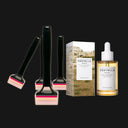
The shop also has a sunscreen serum (SKIN1004 Hyalu-Cica Water-Fit Sun Serum SPF50+ PA++++, 50 millilitres, €18.50). I'm writing this here because this article is about exactly that: if you have to choose between the two, get the sunscreen, from me or from anyone else. The mask is the last step, not the first.
Sources
The sources are about sunscreen, the mechanism of UV radiation, and other people's phototherapy studies; none of them were done with the mask sold here, and the sunscreen study wasn't done with the serum sold here either.
- Hughes MC, Williams GM, Baker P, Green AC. Sunscreen and prevention of skin aging: a randomized trial. Annals of Internal Medicine, 2013. PMID 23732711.
- Gromkowska-Kępka KJ, Puścion-Jakubik A, Markiewicz-Żukowska R, Socha K. The impact of ultraviolet radiation on skin photoaging: review of in vitro studies. Journal of Cosmetic Dermatology, 2021. PMID 33655657.
- Papageorgiou P, Katsambas A, Chu A. Phototherapy with blue (415 nm) and red (660 nm) light in the treatment of acne vulgaris. British Journal of Dermatology, 2000. PMID 10809858.
- Na JI, Suh DH. Red light phototherapy alone is effective for acne vulgaris: randomized, single-blinded clinical trial. Dermatologic Surgery, 2007. PMID 17903156.
- Friedmann DP, Verma KK, Gidwani KA, Nguyen M, Gharibvand L. Comparing a Red and Blue Light-Emitting Diode Light Device With an Existing Blue Light Device for At-Home Treatment of Inflammatory Acne: An Open-Label Randomized-Controlled Trial. Dermatologic Surgery, 2026. PMID 41886698.
- Park SH, Park SO, Jung JA. Clinical study to evaluate the efficacy and safety of home-used LED and IRED mask for crow's feet: A multi-center, randomized, double-blind, sham-controlled study. Medicine (Baltimore), 2025. PMID 39960921.
- Bragato EF, Paisano AF, Pavani C, Motta LJ, Varellis MLZ, Chiedde M, da Silva GA, Bussadori SK, Mesquita-Ferrari RA, Fernandes KPS. Role of photobiomodulation application frequency in facial rejuvenation: randomized, sham-controlled, double-blind, clinical trial. Lasers in Medical Science, 2025. PMID 40167796.
- American Academy of Dermatology. Sunscreen FAQs. aad.org/media/stats-sunscreen (SPF 30: filters out 97 percent of UVB radiation).
- European Commission. Commission Recommendation 2006/647/EC on the efficacy of sunscreen products and the claims made relating thereto. 2006 (UVA protection factor at least a third of the SPF, critical wavelength at least 370 nm).
- ISO 24444. Cosmetics: Sun protection test methods, in vivo determination of the sun protection factor (SPF). The amount applied in the measurement is 2 milligrams per square centimetre.