

Does blue light help with acne? Porphyrin, 415 nanometres, and what the studies actually measured.
According to the proposed mechanism, blue light acts on one specific thing: the pigment that the bacterium living in acne produces, whose absorption peak, according to the literature, sits around 405 nanometres; in the authors' own measurements, the porphyrin peaks of the Cutibacterium strains fell between 402 and 413 nanometres. Several small studies have measured a decrease in inflamed acne lesion count from this, in mild and moderate acne, in studies measured over weeks, 7 to 12 weeks, where frequency was reported: from 15 minutes daily to four times a week. This mechanism doesn't reach hormonal or deep, cystic acne, and the first step that follows from the above is clarifying the cause; light comes, at most, after that.
Before you buy anything: what actually is this on your face?
I'm studying to be a cosmetologist, and I started taking skincare seriously because of my own acne scars. I wrote this article because on mask pages, blue light is only ever labelled "for acne", and that doesn't tell you what it works on, what it doesn't, and how much has been measured. First, two sentences about something more important than that. If you don't have a basic routine (a cleanser, a moisturiser and daily sunscreen), you'll probably regret money spent on the mask, because light doesn't replace these. There's more and stronger evidence for daily sunscreen slowing skin ageing than for any at-home light device: in Hughes and colleagues' 2013 randomised trial, 903 people were sorted into four groups (daily or discretionary sunscreen use, each combined with beta-carotene or placebo); those using daily sunscreen showed no further skin ageing detected over 4.5 years, and 24 percent less was measured compared to those using it at their own discretion.1 It's not exciting, you have to apply it every day, and it costs a fraction of an LED mask.
The other thing to clarify before acne is whether it's acne at all. There are three skin conditions that regularly get mistaken for acne, and all three need different treatment.
Malassezia folliculitis (formerly known as Pityrosporum folliculitis, colloquially "fungal acne") is inflammation caused by Malassezia yeast proliferating in the hair follicles. Chalupczak and Lipner's 2025 review calls it an "underdiagnosed mimicker" right in the title: uniform, itchy small papules and pustules (red bumps and pus-filled spots) that resemble ordinary acne so closely that they're often given antibiotics for it, needlessly.2 According to Draelos and colleagues' 2026 review, warm, humid weather, follicle blockage and a weakened immune system increase the risk, it responds to antifungal treatment, and the authors describe as a separate concern that because of social media, many people apply antifungals on their own, without a diagnosis.3 The dermatologist confirms the diagnosis with dermoscopy, a KOH preparation, a Wood's lamp, and the response to antifungal treatment.2
A drug-induced acneiform eruption (acneiform: resembling acne) appears weeks or months after starting a new medication. According to Ulrich and colleagues' 2026 summary, the lesions are uniform, can appear on unusual, non-sebaceous areas too, and outside the usual age range for acne. The highest risk comes from certain targeted cancer therapies, and it's increasingly common with Janus kinase inhibitors given for inflammatory diseases (a drug family prescribed for joint and skin inflammation). According to the authors, treating the symptom is often the practical path, rather than stopping the drug, so this is decided jointly by the dermatologist and the prescribing doctor.4
Rosacea papulopustulosa is a form of rosacea (a skin condition with persistent redness in the middle of the face) that also has red bumps and pus-filled spots. I haven't brought a separate study for this; the key point is that it appears in adulthood, in the middle of the face, together with redness, is easy to mistake for acne at a glance, and is treated differently. The studies I write about below didn't examine this skin condition, and my own mask's guide states that the device isn't suitable for treating rosacea.
What you can take from this: if your spots itch, are uniform, are in an unusual location, appeared after a new medication, or appeared in adulthood, in the middle of the face, together with redness, see a dermatologist first, and only then any device.
What happens in the skin when acne forms?
Acne is a chronic, inflammatory disease of the hair follicle and its associated sebaceous gland, also driven by the immune system. Cochrane's 2024 review describes it this way: the non-inflammatory lesions are open and closed comedones (blackheads and whiteheads), the inflammatory ones are papules, pustules, nodules and cysts.5 The process happens in steps. The follicle's outlet gets blocked with keratinised cells, the sebum can't get out and builds up, and that's how a comedone forms. A bacterium lives in the follicle, Cutibacterium acnes (formerly known as Propionibacterium acnes), which feeds on the sebum, and proliferates in the blocked, oxygen-poor follicle. The immune system responds with inflammation to the bacterium's metabolic products and the tension on the follicle wall, and that's how the red, painful pimple forms. If the inflammation goes deep and the follicle wall ruptures, it becomes a nodule or cyst, and that leaves a scar.
Sebum production is driven by hormones. According to Tommasino and colleagues' 2025 review, acne has a strong hormonal component, especially in women, and it's the pathway driven by androgens (male sex hormones, which are also produced in women) that hormonal treatments specifically target.6 That's why the same skin picture is about a bad facial cleanser for one person, and about their cycle for another.
What you can take from this: acne is a multi-step process, blockage, sebum, bacteria, inflammation, and often a hormone behind it; blue light targets a single one of these steps, the bacteria, not the rest.
After trying eight masks, I had an idea of what makes a good led mask.
 See the LED mask
What does blue light do to acne?
First, two words about light. Light is a wave, and the wavelength is the distance between two consecutive wave crests, which is measured in nanometers; a nanometer is one millionth of a millimeter. Light with shorter wavelengths consists of higher energy photons and can therefore excite different molecules than longer wavelengths. Serrage et al.'s 2024 publication, based on measurements, defines blue light as the band between 380 and 500 nanometers.7
A Cutibacterium acnes it produces porphyrins: ring dye molecules, relatives of the heme of our blood, whose Soret band, according to the literature, is around 405 nanometers (this is described in the introduction to the Serrage publication with reference to another source). The same announcement, referring to previous investigations, states that the relative Cutibacterium granulosum produces significantly more porphyrins than a C. acnes, and produces particularly large amounts of coproporphyrin III, which has a typical absorption spectrum in the range between 400 and 415 nanometers. When the authors measured a panel of 16 strains of skin bacteria, four Cutibacterium-for two of the trunk (one C. acnes and the C. granulosum) had a porphyrin peak between 402 and 413 nanometers according to the summary and between 389 and 416 nanometers according to the results section. A total of two in the panel C. acnes strain was included, both isolated from healthy volunteers, and only one of them showed this Soret band; the authors explain this by the fact that the porphyrin expression of the other Cutibacterium strains used may have been below the detection limit of the measuring system. The authors also describe that the "405 nanometers is the key wavelength" hypothesis assumes that all microbial species are equally sensitive to light, while the response to light depends fundamentally on the presence or absence of wavelength-specific chromophores.7 The presumed mechanism, as the announcement puts it: blue light excites these light-sensitive molecules in the species that produce them, and this shifts the composition of the skin's bacterial community. According to the announcement, the excited porphyrin produces cell-damaging reactive oxygen species (aggressive molecules formed from oxygen).
This explains why the number in the tests is 415 nanometers. 415 falls close to the Soret peak around 405 nanometers, not on the peak itself. It follows from this that 450 nanometers is further away than this, where the porphyrin presumably absorbs more weakly. The authors built their own measurement platform at 450 nanometers and see potential for clinical application; however, they did not report the measured human acne effect for 450 nanometers, and they themselves write that 405 nanometers is usually considered the key wavelength for the microbicidal effect.7 In addition to the Soret band, porphyrin also has weaker absorption sites: Haag et al. Cutibacterium acnes subsp. elongatum strain coproporphyrin III with 496 nm cyan and 547 nm green light; 496 nm is one of the Q-band absorption maxima of CP III, 547 nm is the peak of the green LED used, and 496 nm cyan gave the strongest reduction.8 This is culture, not skin, so no human influence can be deduced from it.
Another thing blue light can do is reduce inflammation. 2026 Systematic Review (Compendium of Light Treatments for Acne) by Ren et al concludes that blue and red LEDs provide a gradual anti-inflammatory effect that is appropriate for mild to moderate acne, the C. acnes through suppression and modification of inflammatory signal molecules.9 Sebum production is discussed in the same review for other procedures, but not for blue LED.
What you can take away from this: if you look at the blue mode of a mask, the number is the question; the blue at around 415 nanometers is close to the porphyrin peak around 405, the 450 one is further away, and I could not find any human acne studies at 450 nanometers alone. It should also be seen that it was isolated from two healthy volunteers in the surveyed panel C. acnes strain was included, but the peak was only detectable in one of them, which is not enough for species-level generalization.
The absorption peak of C. acnes's porphyrin sits around 405 nanometres (Soret band; it scattered between 402–413 nm in the measured Cutibacterium strains); the studied 414–445 nm blue light starts above this, at the edge of the peak, 450 nm is further away, and the 630–670 nm red is already a different mechanism.
What did the studies measure with blue light?
I'll take them one by one, because the numbers only mean something alongside the study. None is about my own mask.
Papageorgiou and colleagues in 2000 split 107 people with mild to moderate acne into four groups: blue light only (415 nanometre peak), blue and red light together (415 and 660), cold white light, and 5 percent benzoyl peroxide cream. They received the light for 15 minutes daily, over 12 weeks. In the group receiving blue and red light together, inflammatory lesions decreased by an average of 76 percent (95 percent confidence interval between 66 and 87), and this was significantly better than blue light alone at weeks 4 and 8, while at week 12 the difference was no longer significant; benzoyl peroxide was better at weeks 8 and 12, white light at every measurement.10 The blue-only group's own percentage isn't in the abstract, and I didn't have access to the paper's full text, so I can't state that number. Comparison of the three light sources was blinded for the evaluator, the cream's wasn't.
Gold and colleagues in 2011 compared a handheld, at-home blue LED to a sham device in 30 people (looks the same, but doesn't emit light), though the treatments were given in a clinic: for everyone, one similar pimple was chosen on each half of the face, one received light, the other the sham device. The size and redness of the light-treated pimples decreased significantly more (p<0.025).11 Their own abstract doesn't state the wavelength; the JAMA 2025 table gives 414 nm for it.18 The limitation is large: this was 4 treatments, over 2 days total, under clinical conditions, and it's about one pimple each, not the whole face over 12 weeks.
Ash and colleagues in 2015 studied 41 people with 414 nanometre light, measured at week 12 (26 treated, 15 control): in the treated group, the count of inflammatory lesions decreased by 50.02 percent, in the control it increased by 2.45 percent.12 This number, though, isn't blue light's alone: according to their own abstract, the light was given combined with the manufacturer's creams, so it can't be separated how much came from the light and how much from the cream.
Nestor and colleagues in 2016 compared an over-the-counter, 445 and 630 nanometre mask to benzoyl peroxide over 12 weeks, with the evaluator blinded to who received what: in those using the mask only, inflammatory lesions improved by 24.4 percent, with benzoyl peroxide by 17.2 percent.13 This is the highest-wavelength blue among the at-home devices included in the JAMA 2025 review, and here too it went together with red.18
Friedmann and colleagues' 2026 study compared a combined 660 and 415 nanometre at-home device to an over-the-counter, 415-nanometre-only blue device, once daily, over 8 weeks: 30 people were planned, 23 completed it (14 in the combined group, 9 in the blue group). The total lesion count decreased significantly in the combined arm at both weeks 4 and 8, at no time point in the blue-only arm. Inflammatory lesions decreased significantly in both groups, non-inflammatory ones (comedones) in neither, and there was no significant difference between the two groups in lesion counts at any measurement; only the investigator global assessment score (ISGA) was significantly better for the combined group at week 8.14 This was an open-label study, meaning everyone knew which device they were using, and there was no sham-device group.
In Ablon's 2025 study, a wearable mask that delivers 415 and 633 nanometres at once was used in 30 people, over 7 weeks, 4 times a week: both inflammatory and non-inflammatory lesion counts decreased significantly, and in 86 percent of participants the investigator global assessment score (IGA) improved by at least one grade.15 There was no control group here either, and the study was open-label; the author herself describes this as the main limitation.
What you can take from this: the blue light studied was between 414 and 445 nanometres, the decrease showed up on inflamed pimples, in studies measured over weeks, 7 to 12 weeks, where frequency was reported, from 15 minutes daily to four times a week, with small numbers, and where a cream or red light also went alongside it, the effect isn't blue's alone.
And red light on its own?
Porphyrin has absorption in red too, that's what ALA photodynamic therapy is based on, but in the red-light acne studies, the proposed mechanism is different: exciting mitochondrial chromophores. According to Avci and colleagues' 2013 review, photons are absorbed by light-absorbing molecules sitting in skin cells' mitochondria (the cell's energy-producing parts), and this changes how the cell functions, including inflammatory signals.16 There's one red-light-only acne study for this. In 2007, Na and Suh treated one half of the face in 28 people with mild to moderate acne with a portable red LED, the other half stayed untreated, twice daily for 15 minutes, over 8 weeks. On the treated side, both the inflammatory and non-inflammatory lesion counts decreased significantly more than on the untreated side, and the visual analogue scale (VAS) score on the treated side dropped from 3.9 to 1.9; who scored it isn't stated in the abstract.17 Their own abstract doesn't state the wavelength; the table in the JAMA Dermatology 2025 review gives a device between 635 and 670 nanometres for it.18 The limitation is that it's about 28 people, was a split-face design with an untreated control side, single-blind (the direction of blinding isn't stated in the abstract), and the study is from 2007.
What you can take from this: there's acne data for red light too, with a different mechanism, from an equally small study; if you were to use only the red mode on a mask, this is the one study behind it that I found.
What does it show if you put it all together?
Ershadi and Barbieri's 2025 systematic review and meta-analysis, published in JAMA Dermatology, gathered the acne studies of at-home LED devices: 6 randomised trials, 216 participants in total. The blue devices operated between 414 and 445 nanometres, the red ones between 630 and 670 nanometres. Overall, compared to control, the LED devices produced a 45.3 percent greater change in inflammatory lesions (pooled data from 5 studies, 95 percent range between 25.1 and 65.5), 47.7 percent in non-inflammatory ones, and 45.7 percent in investigator global assessment score (these latter two numbers are pooled data from 4 and 4 studies, respectively).18 These three numbers come from mixed devices, blue, red and combined together, so none can be read off for any single colour separately, and the wide ranges show how small the underlying studies are. The abstract isn't available on Europe PMC; the numbers are from the full text.
The other pooled analysis sets the benchmark. Cochrane's 2024 review processed six systematic reviews, from 275 studies, with 40 910 people with acne, covering topical treatments, light treatments and complementary procedures. The authors' conclusion, verbatim: "we found no high-certainty evidence for the effect of any included treatment". Even for benzoyl peroxide, the pharmacy-shelf staple, the evidence is "very low certainty" compared to placebo.5
What you can take from this: the light studies are small and short, but there isn't high-certainty evidence behind the pharmacy-shelf staple either; a mask page that says "clinically proven" is claiming more than can be said about any player in this field.
Hormonal and cystic acne: why is it different?
Blue light reaches the bacterium sitting in the follicle, close to the surface. Hormonal acne is driven by the signal that pushes the sebaceous gland into overproduction, and this signal arises above the bacterium, at the hormone level. According to Tommasino and colleagues' 2025 review, the treatments given for this, combined oral contraceptives, spironolactone and topical clascoterone, all target the androgen-driven pathway; the authors see their place in adult women and in cases that don't respond to standard treatment.6 These are prescription-only drugs, and the decision is the doctor's; all I can state is that light doesn't touch this pathway, and in the studies above, not a single arm examined hormonal acne.
I haven't found a blue-light study for deep, nodular or cystic acne either. The included studies are all about mild and moderate acne, and Ren and colleagues' 2026 review puts LED into this band; for moderate and severe acne, the same review discusses ALA photodynamic therapy, which is a medical procedure made up of a photosensitising agent and a clinical light source, not an at-home mask.9 Cystic acne can leave a scar, and a scar is, again, a different mechanism: the same review describes fractional lasers for depressed scars, light doesn't feature there. I wrote about acne scars on a separate page.
What you can take from this: if your spots come with your cycle, sit along your jaw and chin line, or are deep and painful, light doesn't target what's driving them; there, the dermatologist is the first step, and light can, at most, come alongside it for surface-level, inflamed pimples, if the doctor sees no reason against it.
What's the first step?
The order that follows from the above is simple. First is the cause: is it acne, and if so, is it hormonal, caused by cosmetics, or from mechanical stress. Choi and colleagues' 2025 case-control study associated the use of powder and comedogenic (follicle-blocking) facial cleansers with a higher acne risk, and also the amount of moisturiser used; this is an association, not cause and effect, but it signals that reviewing your routine is cheaper than any device.19 Second is the dermatologist-chosen base treatment: the Cochrane review compared benzoyl peroxide, adapalene (a topical retinoid) and clindamycin (a topical antibiotic), all with very low or low certainty evidence, but these are the ones with any data at all from several thousand people.5 I don't prescribe any of these, and I can't; the concentration and form are for the doctor and your skin's tolerance to decide. Third is the basic routine this article started with: cleanser, moisturiser, daily sunscreen.
And only then does light come, as a supplement, with what it can and can't do as described above: a decrease was measured for surface-level, inflamed pimples with 414 to 445 nanometre blue light, over 7–12 weeks, in small studies, and not for the other skin conditions.
What you can take from this: cause, doctor-chosen base treatment, basic routine, and after that, if you're curious about it, light; in this order, there's nothing you'll skip that you'd regret later.
Blue light produced a measured decrease in small studies for surface-level, inflamed pimples, between 414 and 445 nanometres, over 7–12 weeks; it doesn't speak to hormonal, cystic and non-acne skin conditions, and in this field, the level of evidence isn't high even for the pharmacy-shelf staple.
How long before you see anything from blue light?
The studies measured 7–12 weeks. Papageorgiou and colleagues in 2000 evaluated at weeks 4, 8 and 12, and the difference between the group receiving blue and red light together and blue light alone was no longer significant at week 12.10 Friedmann and colleagues in 2026 saw a decrease in inflamed lesions at weeks 4 and 8.14 No study promises a faster result than this, and none of them is about your mask.
Do you need to use blue light every day?
The studies used 15 minutes daily (Papageorgiou 2000), once daily (Friedmann 2026) and 4 times a week (Ablon 2025), over 7–12 weeks.10 I haven't found a study that examined less frequent use for acne. Your own mask's guide is the ceiling: if it specifies less than the studies, the guide takes precedence. A separate article covers frequency.
Is a blue-light mask good for teenagers too?
The studies in the Cochrane review had participants aged 10 to 59, with an average age between 18 and 30.5 The 216 participants included in the at-home LED devices' JAMA Dermatology 2025 review were aged 12 to 50;18 Nestor and colleagues' 2016 study specifically enrolled participants from age 12,13 and Ablon's 2025 study enrolled participants aged 14 to 45, adolescents and adults together.15 I haven't found a separate teenager study for at-home blue light. Behind adolescent acne is a hormonal shift that light doesn't touch, so the dermatologist is the first step there.
Can blue light be used for acne during pregnancy?
I haven't found a blue-light acne study done on pregnant or breastfeeding women. My own mask's printed guide lists pregnancy and breastfeeding among the exclusion criteria; I haven't gone through every other mask's guide. Pregnancy acne is hormonal on top of that, so this isn't the target from a mechanism standpoint either. A separate article covers the contraindications.
Is blue light good for acne scars too?
It's not for this. Blue light targets the bacterium in an inflamed pimple; a scar is a deficit or excess of connective tissue left after inflammation has already resolved. Ren and colleagues' 2026 review describes fractional lasers for depressed scars, vessel-targeting lasers for red scar marks, and blue LED for neither scar type.9 I wrote about acne scars here.
Can I combine blue light with benzoyl peroxide?
None of the studies I read gave the two together: in Papageorgiou 2000, benzoyl peroxide was a separate arm, against the light,10 and the same in Nestor 2016.13 Ash 2015 combined the light with creams, but the abstract doesn't say which.12 So I haven't found data on whether the two together give more, or irritate more. If you've been prescribed benzoyl peroxide, the prescribing doctor can decide on this.
Is blue or violet light better for acne?
The question is the nanometre. The studied band was between 414 and 445 nanometres,18 and the absorption peak of C. acnes's porphyrin sits around 405 nanometres, scattering between 402 and 413 nanometres in the measured Cutibacterium strains.7 A 415 nanometre "violet" mode sits close to this peak, a 450 nanometre "blue" is further from it. No one has compared the two wavelengths head to head in humans, that I found, and I haven't found an acne study for 450 nanometres on its own. So ask the mask's manufacturer for the measured peak.
My skin got worse from blue light, what could be the reason?
I haven't found a study for this, so I can only describe the possibilities. If the skin condition isn't acne (Malassezia folliculitis, a drug-induced rash, rosacea), the light doesn't target what's driving it, and my guide states that the device isn't suitable for treating rosacea. If you're taking a photosensitising medication, my own guide prohibits this too; I haven't gone through every other mask's guide. In Friedmann and colleagues' 2026 study, the light had no effect on non-inflammatory lesions (comedones) in either arm;14 but it did in Ablon's 2025 and Nestor's 2016 studies, which gave blue and red light together, where the non-inflammatory lesion count also decreased significantly.1513 So it isn't certain that comedones clear up because of the light. If your skin is getting worse, stop, and have a dermatologist look at it.
Does blue light destroy all the bacteria on the skin?
No, and that's not the goal either. According to Serrage and colleagues' 2024 measurement, the bacterial species living on the skin carry different light-absorbing molecules; the proposed mechanism is that blue light acts on the species that carry a pigment absorbing at that wavelength; among the surveyed strains, porphyrin was the rarest such pigment (12.5 percent), flavin (31.2 percent) and carotenoid (18.8 percent) more common.7 The authors note that the chromophores giving light resistance are common in several members of healthy skin's microbiome (M. luteus, Kocuria), so these species may even proliferate after light exposure.7 The same paper also states that the skin's bacterial community's response to blue light is still a poorly understood area. Whoever promises "sterilisation" is claiming more than what's been measured.
Do you need eye protection for blue light?
Yes, and this matters most with blue light. Kim and colleagues reported a case in 2020: a woman used a mask with blue light between 460 and 470 nanometres, where the area around the eyes was open, without a protective covering, for 20 minutes every other day, over a month, and photochemical damage developed in her retina, for which she received an intravitreal bevacizumab injection. Four weeks after the injection, her visual disturbance and photoreceptor layer improved, but the damage to the retinal pigment epithelium remained.20 This is one case, with one mask, so it can't be generalised from. A separate article covers the eyes.
What if I skip a week?
I haven't found a study for this: the studies above all measured continuous use, daily or several times a week, over 7–12 weeks; none worked with a break. In my own reading (there's no study for this), from a mechanism standpoint, skipping doesn't cause harm, the bacteria and porphyrin will be right there when you continue, it's just that the decrease measured up to that point won't necessarily hold. If you skipped, simply continue following your guide, not with a double dose.
Can I use it alongside retinol or a prescription acne medication?
There's little data on this in the studies: Ash 2015 combined it with "the manufacturer's creams", without specifying which,12 the other studies gave the light alone or with red. There's one exception: Nestor and colleagues' 2016 study had a third arm too, where the 445 and 630 nanometre mask was combined with an over-the-counter cream containing 1 percent salicylic acid and retinol. In this arm, inflammatory lesions decreased by 22.7 percent, versus 24.4 percent in the mask-only arm; non-inflammatory ones by 4.8 percent, versus 19.5 percent in the mask-only arm; the investigator global assessment score improved by 13.9 percent, versus 19.0 percent in the mask-only arm.13 This is one study, with one specific over-the-counter cream, and an over-the-counter salicylic acid and retinol combination isn't the same as a prescription retinoid. If your medication is photosensitising (some topical and oral acne drugs are), my own guide prohibits this, I haven't gone through every other mask's guide, and your prescribing doctor can tell you. A separate article covers the order alongside retinol and microneedling.
What I looked for in a mask, after trying eight

After trying eight masks, I had an idea of what makes a good led mask. After that, I dared to start selling my own led mask. Three things followed from the above that I was looking for in myself.
The first is the number. The peak of the blue mode of my mask was measured by the manufacturer with a spectrometer: 414 nanometers, a kind of visible chip. In purple mode, the same tile lights up together with red.
The above tests measured between 414 and 445 nanometers, with other devices. I'm writing the number because a "blue" label doesn't say anything by itself.
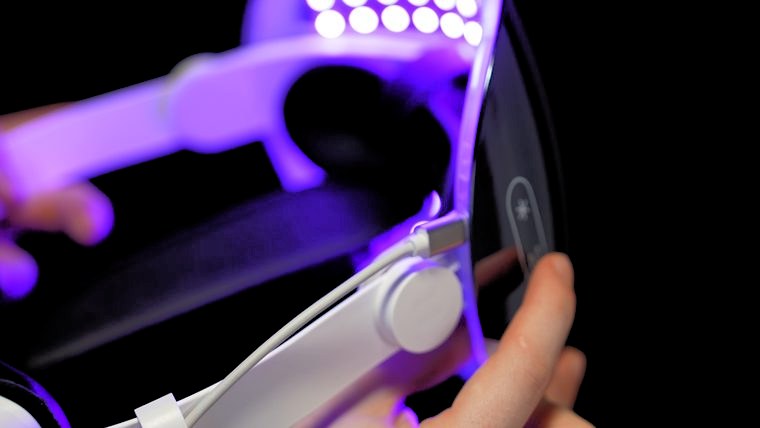
The second is distance. My mask has a rigid frame, the panel is about 1cm away from the skin by my own estimation and doesn't touch your face. The mechanical difference is a fact: the smooth silicone sheet lies on the follicle, the rigid frame does not; I couldn't find any research on whether this counts for inflamed acne. The eye cushion is part of the frame, not a removable accessory. The mask has 99 LEDs.
The third thing I don't do: I don't assign a mode to a skin image. The mask is a home light device for cosmetic purposes, not a medical device, and is not suitable for the treatment of acne or other skin diseases; this is also what your guide says. I have described the above tests with their limitations, the decision is yours, and the order is in the article: cause, doctor, routine, and then the light. If you're still curious about it, I sell the mask and the same restrictions are listed on the product page.
Sources
The cited studies were done with other people's devices, with small numbers, over short periods; none of them are about this mask, and the studied band of blue light was between 414 and 445 nanometres.
- Hughes MC, Williams GM, Baker P, Green AC. Sunscreen and prevention of skin aging: a randomized trial. Ann Intern Med, 2013. PMID 23732711.
- Chalupczak NV, Lipner SR. Malassezia Folliculitis: An Underdiagnosed Mimicker of Acneiform Eruptions. J Fungi (Basel), 2025. PMID 41003208.
- Draelos ZD, Barbieri JS, Tanghetti EA et al. Malassezia Folliculitis Presentation, Diagnosis, and Treatment: A Review of "Fungal Acne". J Drugs Dermatol, 2026. PMID 42081639.
- Ulrich P, Drexler K, Berneburg M, Kurz B, Niebel D. Acneiform drug eruptions: update on pathophysiology and culprit drugs. Front Med (Lausanne), 2026. PMID 41810246.
- Yuan Y, Wang Y, Xia J et al. Topical, light-based, and complementary interventions for acne: an overview of systematic reviews. Cochrane Database Syst Rev, 2024. PMID 39440650.
- Tommasino N, Annunziata MC, Potestio L, Napolitano M. Efficacy and Safety of Hormonal Therapies for Acne: A Narrative Review. Clin Cosmet Investig Dermatol, 2025. PMID 41384221.
- Serrage HJ, Eling CJ, Alves PU et al. Spectral characterization of a blue light-emitting micro-LED platform on skin-associated microbial chromophores. Biomed Opt Express, 2024. PMID 38855662.
- Haag R, Gurow O, Mack M, Moisel J, Hessling M. Enhancement and Limitations of Green-Spectrum Dual-Wavelength Irradiation in Porphyrin-Based Antimicrobial Strategies Targeting Cutibacterium acnes subsp. elongatum. Pharmaceutics, 2026. PMID 41599178.
- Ren X, Ge L, Song Z. Phototherapy for Acne Vulgaris: Strategies and Clinical Applications in Sebum Modulation, Inflammation Control, and Scar Management. Photobiomodul Photomed Laser Surg, 2026. PMID 41980895.
- Papageorgiou P, Katsambas A, Chu A. Phototherapy with blue (415 nm) and red (660 nm) light in the treatment of acne vulgaris. Br J Dermatol, 2000. PMID 10809858.
- Gold MH, Sensing W, Biron JA. Clinical efficacy of home-use blue-light therapy for mild-to moderate acne. J Cosmet Laser Ther, 2011. PMID 22091799.
- Ash C, Harrison A, Drew S, Whittall R. A randomized controlled study for the treatment of acne vulgaris using high-intensity 414 nm solid state diode arrays. J Cosmet Laser Ther, 2015. PMID 25594129.
- Nestor MS, Swenson N, Macri A, Manway M, Paparone P. Efficacy and Tolerability of a Combined 445nm and 630nm Over-the-counter Light Therapy Mask with and without Topical Salicylic Acid versus Topical Benzoyl Peroxide for the Treatment of Mild-to-moderate Acne Vulgaris. J Clin Aesthet Dermatol, 2016. PMID 27354885.
- Friedmann DP, Verma KK, Gidwani KA, Nguyen M, Gharibvand L. Comparing a Red and Blue Light-Emitting Diode Light Device With an Existing Blue Light Device for At-Home Treatment of Inflammatory Acne: An Open-Label Randomized-Controlled Trial. Dermatol Surg, 2026. PMID 41886698.
- Ablon G. A 7-Week, Open-Label Study Evaluating the Efficacy and Safety of 415-nm/633-nm Phototherapy for Treating Mild-to-Moderate Acne in Adolescents and Adults. J Clin Aesthet Dermatol, 2025. PMID 41416031.
- Avci P, Gupta A, Sadasivam M et al. Low-level laser (light) therapy (LLLT) in skin: stimulating, healing, restoring. Semin Cutan Med Surg, 2013. PMID 24049929.
- Na JI, Suh DH. Red light phototherapy alone is effective for acne vulgaris: randomized, single-blinded clinical trial. Dermatol Surg, 2007. PMID 17903156.
- Ershadi S, Barbieri JS. At-Home LED Devices for the Treatment of Acne Vulgaris: A Systematic Review and Meta-Analysis. JAMA Dermatol, 2025. PMID 40042878.
- Choi K, Liu H, Zhu Y, Jiang Z, Lu S. A Case-Control Study Exploring the Association Between Cosmetic Use and Acne Risk: Implications for Prevention and Clinical Practice. Clin Cosmet Investig Dermatol, 2025. PMID 40765696.
- Kim TG, Chung J, Han J, Jin KH, Shin JH, Moon SW. Photochemical Retinopathy induced by blue light emitted from a light-emitting diode Face Mask. 2020. PMC7302677.