

How to read the LED mask's specification? Wavelength, tolerance, LED count, eye covering, battery, and the paperwork.
Six things matter on an LED mask's product page: the peak wavelength per mode with its tolerance, whether it's a measured or a nominal number, how and in which mode the near-infrared runs, how many LEDs it has and how many chips per LED, how it covers the eyes, and what paperwork stands behind it. The number of colours and the sheer LED count say nothing about the light itself. Before you spend on any mask: if you don't have a basic routine (cleansing, moisturising, daily sunscreen), you'll probably regret the money spent on the mask, because there's more and stronger evidence for daily sunscreen slowing skin ageing than what I've seen so far on any at-home light device, and it costs a fraction of the price.
This is the study behind the sunscreen claim: in 2013, Hughes and colleagues followed 903 Australian adults for four and a half years, and among those who applied sunscreen daily, skin ageing didn't detectably increase; they measured 24% less ageing in them than in occasional users.1 This is about sunscreen, not about any mask. There's no study of this size and length behind any LED mask; what exists is small in sample size, a few weeks or a few months long, and made with other manufacturers' devices. If you already have the routine and still want to look at a mask, it's worth reading the product page the way you'd read an instrument's spec sheet: number, tolerance, measurement method, paperwork. In this article I go through these six questions, and at the end you get a checklist you can take with you.
What does wavelength mean, and what does the ± tolerance tell you?
Wavelength is the distance between two consecutive wave crests. Light is an electromagnetic wave, and for light this distance is measured in nanometres: one nanometre is one millionth of a millimetre. Your eye reads wavelength as colour: the shorter wave goes towards violet and blue, the longer one towards red, and anything longer than red you can no longer see, that's the near-infrared. Wavelength isn't strength and isn't dose. It decides which molecule can absorb the light, because every molecule only absorbs certain wavelengths, and light only does something where it's absorbed.
That's why it isn't all the same whether a blue mode shines at 415 or 450 nanometres. In the JAMA Dermatology 2025 review summarising at-home LED devices' acne studies, blue devices worked between 414 and 445 nm, red ones between 630 and 670 nm,2 and the blue band is there because porphyrins (the pigment molecules that absorb the light) have a characteristic absorption peak, the Soret band, which according to the article's introduction (citing another source) sits at 405 nm; a 2024 study gave the measured porphyrin peaks of Cutibacterium strains isolated from healthy skin as 389 to 416 nm according to its results, and 402 to 413 nm according to its abstract.3 The 415 nm blue mode sits at the edge of this band relative to the 405 nm peak, not at the peak itself; a 450 nm mode falls even further from it. The colour name is the same, the studied range is different.
The ± tolerance tells you how far the peak can drift from the stated number. For a blue mode, "450 ± 10 nm" means the peak can be anywhere between 440 and 460, because the manufacturer sorts LED chips into groups by wavelength (this is called binning), and there's spread even within a group. Ten nanometres doesn't sound like much, but at the edge of the studied band it's exactly what decides whether the light falls inside it or not. It matters for the eyes too: the International Commission on Non-Ionizing Radiation Protection's (ICNIRP) blue-light hazard weighting function reaches its peak between 435 and 440 nm, where its value is 1.000; at 415 nm it's 0.800, at 450 nm it's 0.940.4 This is a weighting function: it shows which wavelength loads the retina more at the same amount of light, not that "this much is the risk."
Look for this: the peak wavelength in nanometres for every mode, the ± tolerance next to it, and check whether, even with the tolerance, it stays within the studied band.
The ± tolerance marks out a band around the stated number; whether that band stays within the studied range is something only the two numbers together can show. The LED count is a separate figure, and on its own it says nothing about brightness.
Measured or nominal: how do you know what the mask actually delivers?
The nominal wavelength is the catalog number of the chip; the measured wavelength is what a spectrometer (an instrument that measures the color composition of light) sees on a specific piece. There can be any amount of difference between the two within tolerance. An example from my own desktop, for two modes: the manufacturer's data gave a nominal red of 630 ± 10 nm and a purple of 420 ± 10 nm, the manufacturer's spectrometer measurement for the same type gave a peak of 633,7 nm and 415,4 nm. Both are within the tolerance, but for purple, these five nanometers matter: according to the results of a 2024 study, the measured porphyrin peaks of the Cutibacterium strains were between 389 and 416 nm, according to its summary, they were between 402 and 413 nm, and the Soret peak, according to the introduction of the announcement (referring to another source), is at 405 nm; 415,4 nm is on the edge of the band relative to this peak, not on the peak. For the blue mode, the manufacturer's data was nominally 450 ± 10 nm, the spectrometer measurement gave 414,3 nm. The tolerance does not explain such a difference: the manufacturer gave the nominal value here, without a measured peak, and the chip around 414 nm lights up in the mask. The tolerance in itself does not mean that it is a measure, and it can also be a nominal number in a mixed way: the manufacturer gave 580 ± 10 nm for yellow, even though it is a mixture of green and red.
A round catalog number is not an error in itself. On the other hand, only the measurement tells you which edge of the tolerance your piece is on, and a measured number also reveals the instrument the manufacturer used. There are two telltale signs on the card. If all values are round and without tolerance (630, 850), it is catalog data. If a mode has no peak, only one band is given as a band with no peak, or no number at all, that mode probably comes from mixed tiles and does not have a single wavelength; this will be discussed in the next section.
Look for: next to the wavelength, the word "measured" or a spectrum diagram; if there are only round numbers without tolerance, treat it as catalog data and ask if it is a measure before buying.
I tried eight LED masks before I dared to market one.
 See the LED mask
How many colours are real, and how does the near-infrared run?
There can be several tiles in one LED, and the color list of the mask is created by mixing the tiles. From one red, one green and one blue tile, yellow is red and green together, cyan is green and blue together, and white is all three at the same time. The list of a seven-color mask can also be built like this: from three or four individual wavelengths and their mixtures. Mixed mode does not have a single peak, so it cannot be tied to a single test, and the product sheet does not write a number on it, or only writes a band or a nominal value. This in itself is not a problem, you just need to know how many of the seven colors have an independent tile behind them. My own mask is built exactly like this: according to the manufacturer's spectrometer measurement, there are three visible tiles, one blue, one green and one red, and the near-infrared gives the seven modes.
Infrared is a separate issue. Near infrared (around 850 nm) is the longest wavelength light in a mask and the only one you can't see. Red and near-infrared light is absorbed by the mitochondrial chromophores of the skin cells (mitochondria are the energy-producing part of the cell, the chromophore is the light-absorbing molecule).5 Two things must be read from the product sheet: whether it is provided by an independent chip (then it has a measured or nominal peak) and in which mode it lights. There are masks where the infrared goes in all modes in addition to the visible color, and there is a separate mode that you switch on alternately with the visible colors. If the eighth item in the color list is "infrared", the sheet does not tell you which case you have.
Look for this: how many individual chips are in an LED, which color is an individual peak and which mixture, and which mode the infrared works in.
How many LEDs do you need, and why does the count say nothing about the light?
The LED count tells you how many points of light sit on the panel; brightness is given by the irradiance, in mW/cm². This is called irradiance: it means how much light energy reaches one square centimetre of skin per second. The dose, given in J/cm², is the product of this and the time.6 A hundred LEDs can give as much light as two hundred, if the chips are stronger, the grid denser, or the distance smaller; and a "several hundred LEDs" page can give less, if the chips are weak. So the count alone doesn't let you conclude anything in either direction.
I can't give you an accepted target value either, because there isn't one. According to Zein, Selting and Hamblin's 2018 review, there's still no consensus on light therapy parameters and protocols today, individual research groups' recommendations differ from each other, and because of the wide range of parameters (wavelength, energy, power, duration, repetition), some of the results contradict each other.7 This is the territory of laboratory and clinical studies, with many different devices, none of them a mask's target value. A mask's modes switch on different chips, so a single mW/cm² number doesn't describe all of them; and without the measuring distance, the number alone isn't comparable, because light weakens with distance.
Look for this: alongside the LED count, the number of chips and the irradiance (mW/cm²) per mode, together with the measuring distance; if only the count is given, you learn nothing about brightness.
Silicone sheet or rigid frame: what does the shape decide?
There are two basic shapes. A silicone mask is a soft, bendable sheet with the LEDs sitting in it, which you press onto your face with a strap; it lies on your face like a sheet mask. A rigid-frame mask is a shape-holding shell that sits on the strap and holds the LED panel in front of your face, without it touching. The shape decides four things: the distance, the distribution of the light, the ventilation, and what happens to the LED sheet every time you put it on.
With silicone the distance depends on your face shape and how you put it on, so it varies by occasion and by area of the face; with a rigid frame it's the same every time you use it. On the distribution of the light, this is my own hypothesis, not a measured result: an LED is a point, and if the chip lies on the skin, there's a hot spot beneath it and shadow between the chips, while from a distance of one or two centimetres the neighbouring chips' cones of light overlap, and the skin gets the light more evenly. Whether distance is better than contact, I haven't found a study on that. Ventilation is simpler: a sheet that hugs the skin seals it off and rubs against it, under a frame there's air; on inflamed skin this difference can be noticeable. The fourth is the sheet itself: the LEDs in a silicone mask sit on a flexible printed circuit, and it bends every time you put it on, which in my view stresses the copper traces and the solder joints, because metal fatigues under repeated bending; a rigid sheet has no such stress. A known source of wear is thus missing from the rigid sheet. What speaks for silicone: it packs down smaller.
Look for this: in the photos, whether the panel touches the skin, and whether the LED sheet bends when you put it on; on the product page, the distance between the panel and the skin.
On the left, the sheet that hugs the skin: a hot spot under the chip, shadow between the chips, distance depending on face shape. On the right, the rigid frame: constant distance, the cones of light overlap, the skin gets airflow. The part about distribution is my own hypothesis, not a measurement.


How does it cover the eyes, and what can you see of this in the photos?
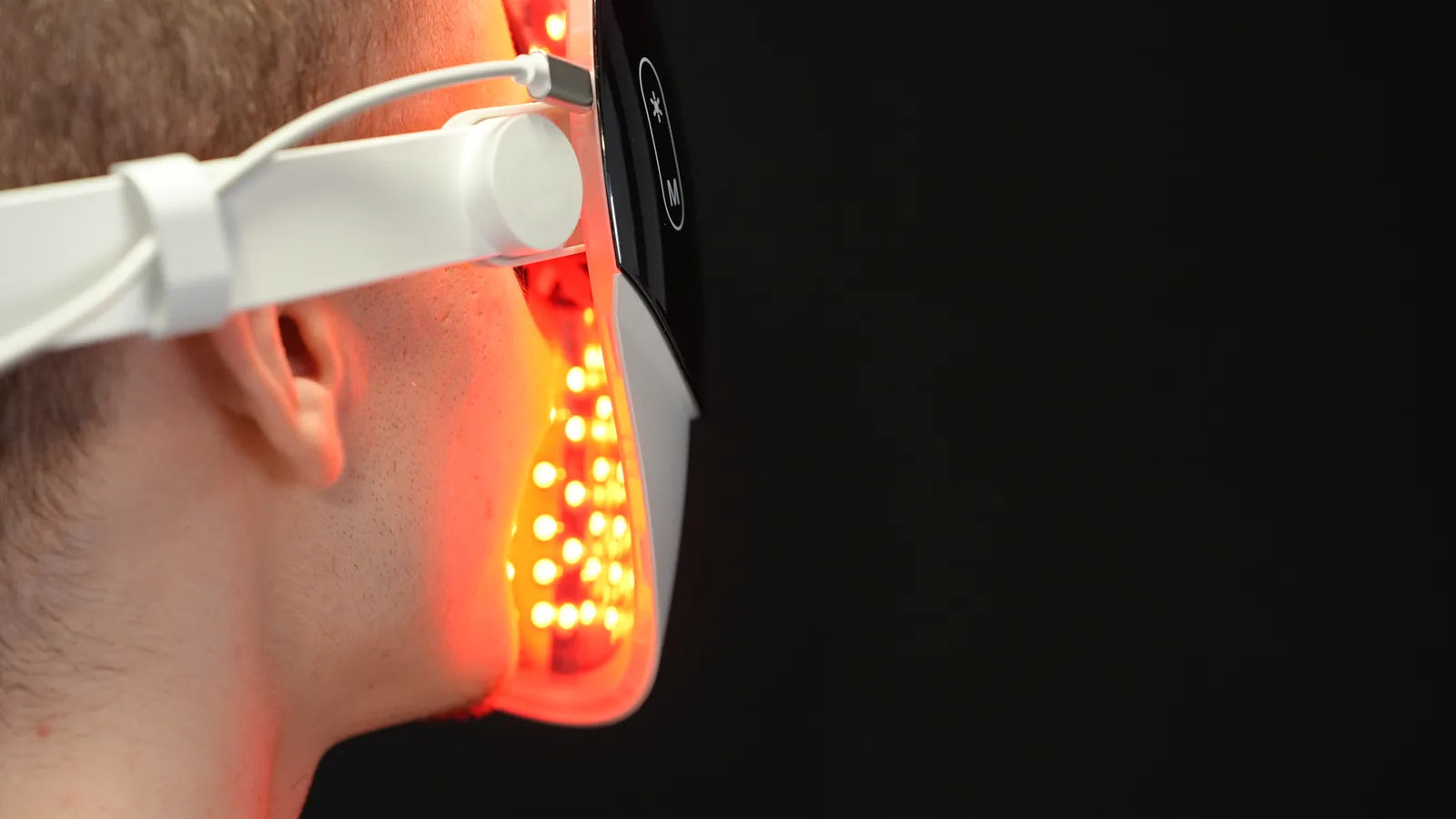
What matters for eye covering is whether the light from the LEDs sitting around the eyes reaches the eye. Eye pad size is a design question: there are silicone masks where the eye pad is small and doesn't cover the light coming from the LEDs enough, and there are ones that give adequate protection despite the cutout size; and because the soft sheet conforms to your face, even on the same mask where it covers and where it doesn't can depend on your face shape. This can be checked per type in the photos. On a rigid-frame design, the pad can be bigger, because it doesn't need to conform to the skin, and the frame places it in the same spot every time you use it. Whether an LED sits on the eye line is also a design question: where the matrix breaks at the eye line, there's nothing to cover.
Why this matters: in 2020, Kim and colleagues published a case in which a 37-year-old woman used a three-source LED mask (blue 460–470 nm, red 620–680 nm, infrared 760–900 nm), and according to the mask's design "the area around the eyes is open, without a protective covering"; the woman used it with her eyes open, following the manufacturer's recommendation, during her daily activities, 20 minutes, every other day, for one month. Ophthalmologists gave her an intravitreal injection (intravitreal bevacizumab); four weeks after the procedure, the visual disturbance and the photoreceptor layer (the layer of light-sensing cells) improved, but the damage to the retinal pigment epithelium (the cell layer beneath the light-sensing cells) remained, even compared to the control.8 This is one case, with one mask, with one treatment, so it can't be generalised from; it shows only that eye covering isn't a minor detail for blue modes. You saw the hazard weighting function above: blue modes sit in the most heavily loaded band for the retina, or at its edge.
Look for this: in the photos, the size of the eye pad and whether an LED sits on the eye line; on a rigid frame, whether the covering is part of the structure. I go through the designs in the eye article.
What do CE, LVD, EMC and RoHS mean?
The CE mark is the manufacturer's (or whoever places the product on the market under their own name) own declaration that the product meets the EU requirements that apply to it. It isn't an official authorisation, isn't an independent test, and isn't a proof-of-effect test; the technical documentation behind it is compiled and held by the manufacturer. The Low Voltage Directive (LVD) looks at electrical safety: electric shock, overheating, fire. The directive itself states that it contains no conformity assessment procedure that would require a notified body, that is, an independent certifier.9 Electromagnetic compatibility (EMC) looks at whether the device doesn't disturb other electronics, and isn't disturbed by its surroundings either. RoHS is the restriction of hazardous substances (lead, mercury, cadmium and the like) in components. None of them say anything about what the light does to your skin.
Look for this: the certificates themselves (number, lab, list of standards), and whether the page presents these as safety paperwork or as proof of effect.

Where does the battery sit, is it replaceable, and does the mask run off a cable?
Where the battery sits decides what happens to the mask once the battery wears out. There are three designs: the battery is built into the LED sheet and isn't replaceable; the battery sits in a separate module (in the strap or a small box), connects by cable, and the module can be opened or replaced; or there's no battery, and the mask only runs off a cable. A lithium battery loses capacity with every charge cycle, that follows from its chemistry; the only question is whether the mask will still run off a cable at that point, or whether it goes in the bin along with the battery. The EU battery regulation is pushing the market in this direction: from February 18, 2027, end users must be able to remove and replace portable batteries, using tools available on the commercial market.10
For cable operation, the charger's rating matters: the product page gives a voltage and a current (for example 5 V / 2 A), and the LED output depends on the power supplied; from a weaker source the light can be dimmer. If the page just says "wireless," it's worth asking before buying whether the mask also runs off the charger, and whether the battery module can be opened with a screw.
Look for this: a battery sitting in a separate module or replaceable, a mask that also runs off a cable, and the stated charger rating.
How much does an LED mask cost, and what does the price tell you?
Prices among the known brands vary widely, and I found few dated data points for them. One well-known premium brand's mask is roughly 170 000 Ft (≈ 425 €), this is from an internal price note, undated; another sits well above that, it was between 839 and 1149 euros, also from an internal price note, undated.11 One dated price point, without checking the build: the MOVTECH mask was 87 700 Ft (≈ 220 €) on July 16, 2026, from an internal price note. Marketplace, unbranded sheets are available for a fraction of this; those get a separate article. The price speaks to the brand and the build; neither price tells you anything about the effect of the light, because the effect studies weren't done by price category. The questions above decide: the wavelengths and the tolerance, the measured number, the eye covering, the frame, the battery, and the paperwork.
What you can take from this: for rigid-frame masks I don't have a dated price data point in this article, so compare the build with the six questions above, regardless of price; my own mask's price is known on the product page.
What do "7 colours", "several hundred LEDs" and "clinically proven" mean in an ad?
"7 colours" can come out of mixing chips too, "several hundred LEDs" is a count without the chip count and the power, and "clinically proven" means that someone, somewhere, did a study with some device. I broke down the first two above. For the third there are three questions: which study, with what device, and on how many people. The JAMA Dermatology 2025 review summarising at-home LED devices' acne studies found six randomised trials, with 216 people in total;2 that's how many the review included, and these are other manufacturers' devices. Since the review closed, a few more small at-home-device studies have appeared, in an open-label design, without a sham treatment: one started with 30 people (15 men, 15 women), in the other, of the 30 targeted, 23 completed the study,12 so the evidence base has grown somewhat since then, along with its limitation. On the wrinkle side I haven't found a comparable summary. The reference point is Cochrane's 2024 review: from six systematic reviews, 275 studies and data on 40,910 people, it found high-certainty evidence for not a single included acne treatment, and even for pharmacy benzoyl peroxide only very low-certainty evidence.13
The field's wording, verbatim and dated: a well-known premium brand's product page says "Reduce wrinkles by 32% in just 2 weeks," meaning according to the brand, wrinkles are 32% fewer within two weeks, retrieved in August 2026;14 a Hungarian retailer writes on its own product page that "Clinically proven technology for treating wrinkles and pimples," and in its FAQ that "We're currently working on our MDR registration."15 I'm not rating these, I'm placing them side by side. What the relationship is between a study and a company's own product is covered in a separate article in the cluster.
Look for this: alongside "clinically proven," the name of the study, the device, and the sample size; if these aren't there, there's no verifiable data behind the phrase.
What to take with you: the checklist
Printed out or as a screenshot, six questions for the product page and three for the photos. 1. What's the peak wavelength in nanometres per mode, and how big is its ± tolerance? 2. Is it a measured value or a catalogue number? 3. Is the near-infrared an independent chip, and which mode does it run in? 4. How many LEDs, how many chips per LED, and what's the irradiance per mode (mW/cm²), measured at what distance? 5. What's the eye covering like: how big is the pad, does an LED sit on the eye line, is it part of the structure? 6. What paperwork stands behind it: LVD, EMC, RoHS with a certificate number? And for the photos: does the panel touch the skin, does the LED sheet bend, and where does the battery sit, does the mask run off a cable. If the page doesn't answer a question, you don't know the answer, and it's worth asking before buying.
The specification describes what this light is: wavelength, tolerance, chip, paperwork. Not what it does to your skin; that's what other devices' small studies are about, and none of them are about your mask.
How many nanometres does a good LED mask need?
In the JAMA Dermatology 2025 review summarising at-home LED devices' acne studies, blue devices worked between 414 and 445 nm, red ones between 630 and 670 nm; porphyrins' characteristic absorption peak, the Soret band, sits at 405 nm according to the article's introduction (citing another source); a 2024 study gave the measured porphyrin peaks of Cutibacterium strains isolated from healthy skin as 389 to 416 nm according to its results, and 402 to 413 nm according to its abstract. This tells you what was studied, not that another wavelength can't do anything. On the product page, look at the peak per mode and the tolerance.
What does the ± tolerance next to the wavelength mean?
Tolerance tells you how far the peak can drift from the stated number: a 450 ± 10 nm blue mode's peak can be anywhere between 440 and 460, because the manufacturer sorts LED chips into groups by wavelength, and there's spread even within a group. At the edge of the studied band, these ten nanometres decide whether the light falls inside it; at the middle of the band it doesn't matter.
How many LEDs does a good LED mask have?
The count alone says nothing about the light. An LED can hold several chips, and brightness is given by the irradiance (mW/cm²), which depends on the strength of the chips, the density of the grid, and the distance. A hundred LEDs can give as much light as two hundred. If the page gives the LED count without a chip count and mW/cm² per mode, you learn nothing about brightness.
What if the product page doesn't show the wavelength or the mW/cm²?
Then you don't know what you're buying: without the wavelength, not even which molecule absorbs the light; without the irradiance, not even how much your skin gets. According to Zein and colleagues' 2018 review, there's still no consensus on light therapy parameters, so I can't give you a "good" number either; a missing number, though, means the manufacturer didn't even disclose it. Ask about it, and if there's no answer, don't buy this mask blind.
Is a silicone or a rigid-frame LED mask better?
On structural points, the rigid frame comes out ahead: the distance is the same every time you use it, the eye pad can be bigger, the LED sheet doesn't bend when you put it on, and the panel doesn't touch the skin. Silicone packs down smaller. Whether distance is better than contact for light distribution is my own hypothesis, I haven't found a study on it. Neither shape says anything about the effect of the light.
What does the CE mark mean on an LED mask?
CE is the manufacturer's (or whoever places the product on the market under their own name) own declaration that the product meets the EU requirements that apply to it, typically electrical safety (LVD), interference protection (EMC), and hazardous substances (RoHS). It isn't an official authorisation, isn't an independent test, and says nothing about the effect of the light. What you can check is the certificate behind it: number, issuing lab, standards tested.
What does it mean for an LED mask to be "clinically proven"?
That someone, somewhere, did a study with some device. Three questions decide whether it's worth anything: which study, with what device, on how many people. The JAMA Dermatology 2025 review summarised at-home LED devices' acne studies across six randomised trials, with 216 people, using other manufacturers' devices; Cochrane's 2024 review found high-certainty evidence for not a single acne treatment.
Is the battery replaceable in LED masks?
It depends on the design. There are masks where the battery is built into the LED sheet and isn't replaceable; there are ones where it sits in a separate module, connects by cable, and the module can be opened with a screw. Under the EU battery regulation, from February 18, 2027, end users must be able to remove and replace portable batteries, using tools available in shops. On the product page, look for where the battery sits, and whether the module can be opened.
Does the LED mask work off the charger, without a battery?
Some do: if the battery sits in a separate module and connects by cable, the mask can also run off a suitable USB-C source without the battery. The page then gives a voltage and a current (for example 5 V / 2 A); the LED output depends on the power supplied, from a weaker source the light can be dimmer. If the page just says "wireless," ask whether it runs off the charger.
How much does an LED mask cost?
I found few dated price data points: one well-known premium brand's mask is roughly 170 000 Ft (≈ 425 €) (from an internal price note, undated), another sits well above that, it was between 839 and 1149 euros (also from an internal price note, undated). MOVTECH's price was 87 700 Ft (≈ 220 €) on July 16, 2026, from an internal price note, I didn't check its build. Marketplace, unbranded sheets are available for a fraction of this; the price speaks to the build, not to the effect of the light.
What if a mask's blue mode peaks at 460 nm?
The blue devices in the at-home acne studies worked between 414 and 445 nm, so 460 nm isn't within this at-home-device evidence base; this tells you what was studied, not that another wavelength can't do anything. It isn't gentler on the eyes: the ICNIRP blue-light hazard weighting function is 0.800 at 460 nm, the same as at 415 nm, the peak sits between 435 and 440 nm. The eye case published in 2020 involved a mask giving blue light between 460 and 470 nm, without a protective covering. For a blue mode, check the eye covering first.
What I looked for in my own mask
I tried eight LED masks before I dared to market one, and the list above was made up of what I missed about them. The data of my own mask in the order of the questions above: the manufacturer measured all seven modes with a spectrometer, the peaks are 414 nm blue, 515 nm green and 634 nm red, for the near infrared the manufacturer gave 852,7 nm in a previous communication (namely 850 ± 10 nm); purple is blue and red, cyan is blue and green, yellow is green and red, and white is all three tiles at once. Near infrared works in all modes. It has 99 LEDs, each with 4 chips. Rigid frame, the panel is about 1 cm away from the face and does not touch it; closed, padded cover around the eyes, which is part of the structure, and there is no LED on the eye line. Works from USB-C, 5 V / 2 A source; the battery is in a separate, screwed module in the back strap, so the mask works without the battery. LVD and EMC certificates are available, with certificate number. It comes with a two-year warranty. This list says nothing about the effect of light; that is what the above tests are about, with other devices. I am selling this mask.
Sources
The sources are about sunscreen, the wavelength bands, the load on the eyes, and the legal background of the certificates; none of them were made about this mask, and none of them prove the effect of the light on this device.
- Hughes MC, Williams GM, Baker P, Green AC. Sunscreen and prevention of skin aging: a randomized trial. Annals of Internal Medicine, 2013. PMID 23732711.
- Ershadi S, Barbieri JS. At-Home LED Devices for the Treatment of Acne Vulgaris: A Systematic Review and Meta-Analysis. JAMA Dermatology, 2025. PMID 40042878.
- Serrage HJ, Eling CJ, Alves PU, et al. Spectral characterization of a blue light-emitting micro-LED platform on skin-associated microbial chromophores. Biomedical Optics Express, 2024. PMID 38855662.
- ICNIRP. Guidelines on limits of exposure to incoherent visible and infrared radiation. Health Physics, 2013; 105(1):74-96, Table 2 (Retinal hazard spectral weighting functions).
- Avci P, Gupta A, Sadasivam M, et al. Low-level laser (light) therapy (LLLT) in skin: stimulating, healing, restoring. Seminars in Cutaneous Medicine and Surgery, 2013. PMID 24049929.
- Jagdeo J, Austin E, Mamalis A, et al. Light-emitting diodes in dermatology: A systematic review of randomized controlled trials. Lasers in Surgery and Medicine, 2018. PMID 29356026 (PMC6099480).
- Zein R, Selting W, Hamblin MR. Review of light parameters and photobiomodulation efficacy: dive into complexity. Journal of Biomedical Optics, 2018. PMID 30550048.
- Kim TG, Chung J, Han J, Jin KH, Shin JH, Moon SW. Photochemical Retinopathy induced by blue light emitted from a light-emitting diode Face Mask: A case report and literature review. Medicine (Baltimore), 2020. PMID 32541484 (PMC7302677).
- Directive 2014/35/EU of the European Parliament and of the Council (Low Voltage Directive), recital (9). Official Journal of the European Union, 2014. eur-lex.europa.eu
- Regulation 2023/1542 of the European Parliament and of the Council (EU) on batteries and waste batteries, Articles 11(1) and 96(2)(a). Official Journal of the European Union, 2023. eur-lex.europa.eu
- Price check: MOVTECH internal price note (HUF 87,700, 2026. July 16, without export control), product pages of two well-known premium brands (EUR 839-1149, respectively approx. HUF 170,000, from internal price note, without date; I will not name the brands on purpose).
- Ablon G. A 7-Week, Open-Label Study Evaluating the Efficacy and Safety of 415-nm/633-nm Phototherapy for Treating Mild-to-Moderate Acne in Adolescents and Adults. The Journal of Clinical and Aesthetic Dermatology, 2025. PMID 41416031. · Friedmann DP, Verma KK, Gidwani KA, et al. Comparing a Red and Blue Light-Emitting Diode Light Device With an Existing Blue Light Device for At-Home Treatment of Inflammatory Acne: An Open-Label Randomized-Controlled Trial. Dermatologic Surgery, 2026. PMID 41886698.
- Yuan Y, Wang Y, Xia J, et al. Topical, light-based, and complementary interventions for acne: an overview of systematic reviews. Cochrane Database of Systematic Reviews, 2024. PMID 39440650.
- Product page of a well-known premium brand, called 2026. August 21 (I will not name the brand on purpose): "Reduce wrinkles by 32% in just 2 weeks."
- The product page and FAQ of a Hungarian distributor, checked in the summer of 2026 (I will not name the distributor on purpose): "Clinically proven technology for the treatment of wrinkles and acne" · "We are currently working on the MDR registration".