
Why you shouldn't buy it
If you don't have a basic, consistent skincare routine, put that together first: it's cheaper and worth more. The mask is a good complement to a routine that already works, but it's not enough in place of the basics.
If you're looking at it for how your skin looks: have this in place first
1. Sunscreen every morning. Behind this step is a four-and-a-half-year randomized trial: 903 adults, and in the daily users there was no detectable increase in skin ageing, 24% less than in the occasional users. If you were to use just one thing, make it this.
2. A gentle cleanser and a moisturiser. Every day. Without them, the layers you put on top are worth little. If you're putting it together now, here's some help.
3. An evening active can go alongside. Retinoids are the established option for this. Retinal and retinol are available without a prescription, in drugstores too. Tretinoin, on the other hand, is prescription-only, and your dermatologist decides on it: which one is right for you, in what strength, when you mustn't use it and what it doesn't combine with is their call. I don't prescribe anything.
4. Sun exposure and smoking. There's plenty of literature on their effect on the skin, so they're worth thinking about too when we talk about skin ageing.
And after that comes the mask, as a complement. A comfortable extra step at the end of your routine: a few times a week, hands-free.
What did they find for wrinkles? Red light has also been studied for wrinkles, with other masks. In a 60-person, 16-week, double-blind study with a mask combining red and infrared light, the independent assessors found a significant difference in crow's feet compared with the sham mask at weeks 8, 12 and 16 (Park et al., 2025; funded by the mask's manufacturer). In a 95-person, 4-week study, the software measurement found significantly shorter wrinkles than the sham treatment on two of the four measured facial areas, while the expert wrinkle scale showed no difference (Bragato et al., 2025). The details and the limitations are here.
The source for point 1: Hughes et al., 2013. Sunscreen and prevention of skin aging: a randomized trial. Annals of Internal Medicine, PMID 23732711. A randomized, community-based trial, 903 adults, Nambour, Australia. Relative odds 0.76 (95% CI between 0.59 and 0.98). The authors note as limitations that some outcome data were missing and that the study had modest power to detect moderate effects.
If you're looking at it because of breakouts: have this in place first
1. Look at the cause first, not the light. How long has it been going on? Does it come with anything else: a change of medication, contraception, sweat after sport, a helmet or cap rubbing, hair products on your forehead? What are you using now, and since when? If your answer to any of these is that you don't know, start there: that's the first step.
2. The basics are the basics here too. A gentle cleanser without rubbing, a moisturiser and a sunscreen that don't clog your pores, and consistency.
And after that comes the mask, as a complement. A complement to caring for breakout-prone skin, alongside a routine that already works. Light therapy for acne has already been looked at in 71 randomized trials, with other devices. I list four studies below, together with what they found. According to a Cochrane review, there's no good-quality evidence yet, so the cause comes first and the mask comes alongside it. It doesn't replace medical treatment. There's a separate article on blue light and breakouts.
-

-


 Rigid frameDoes not touch the skin
- Closed eye shield, part of the structure
- Rigid frame, the LEDs do not flex
 Rear moduleRechargeable via USB-C
- Screwed, replaceable battery module
- Ratchet headband, set it once
 What I designedThe strap adapter in place
- My own design, 3D printed
- With your monogram on request
 BetaRotate the product


Details of the seven modes ↓
ENC2404034GZ58-2 · ENC2404034GZ58-1The certificates themselves ↓


LED Light Therapy Mask
LED Light Therapy MaskRigid-frame LED mask that doesn't touch your face and encloses your eyes.

I've worn it every other day for half a year. I tried eight masks on my own face, and this is the one I kept. Marci, founder
What will your points be worth? You earn points for every purchase, redeemable in the points shop without paying money. Your points never expire, and they will be redeemable for every future product too:


+4gifts with the maskfree
-
 Biodance bio-collagen maskOne in the box, the same one that's sold in my shop.free
-
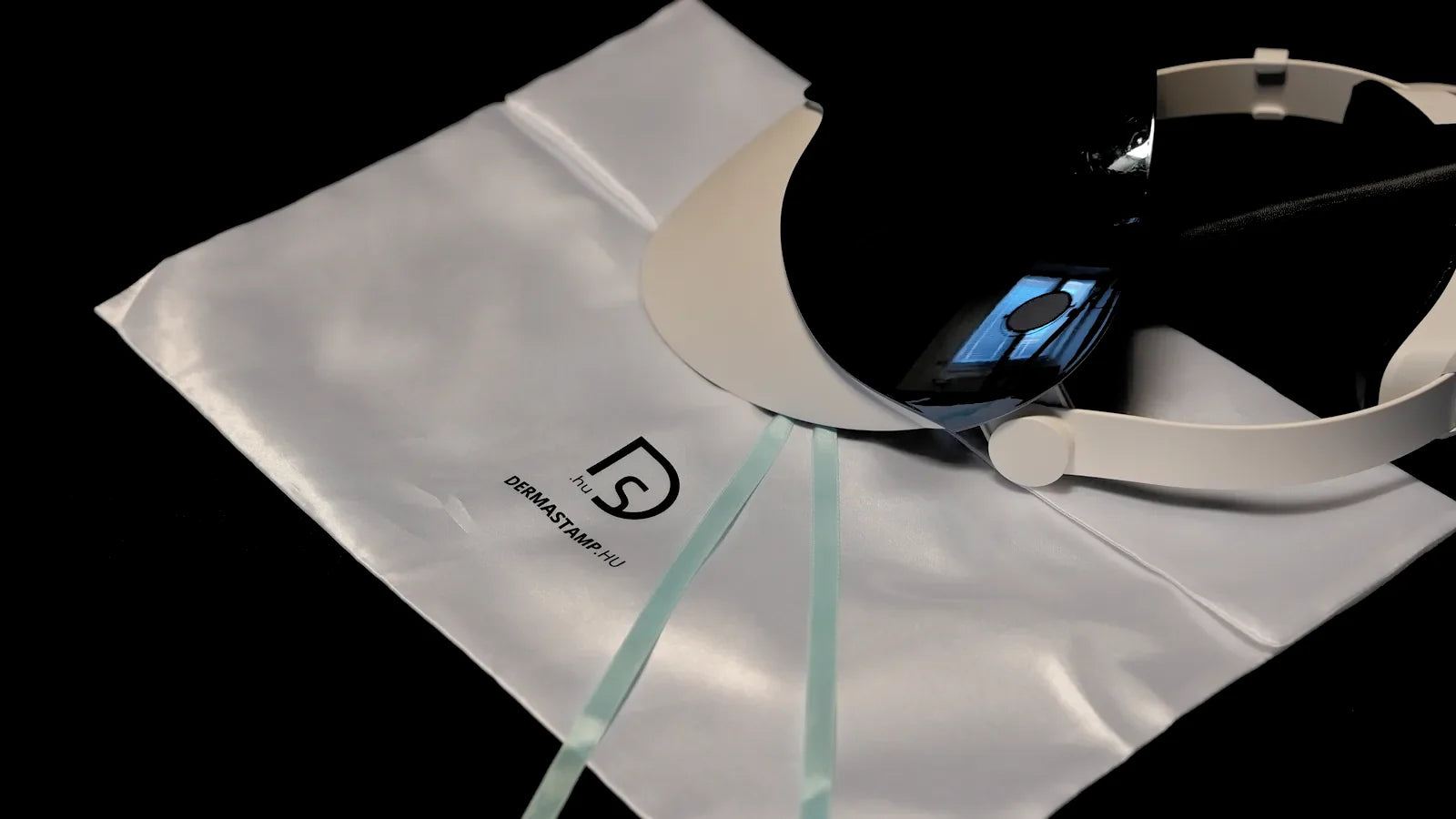
 White satin storage bagWith the dermastamp.hu logo. For simple storage of the mask.free
-
 3D printed strap adapterI designed it and I print it. Want to personalise your mask even further? Write or call, and I'll design and print it.free
- Printed routine helpHow long, how often, which button gives which mode, which wavelength each mode works at, and what you can do alongside the mask to help reach your goal.free

We currently ship within the European Union only.
Choose your EU country to see the price in euros and the delivery options. The forint prices shown here apply to Hungary.
How long? 30 days from receipt.
Can I use it during the trial? Yes. Put it on, turn it on, run one programme: that doesn't reduce your refund.
What's the condition? For the part after day 14, the original box and all the accessories. The gifts stay yours.
What do you pay? The cost of sending it back, and if you've used it beyond trying it out, the loss of value. I back up any deduction with a photo.
And the 14-day right of withdrawal? You keep it, independently of this.
What does the warranty cover? The whole device, including the battery, the LEDs and the strap. If it fails within two years, I'll repair or replace it.
What does it cost you? Nothing. The repair, the replacement and the shipping that goes with them are on me.
Where is it valid? In every country I ship to.
What doesn't it cover? Faults caused by improper use, by not following the guide, or by natural wear and tear.
And after that? The rear module is screwed, not glued. I'll replace the battery module even after the warranty, and I'll tell you the price in advance.
What you get in the box
- LED light mask with headband. 99 LEDs. The rear strap module holds the battery and the ratchet head-size adjuster.
- USB-C cable. It connects the battery module to the LED panel, and you charge with it. Both ends are detachable.
- 3D printed strap adapter. I designed it and I print it; it holds the front strap point. Want another one? I'll print it.
- Satin storage bag. White, with dermastamp.hu logo. The folded mask fits inside.
- Printed guide, in Hungarian. 12 pages: how to use it, the seven modes, a safety section, contraindications.
- Printed routine help. How long, how often, which button gives which mode, and which wavelength each mode works at. Alongside it, what you can do for your skin beyond the mask.
- Gift box. It comes in this.
LED masks commonly promise big percentages and exact timeframes. You won't find any of that on this page.
What you read on the market
From the brands' own product pages, in translation.
What the studies found
Four studies on breakout-prone skin, one on wrinkles around the eyes, all with other devices.
Details of the five studies: how many people, how long, what the limitations are
- 28 people, 8 weeks. Red light: on the treated half of the face, both the inflammatory and the non-inflammatory lesion counts improved significantly more than on the untreated half.Na and Suh, Dermatologic Surgery, 2007 · randomized, without sham
- 30 people, 2 days, 4 sessions. Blue-purple, 414 nm, a handheld device made for home use, with the sessions done in the clinic: the size and redness of the treated pimple improved significantly more than with the sham device.Gold et al., 2011 · vs a sham device · 4 sessions in two days, in the clinic
- 107 people, 4 groups, 12 weeks. Blue (415 nm) and red (660 nm) light together was significantly better than blue alone for inflammatory lesions at 4 and 8 weeks. By week 12, the difference was no longer significant.Papageorgiou et al., Br J Dermatol, 2000 · both lights at once, without near-infrared, with 660 nm red; on this mask the purple mode gives both, with 634 nm red, plus near-infrared too
- At-home mask, 7 weeks. 415 and 633 nm: in 29 people (one of the 30 dropped out), both the inflammatory and the non-inflammatory lesion counts fell significantly.Omnilux Clear, J Clin Aesthet Dermatol, 2025 · open-label, no control arm · funded by the manufacturer · during the study they also got a new, standardised skincare routine · both lights at once, without near-infrared; on this mask the purple mode gives both, plus near-infrared too
- 60 people (59 evaluated), 12 weeks. Red (630 nm) and near-infrared (850 nm) light together, in another manufacturer's at-home mask (Easy Claire). At week 12, according to the independent assessors, crow's feet eased by at least one grade in 25 of the 29 people using the mask and in 5 of the 30 using the sham mask. In the participants' own ratings there was no significant difference between the two groups. Use lasted 12 weeks, and they were followed for another 4 weeks after that: for the independent assessors, the difference was significant at weeks 8, 12 and 16.Park et al., Medicine, 2025 · double-blind, in two centres · the sham mask gave no infrared, and red at one-tenth strength · funded by the manufacturer of the mask studied · Asian participants aged 30 to 65
Details of the seven modes ↓
ENC2404034GZ58-2 · ENC2404034GZ58-1The certificates themselves ↓
19-minute video: everything science knows about LED masks
Are LED Mask Brands Misleading You?
Under the Lens, episode 1 · 6 October 2026
I go through what the market promises, what the studies measured, and what to watch for when you buy a mask. I hold this mask to the same standard.
What's different about this mask, and why it's better
An enclosed, padded cover around the eyes
The LED matrix stops at the eye line, and a padded silicone cover encloses the eyes. The cover is part of the structure, not a removable accessory.
Why this was the deciding factor
In 2020 a case was published in which the retinal pigment epithelium was damaged after a mask's blue light; on that mask the area around the eyes was open, with no protective cover. After injection treatment into the eye, at the four-week follow-up the symptoms and the layer of light-sensing cells had improved, but the damage to the pigment epithelium remained. The blue light in that case was between 460 and 470 nm; this mask's blue chip is 414 nm, according to the manufacturer's measurement, it lights up in the blue, purple, cyan and white modes, and this light isn't harmless to the eyes either. This weighed most in deciding which of the eight masks I tried I would bring to market. The details and the source are in the eye section.
Doesn't touch your facial skin
The panel sits on a rigid frame, the LEDs are about a centimetre from your skin, and that distance is the same every time you use it. It doesn't touch your nose either, so it doesn't press on it. Your skin can breathe underneath, and there's no friction on inflamed skin.
Why one centimetre is a good spot
This is my own hypothesis, not a measured result. With a dense LED grid, the light cones of neighbouring diodes already overlap at one centimetre, so the skin gets more even light than with a face-hugging mask, where there's a hot spot under each diode and shadow between them. At this distance, the light from a grid of sources barely weakens yet, while the air can still circulate, and the panel doesn't rub against inflamed skin.
Whether one centimetre is better than direct contact, I haven't found a study that answers. Face-hugging silicone seals off your facial skin; on inflamed skin, friction and a sealed surface are exactly what you don't want.
The LEDs don't bend
They sit on a rigid board. In a foldable mask, they flex at every use.
What this means for the lifespan
Bending stresses the solder joints and the conductive traces; on a rigid board, that stress isn't there. So the rigid board lacks one known source of wear. I didn't measure lifespan.
Lands in the same spot every time
The rigid frame keeps the LEDs at the same distance from your face, always.
Why this is hard on a silicone mask
On a face-hugging sheet, the distance of the LEDs depends on the shape of your face and how you put it on, so it varies by session and by area of the face. On the rigid frame, that variable drops out.
The rigid frame folds up, and it comes with a white satin pouch with the dermastamp.hu logo for travelling. The real advantage of the silicone mask is the smaller packed size.
My mask: an enclosed eye cover, the panel doesn't touch your skin, the LEDs don't bend, and it lands in the same spot every time. Silicone's advantage: a smaller packed size. That's it, on structural points.
How far the light reaches
The current trend with LED masks is maximum facial coverage. That has a price rarely written down: the light gets closer and closer to the eye. Coverage alone isn't a quality benchmark.
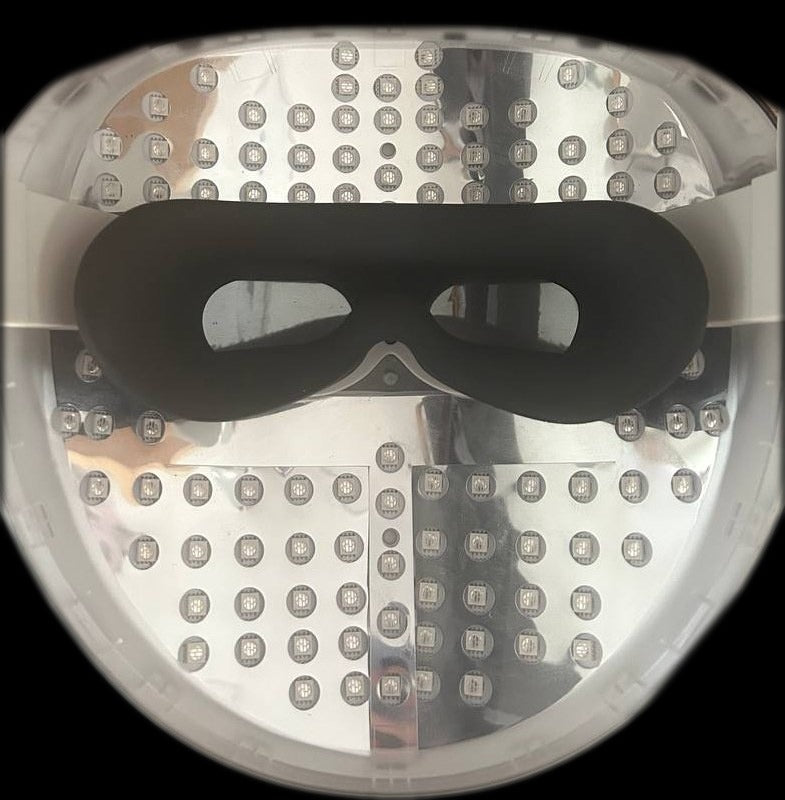
Not a single LED faces your eyes. The matrix stops at the eye line, and a padded silicone cover encloses the eyes.
Why does eye protection matter?
In 2020 a case was published in which the retinal pigment epithelium was damaged after a mask's blue light between 460 and 470 nm; on that mask the area around the eyes was open, with no protective cover. After injection treatment into the eye, at the four-week follow-up the symptoms and the layer of light-sensing cells had improved, but the damage to the pigment epithelium remained. This mask's blue chip is 414 nm, according to the manufacturer's measurement, it lights up in the blue, purple, cyan and white modes, and this light isn't harmless to the eyes either. This weighed most in deciding which of the eight masks I tried I would bring to market.
The limit: the retinal damage is a single published case, not a study. All it shows is that the phenomenon exists. And the cover only protects if the mask is in place.
What's known about eye exposure, and what isn't
In the case, a 37-year-old woman used a mask with open eye cut-outs for twenty minutes every other day, for a month. At the four-week follow-up, her visual disturbance and the photoreceptor layer on the OCT scan had improved, but the damage to the retinal pigment epithelium remained.
I don't know of a published case like this for near-infrared, but it isn't a zero-risk band either. People taking photosensitising medication and people living with an existing eye condition shouldn't use it without consulting a doctor.
Source: Kim et al., 2020. Photochemical retinopathy induced by blue light emitted from a light-emitting diode face mask. PMC7302677. The device in question was another manufacturer's mask with open eye cut-outs.

The light you choose
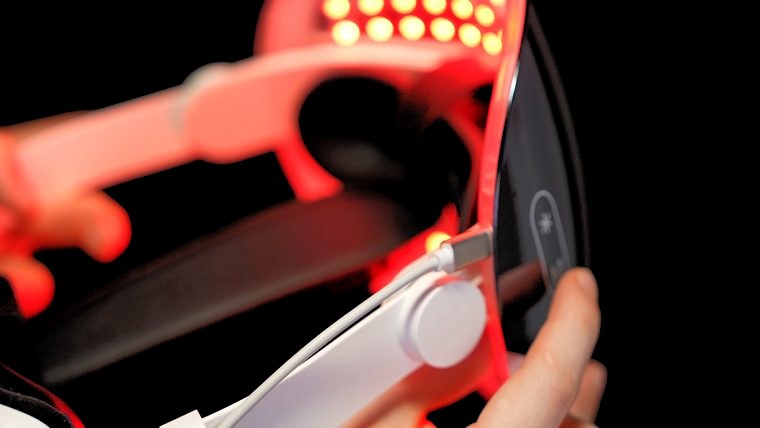
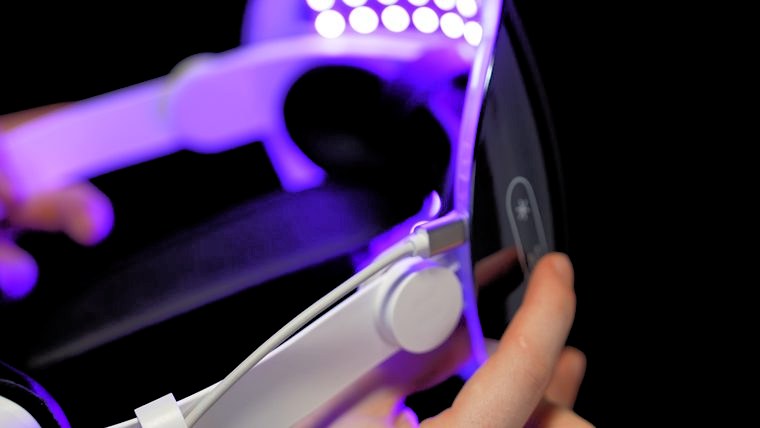
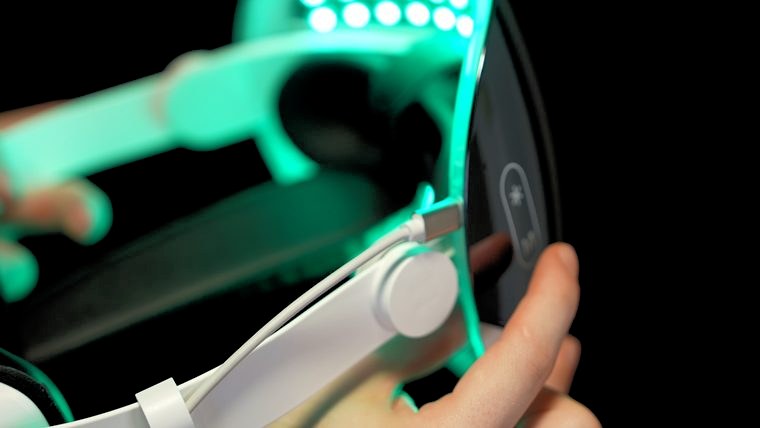
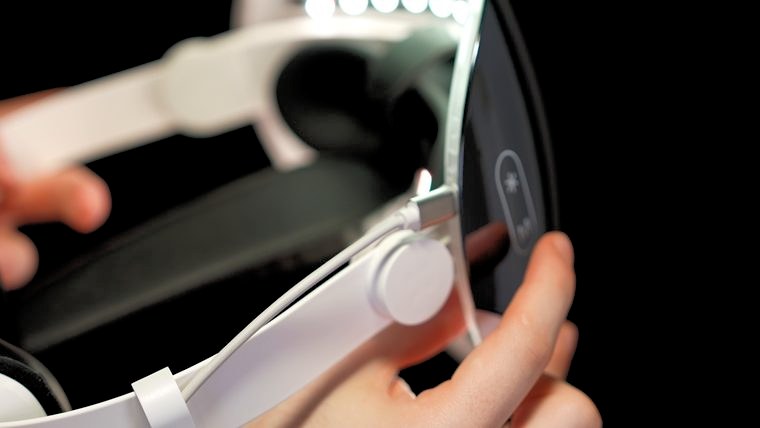
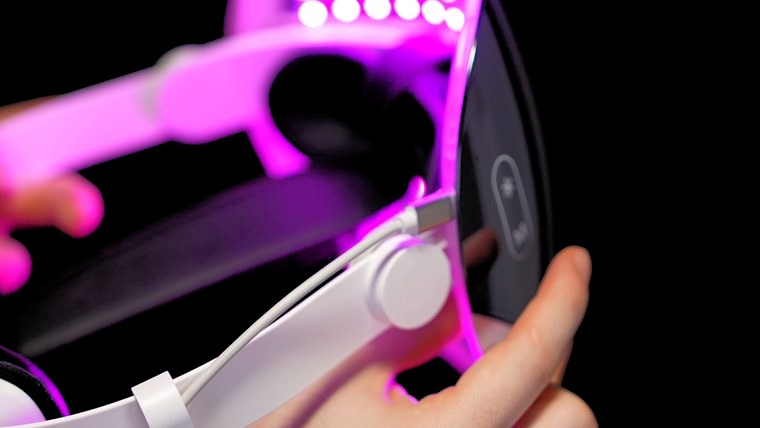
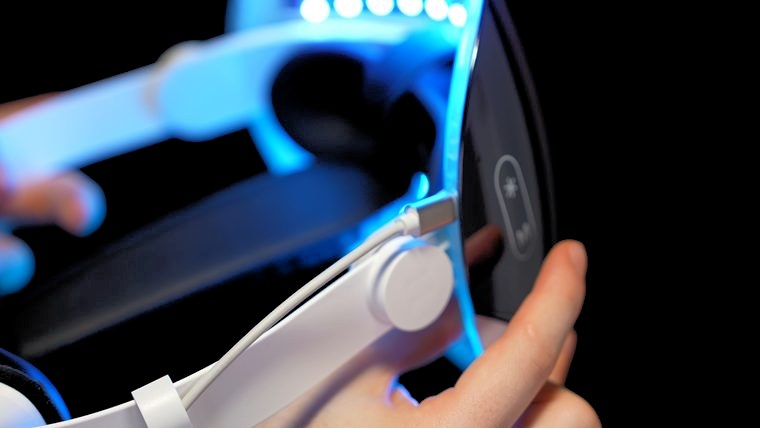
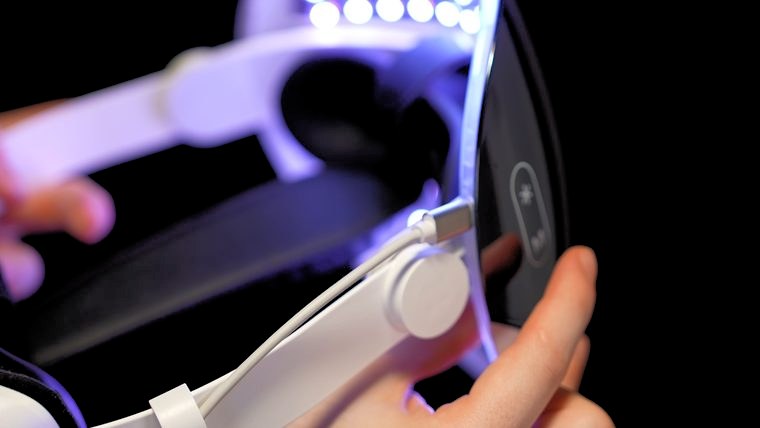
The blue and red chips light up in the studied range. Blue at 414 nm, red at 634 nm, according to the manufacturer's measurement. The blue mode, the red mode and the purple mode that gives both together work at these wavelengths; the studies were done with other devices.


What was studied at this wavelength
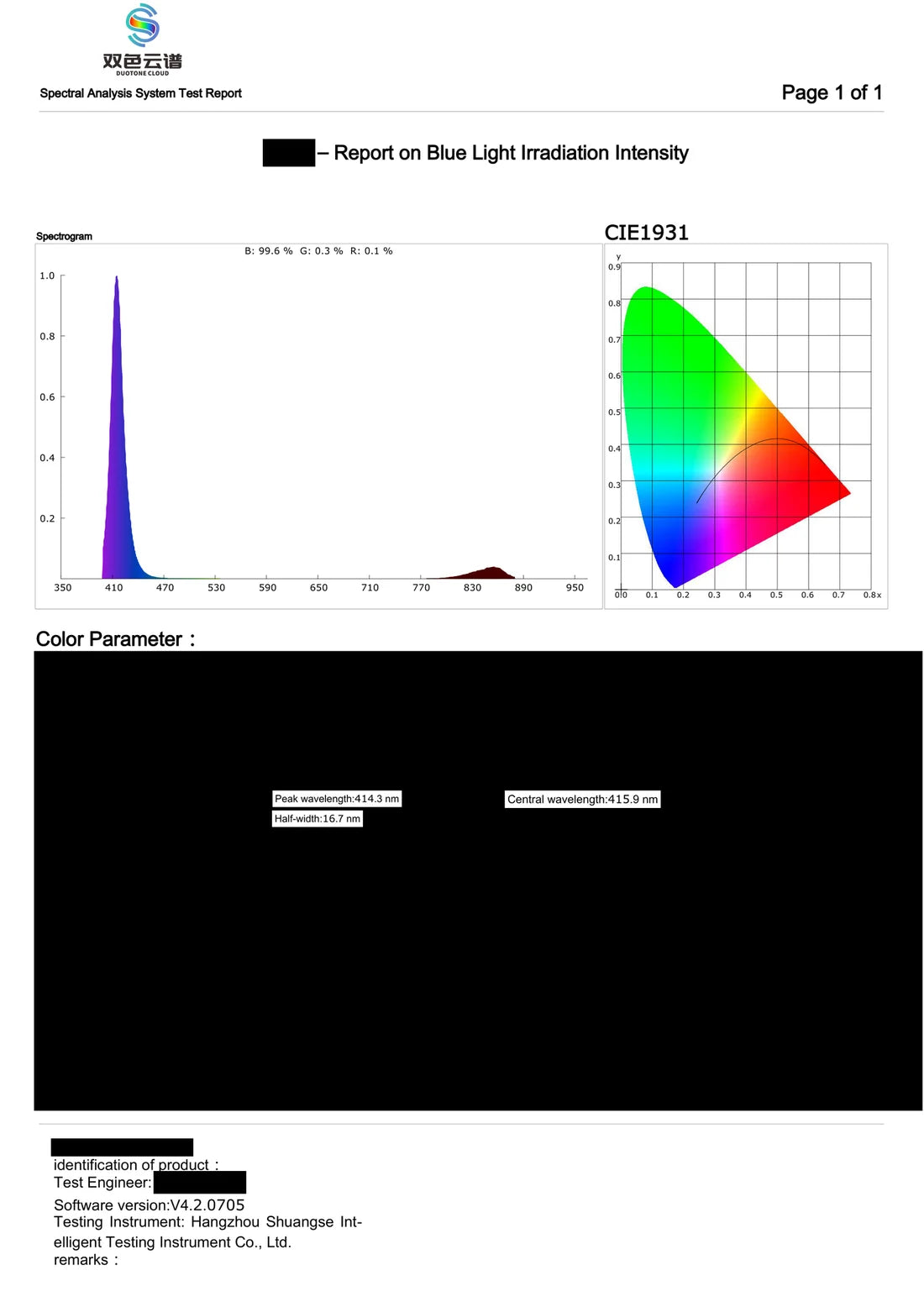
The manufacturer measured all seven modes with a spectrometer. The curve shows which wavelengths of light come out of the mask, relative to the strongest peak. On the far right, around 850 nm, you can see the near-infrared, which runs in every mode.
What did I redact?
What wavelength means
A wavelength is the distance between two consecutive wave crests, and it decides what colour you see. Shorter waves move towards blue, longer ones towards red. The 850 nm near-infrared is the longest-wavelength light in this mask; it runs in every mode, and it's the only one the eye can't see.
What light is, and why I talk about wavelength
Light is an electromagnetic wave, from the same family as radio waves or X-rays. What sets them apart is the wavelength: the distance between two consecutive wave crests. For light, this is measured in nanometres, a millionth of a millimetre.
Your eye reads wavelength as colour. The shortest one you can still see looks violet, the longest looks red. What's longer than red is infrared: the mask's 850 nm chips give off light like that, which is why you don't see it when they're on. The shorter the wave, the more energy each particle of light carries. That's why violet can excite a molecule that red can't.
So wavelength isn't strength, and it isn't dose. It tells you which molecule can absorb the light. Devices are designed around this number, and studies measure on it too.
What's the point of colours lighting up your face
Light only does something where a molecule absorbs it. Whatever isn't absorbed is reflected or scattered, and nothing happens. Different molecules absorb different wavelengths, so the colour decides which molecule gets the energy.
Two examples that have been studied. Acne-associated bacteria produce porphyrins, and coproporphyrin III absorbs between 400 and 415 nm: the blue mode, at 414 nm according to the manufacturer's measurement, sits at the edge of that range. Red and near-infrared light are absorbed by mitochondrial chromophores in skin cells; the red devices studied in the at-home acne LED review worked between 630 and 670 nm.
That's why the mask has seven modes instead of a single bright white light. The mask has three kinds of visible chips, according to the manufacturer's measurement: a 414 nm blue, a 515 nm green and a 634 nm red. Alongside them, the nominally 850 nm near-infrared lights up, in every mode. The seven modes are built from these: blue, green and red are one chip each, purple is blue and red, cyan is blue and green, yellow is green and red, and white is all three at once. Your eye mixes the yellow, the cyan and the white. Absorption is the first step. What happens in the skin after that was measured in studies of other devices: you can read it above, mode by mode, together with the limitations.
Sources: porphyrin absorption: Biomedical Optics Express, 2024, PMID 38855662; mitochondrial chromophores: Avci et al., Seminars in Cutaneous Medicine and Surgery, 2013, PMID 24049929; the studied bands: JAMA Dermatology, 2025, PMID 40042878.
Context you rarely see on product pages
Zero. That's how much high-certainty evidence exists for the effect of any acne treatment included in the review, from the data of 40,910 people. Cochrane's 2024 review processed six systematic reviews, drawn from 275 trials. Its conclusion, verbatim: We found no high-certainty evidence for the effects of any therapy included. If that's the truth even for the standard over-the-counter basics, then the modest claim I make about myself isn't sugar-coating either.
Cochrane Database of Systematic Reviews, 2024, PMID 39440650.

After eight masks, this one stayed

I bought 8 different LED masks and tried them on my own face before deciding which one to sell. This is the one that stayed.
I found the best LED mask and made it even better with 3D printing. I'll keep improving it with accessories, and if you have any suggestion after using it, I'll design it and print it.
What I wasn't happy with, I designed and printed
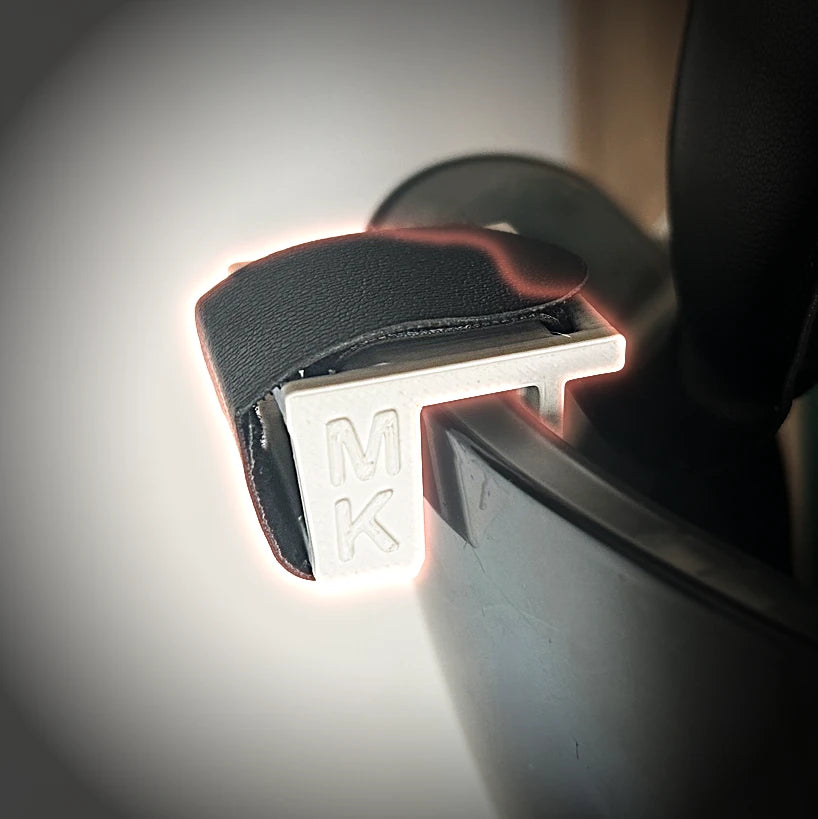
One thing bothered me about the mask: the connection point of the front strap. I designed an adapter for it and printed it. This piece comes with the mask, it's part of what you get.
Want to personalise your mask even further? Write or call, and I'll design and print it.
If you want another one
The adapter doesn't open the electronics and doesn't touch the light. It's a structural piece that holds the strap. I print it myself, so you can ask for as many as you want: a spare, a different colour, a modified version.

The image is a rendered view from the actual model released for printing. This is the final version: I printed it, tried it on, and it's the one that stayed.
With your own monogram, if you want it
In the picture, the piece carries two sample letters. At checkout, you pick the two letters from a dropdown, and I print them in: your monogram, or any two letters you like. Free.
The dropdown offers the letters A to Z. The mark sits on the outer side panel of the rail, outside what the strap holds: it doesn't open the electronics, and it doesn't touch the light. If you don't choose any letters, you get a plain, unmarked piece.


What's in the box


documentation behind the mask
CEmarking
CE means that whoever places the product on the market declares, on their own responsibility, that the device complies with the EU directives that apply to it.
Compiling and keeping the technical documentation behind the CE marking for ten years is the obligation of the party placing it on the market.LVDin hand
 Teljes meretben
Low Voltage Directive, 2014/35/EU. It tests whether the device is electrically safe: electric shock, overheating, fire.
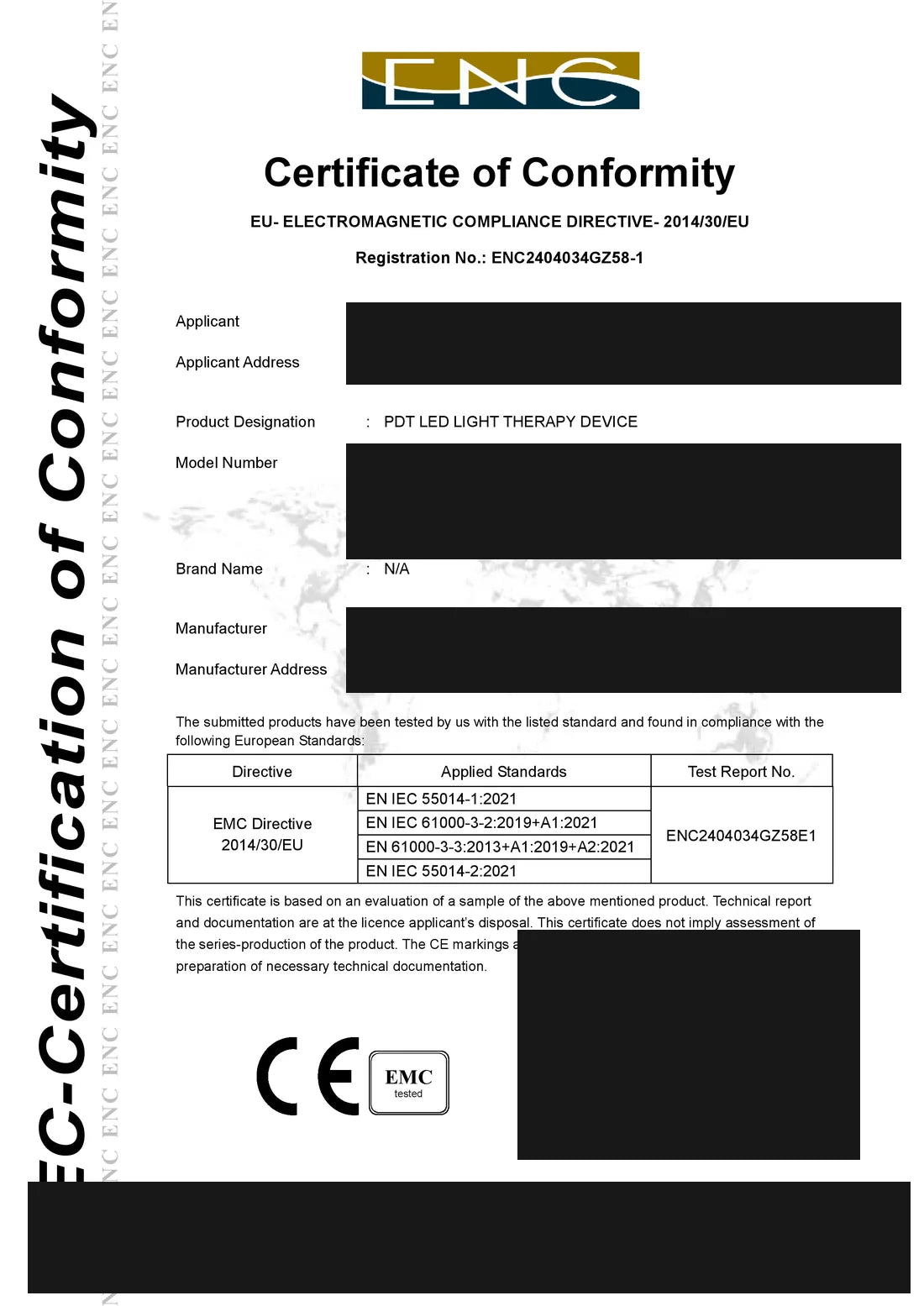
Certificate: ENC2404034GZ58-2 · issued 2024-04-03 · EN 60335-1, EN IEC 60335-2-113, EN 62233EMCin hand
 Teljes meretben
Electromagnetic compatibility, 2014/30/EU. It tests that the device doesn't interfere with other electronics, and that its surroundings don't interfere with it either.
Certificate: ENC2404034GZ58-1 · issued 2024-04-03 · EN IEC 55014-1, EN IEC 55014-2, EN 61000-3-2, EN 61000-3-3Spectrumin hand
 Teljes meretben
The manufacturer measured all seven modes with a spectrometer. The report shows which wavelengths of light come out of the mask: blue 414, green 515 and red 634 nm, plus the near-infrared.
Spectrometer measurement, 7 modes · peak, centre wavelength, full width at half maximumThe full report (PDF)IEC 62471ordered
Photobiological safety. It measures how much the mask's light loads the eyes and skin (blue light the retina, heat and infrared the eyes and skin), and on that basis assigns it a risk group: exempt, group 1, 2 or 3. I ordered this test for this mask myself; the result isn't in yet, and it will go here as soon as it arrives.
The most important thing to know about these
The LVD and the EMC certify electrical safety and interference protection, the spectrum report shows the wavelength of the emitted light, and the IEC 62471 will test the light's safety for the eyes and skin.
On the papers, I covered the name and address of my supplier. That's business information and isn't meant for the public. What the document proves stays readable: the certificate number, the directive and the list of standards tested.
Questions and answers
Does this work at all?
The studies are about the mechanism of the light, done with other devices, at group level: on breakout-prone skin they measured improvement in the blue and red light bands, and the mask's blue (414 nm) and red (634 nm) chips light up in these bands, according to the manufacturer's measurement. The studies are small: a 2025 review pooled six randomized trials with 216 people, and according to a Cochrane review there's no good-quality evidence yet. I don't promise results, because the studies are at group level. You can read what was studied, mode by mode, in the light selector.
A medical device? What certification does it have?
An at-home light device for cosmetic use, not a medical device. A lab tested its electrical safety (LVD) and interference protection (EMC); the certificates, with their numbers, are below. The manufacturer measured the wavelength of the light with a spectrometer, in all seven modes. I ordered the photobiological safety test (IEC 62471) for this mask myself; the result isn't in yet, and I'll post it as soon as it arrives.
What wavelengths does it emit, and have they been studied?
The mask has three visible chips, according to the manufacturer's measurement: blue 414, green 515 and red 634 nm, plus the nominally 850 nm near-infrared in every mode. In the at-home acne studies of a 2025 review, the blue band was between 414 and 445 nm and the red between 630 and 670 nm: the mask's blue and red chips light up in these bands; the studies were done with other devices. You can see the measurement above, mode by mode, in the light selector.
Why is it better than a silicone mask?
Because of four structural things. An enclosed, padded cover around the eyes: the LED array stops at the eyes. It doesn't touch your facial skin: the LEDs sit about a centimetre away, and it doesn't touch your nose either. The LEDs don't bend, because they sit on a rigid board. It lands in the same spot every time, because the frame keeps the LEDs at the same distance. The silicone mask's advantage is a smaller packed size.
Do I have to keep my eyes closed?
There's no LED in front of your eyes, and the cover encloses them, so it doesn't dazzle you. You can keep your eyes open too. The cover only protects if the mask is in place, so don't push it up onto your forehead while you're using it.
Can I use it daily? If I wear it longer, is it faster?
The printed guide says 3-5 sessions a week, at most 10 minutes each. The mask switches itself off after 30 minutes. More isn't better: I write about this in the Usage section.
Under or over skincare?
Onto clean, dry skin. Your creams come after. The panel doesn't touch your face, so it won't smear what you've applied, but you still don't want a layer in the light's way.
Which mode should I use?
The device cycles through seven modes with one button, and the 850 nm near-infrared runs in all of them. I don't recommend a mode. The studies were done with other devices and small numbers of people, so you can't responsibly match a mode to a skin concern from them. What was studied for which wavelength, you can read in the light selector, opened mode by mode.
Can I use it while pregnant or breastfeeding?
No. The printed guide lists pregnancy and breastfeeding among the cases where it must not be used, together with the other contraindications.
Does it emit UV?
The mask works with visible and near-infrared light. Its shortest-wavelength chip is the blue, peaking at 414 nm according to the manufacturer's measurement; UV radiation is below 400 nm. On darker skin, blue light can cause pigmentation; I write about this under the blue mode.
Can I personalise the mask?
Yes. I designed the strap adapter and I print it. If you'd like to tailor it even more to your own needs, in a different colour, with your monogram or in a modified shape, write or call, and I'll design and print it.
What if the battery or the LEDs wear out?
It has a two-year warranty, and within the warranty a fault in the battery, the LEDs or the strap is on me too: I repair or replace it. The rear module and the controller are screwed, not glued, so they can be opened. Even after the warranty, get in touch before you buy a new mask: I replace the battery module myself, here in Hungary.
Does it press on my nose? Does it cover my chin too?
It doesn't press: the panel doesn't touch your nose either. It covers your chin too. If it still doesn't sit well on your face, I'll take it back within 30 days.
With glasses or contact lenses?
Glasses don't fit under the cover, so take them off. With contact lenses there's nothing to do, but if anything feels uncomfortable, take the mask off.
When will I see anything?
I don't give a timeframe for this, because I have no measurement that would let me read one out. What I'd suggest: photograph yourself in the same light before the first session, and again the same way after three months. Your own eye is the worst measuring instrument for day-to-day change.
Price and warranty
No recurring cost behind it. Flexible silicone masks sit in the same price range, the difference is in the construction.
Hungarian shop, Hungarian customer service
I give a two-year warranty for the LED light mask: if it breaks, I will repair it or replace it.
Put it on, switch it on, run one programme. That's trying it out as intended, and it doesn't affect your refund.
The exact terms
Warranty. I give it a two-year warranty, in every country I ship to: if it fails, I'll repair or replace it, shipping included, free of charge. In Hungary this is also the statutory mandatory warranty (Government Decree No. 151/2003). You'll receive the warranty card no later than the day after handover. It doesn't cover faults caused by improper use, by not following the guide, or by natural wear and tear.
Returns. On top of the statutory 14 days, I take it back for 30 days in total. The condition for the extension is the original box and a complete set of accessories; it doesn't affect your statutory 14 days. I may deduct the loss of value resulting from use beyond trying it out, and I back up the deduction with a photo.
Power supply. The manufacturer's specification is 5 V / 2 A, so this isn't a detail you can skip. Within the warranty, replacing the battery module is a service I provide.
The device is an at-home light device for cosmetic use.