

Dermastamp at home: what microneedling is,
and how to use the 1 mm stamp.
Microneedling opens tiny, controlled channels in the skin to trigger the skin's own repair process. The Dermastamp brings this home, with fixed 1 mm needles. Everything is here in one place: what the mechanism is and whether it works, why 1 mm specifically, your first session and technique, disinfection, frequency, aftercare and minoxidil timing, and when not to stamp. The evidence belongs to the mechanism, we have no study of our own. This is information, not medical advice.
What is microneedling?
Microneedling uses tiny needles to create controlled micro-injuries in the upper layers of the skin. The body responds with its own repair response: new collagen, growth factors, skin renewal. Singh 2016 We're triggering the skin's own process.
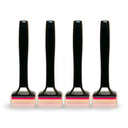
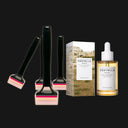
The Dermastamp brings this home: a stamp head with tiny needles on a handle. You press it down and lift it up in one spot, and the needles open micro-channels. Our device is fixed at 1.0 mm, meaning it always punctures to the same depth, that's the one length it does.
The needle reaches the dermis, where the collagen sits. The repair response starts around the point-like micro-injury, with intact skin remaining in between.
How does the repair process start?
The micro-injury triggers three steps: first an inflammatory signal, then new tissue formation (collagen, tiny blood vessels), and finally remodeling. This is the skin's natural wound healing, just on a very small, controlled scale.
The evidence belongs to the MECHANISM of microneedling, not to our device. The studies behind it were typically done with clinical devices (a one-and-a-half to two millimeter roller or radiofrequency microneedling, under medical supervision). No separate study has been done with the 1 mm Dermastamp. We have no study of our own.
Does it work? What's the evidence, and what isn't?
The studies were done at group level, with other devices, under other conditions, not on your skin. Many good effects are possible, but not guaranteed.
What is it used for?
Same mechanism, five different goals. Each has its own page with the detailed evidence and the evidence level:
- Acne scars: this is where the most research is, the strongest ground. Less so for deep, needle-width (icepick) scars.
- Wrinkles and anti-aging: collagen induction in aging skin.
- Stretch marks: fresh, red stretch marks respond better than old, white ones.
- Pores and skin texture: tightening the frame around the pore (the opening itself doesn't widen).
- Hair loss (women's page separate): the strongest data is combined with minoxidil.
Why exactly 1 mm?
It's tempting to assume a deeper needle achieves more. The research says otherwise: in a meta-analysis of 12 studies, 631 people, needle depth (up to 1 mm vs over 1 mm) did not meaningfully affect the hair outcome. Ahmed 2025 So at home, 1 mm is not a compromise, the longer needle didn't give a proportional extra here.
The longer needle does come at a cost, though: it punctures deeper, so it can bring more irritation, more pinpoint bleeding, and greater risk. That's why the deeper, clinical treatment stays with the professional. On pricing and comparing the two paths: clinic or home.
The at-home 1 mm is not a clinical treatment
The fixed 1 mm at-home stamp is not the same as the clinical treatment. In dermatology, microneedling and radiofrequency microneedling are typically performed with a longer needle (roughly 1.5–2.5 mm), under medical supervision, and most of the referenced studies were done with that kind of device. The at-home 1 mm is a shallower, more manageable version of that: the same mechanism, at a smaller depth, at your own pace.
Why a stamp, and not a roller?
You press the stamp down and lift it up perpendicular to the skin, in one spot, so the needles enter straight, to the same depth. A roller has to be rolled across the skin, so the needles enter and exit at an angle, which can leave an elongated, tearing mark. That's why the stamp is more predictable and gentler at home. A detailed comparison of the two: Dermastamp or dermaroller.
How to hold and press it?
The stamp's motion is simple: hold the handle, place the head on the skin perpendicular to it, press down with even, light pressure, then lift up. Down and up, in one spot. The key is not to drag it across the skin like a roller.
If you move it by dragging, the needles come out at an angle and leave an elongated, tearing mark. Perpendicular pressure gives a pinpoint, same-depth channel, with intact skin in between. The pressure should be even and moderate, not to the point of bleeding: more force doesn't give a better result, it just increases the risk of irritation and scarring.
How do you work through an area?
Work area by area, in a grid pattern: press once, lift up, move slightly to the side, and work through it this way, overlapping slightly, so no patch is missed, but without pressing the same point too many times either. Don't jump around the skin at random. On sensitive, bony areas, such as around the eyes or on the forehead, work with lighter pressure.
Your first session, step by step (how to dermastamp)
- Clean skin. Wash your face, remove all makeup and cream. Stamping starts on clean, dry skin.
- Disinfection. Disinfect both the stamp head and the skin area to be treated. The needle goes under the skin, so hygiene is non-negotiable. The full routine is described below, in the disinfection section.
- Stamping. Press down and lift up perpendicular to the skin, area by area, overlapping slightly, with even, light pressure. As a beginner, take your time, it's not a race.
- Soothing. Right after, the skin can be red and warm. A simple, soothing, fragrance-free serum or hyaluronic acid is a good choice at this point.
- Protection. Leave the skin alone on the day of the treatment, sunscreen is recommended from the next day on. Fresh skin is more sensitive to the sun.
What do you feel and see the first time?
For most people, the 1 mm needle causes a mild sting, tingling, not sharp pain. Strong pain signals that the pressure is too high, in that case ease up on it.
Right after, the usual, expected reaction is temporary redness: the skin can be red and warm, in places with tiny, pinpoint flushing. Chu 2021 This typically fades within hours, and clears up over the following day(s), though it can vary from person to person. Strong pain, persistent swelling, or signs of inflammation are not part of the normal course, in that case stop, and if it doesn't go away, get a dermatologist's opinion.
Disinfection: this is your job
The needle goes under the skin, so hygiene is a non-negotiable part of the routine. In order, per the instructions:
- wash your hands, wash the skin to be treated
- open the packaging right before use
- rinse the needle head with warm water
- disinfect with 70% (or higher) alcohol, for at least 60–120 seconds
- let it fully dry before application
Don't touch the needles with your hands, and don't put it down on a contaminated surface. A Dermastamp is meant for one treatment session, on a single person, after which you throw it away, you don't clean it or reuse it. Never share it with anyone: the literature openly calls the transmission of blood-borne pathogens on a shared device an unanswered question.
How often should you stamp? (how often to dermastamp)
The 1 mm needle creates a genuine micro-injury: tiny, controlled channels open up, and this is what triggers the skin's own repair process. This process takes time. While the skin is still healing from an earlier treatment, there's no point puncturing the same area again. That's why microneedling typically comes weekly, per area, not daily.
On the day of stamping, the skin's integrity drops, then gradually recovers. The surface settles enough in roughly a week for the next treatment to follow in the same spot. If you puncture more often than that, the skin never gets back to its intact level between sessions.
Why isn't daily good?
The repair process happens in stages: first cleanup and mild inflammation, then new collagen builds, and finally the surface settles. If you puncture the same skin again every day, you interrupt this process before it finishes. More puncturing in that case brings more irritation: persistent redness, sensitivity, and a higher chance the skin's surface gets damaged. Healed skin is the right starting point.
How much per area?
| Area | Typical frequency | Why |
|---|---|---|
| Scalp | weekly | you stimulate the follicle environment, a shallower injury |
| Face, wrinkles, acne scars | less often, every two to three weeks | more sensitive, more visible skin, allow more healing |
| Larger body area | weekly or less often | depends on the size of the area and the skin's reaction |
These are guidelines, not rules. If your skin is still red or sensitive in a given area, wait longer. Healed skin is the signal that the next one can come.
What to apply after, and what to avoid?
Right after the treatment, the skin is more open and more sensitive, so what you put on it matters. Active ingredients get in more easily and more deeply through the fresh channels, which at this point is more of a risk than a benefit. Cureus 2025
- Right after: a simple, soothing, fragrance-free serum, hyaluronic acid, or a panthenol-based soother. The goal is to calm the skin.
- What to avoid right after: retinol and retinoids, AHA or BHA acids, high-concentration vitamin C, fragranced or alcohol-based products. These sting and can irritate fresh skin. For retinoids, the user guide asks for 24 hours; beyond that, 72 hours is the caution practice, and on sensitive or discoloration-prone skin, returning between day five and day seven. Resume the rest in the following days, once the skin has calmed down.
Actives and minoxidil timing
After puncturing, the skin has open micro-channels for a while, and the surface is more sensitive during that time. As the skin settles, the channels close, and the usual application becomes safer. Cureus 2025
If you also use minoxidil for your hair loss, it's best to put it back on not on the day of puncturing, but roughly a day later, once the skin has calmed down. We don't apply active ingredients right away on freshly punctured skin because absorption is increased through the open micro-channels. This is also how the strongest hair data was done, the protocol studying the combination of microneedling and minoxidil: they skipped application on the day of puncturing, and resumed roughly a day later. Dhurat 2013
Important limitation: this study was done clinically, with a roller with a longer needle than ours, under controlled conditions, not with the Dermastamp. Minoxidil is a real drug, with its own side effects; how it works, what forms it comes in, and when microneedling plays a role alongside it: the minoxidil guide. The exact dosage is given on the product label.
Does it leave a scar?
Stamping opens many tiny, separate channels, with intact skin remaining in between, and this pattern regenerates. A scar comes from the continuous, deep injury on the right, where there's no island of intact skin.
Because intact skin remains between the many tiny, separate punctures, stamping isn't comparable to a continuous, deep wound. That said, microneedling does carry risk: one of the most common reactions is temporary redness, and with poor technique (too much pressure, a dragging motion, incomplete disinfection) irritation, marks, or rarely a scar can occur. Chu 2021 Proper technique and hygiene reduce this risk.
When should you NOT stamp?
There are times when microneedling at home is not recommended, when it's better to wait, or see a dermatologist:
- Active, inflamed acne in the area to be treated: the needle can spread the infection.
- Active herpes, an open wound, eczema, rosacea, or other active skin inflammation in the area.
- If you're prone to keloids, meaning overgrown scarring.
- During or shortly after an isotretinoin (Roaccutane) course.
- Fresh tanning or sunburn in the area.
The full risk picture with every documented side effect and contraindication: risks and things to know.
Microneedling in summer: timing and sun protection
Why is the skin more sensitive to the sun after treatment?
Microneedling opens tiny channels, and the skin then heals for a few days afterward. One documented side effect of the method is post-inflammatory hyperpigmentation, meaning a brownish mark after healing. Chu 2021 This type of pigment mark is worsened by UV light and visible light, which is why freshly treated skin is more sensitive to the sun. Fatima 2020
The rules for summer
- Sunscreen is required from the days after treatment on: generous, high-factor (SPF 50) sunscreen, reapplied daily. Fatima 2020
- Avoid the strong midday sun right after the treatment.
- Don't stamp on a fresh sunburn or fresh tan.
- On the day after treatment, avoid direct, intense sun exposure.
When should you stamp in summer?
The best timing is in the evening, before bed: this way the skin can heal overnight, without sun, and you start the next day with sunscreen. If it falls during the day, plan it for a day when you won't be in the intense sun for long.
When NOT in summer?
Skip the treatment if you'll be in intense sun for a long time that day or the next (beach, all-day outdoors), if you have a fresh sunburn, or if you can't keep up your sun protection. The full list of contraindications: risks and things to know.
The sun isn't the enemy. Sunlight has a circadian and mood benefit. This is about the few days right around a fresh treatment.
Frequently asked questions
Does stamping hurt with the 1 mm needle?
For most people it's more of a mild sting, tingling, not sharp pain. It's more noticeable on sensitive, bony areas (around the eyes, forehead). Strong pain signals that the pressure is too high, in that case ease up on it.
Does it need to bleed to work?
No. The goal is controlled micro-injury, not bleeding. "Press until it bleeds" is a common myth: more pressure doesn't give a better result, it just increases the risk of irritation and scarring. Tiny, pinpoint bleeding, or more often just flushing, can occur, depending on the area and the pressure.
How deep does the 1 mm go?
The 1 mm needle goes through the surface down to the dermis, where collagen is produced. Our device is fixed at 1.0 mm, it always punctures to the same depth. Research suggests the deeper needle isn't necessarily better: according to a meta-analysis of 12 studies (631 people), needle depth did not meaningfully affect the hair outcome. Ahmed 2025
Should I use it perpendicular or by dragging it?
Perpendicular: place the head on the skin, press down with even, light pressure, then lift up, without dragging. If you drag it across like a roller, the needles come out at an angle and can leave an elongated, tearing mark. Perpendicular pressure gives a pinpoint, same-depth channel.
How long does the first session take?
Typically just a few minutes for one area, plus the prep (cleansing, disinfection) and the soothing afterward. As a beginner, it's worth taking it slow and calm, it's not a race. The routine gets faster over time.
How long does my skin stay red afterward?
Temporary redness is the usual, expected reaction: the skin can be red and warm, this typically fades within hours, and clears up over the following day(s). It can vary from person to person, and also depends on the pressure and the area. If the redness is strong, persistent, or inflamed, get a dermatologist's opinion.
What should I apply right after the treatment?
A simple, soothing, fragrance-free serum: hyaluronic acid or a panthenol-based soother. Skip acids (AHA, BHA), retinol, and high-concentration vitamin C right after, since they sting and can irritate fresh skin. For retinoids, the user guide asks for 24 hours, our own caution practice is 72 hours, and on sensitive or discoloration-prone skin, returning between day five and day seven; return to acids and vitamin C once the skin has calmed down.
How often should I stamp, and the same amount for face and scalp?
Typically weekly per area, so the skin can fully heal between two sessions. On the face, where the skin is more sensitive and more visible, many people do it less often, every two to three weeks. This is a guideline, not a strict rule: healed skin is the signal that the next one can come.
How do I disinfect the stamp?
Wash your hands, wash the skin, then rinse the needle head with warm water and disinfect it with 70% (or higher) alcohol for at least 60–120 seconds, and finally let it fully dry. The stamp is single-use, on one person only, and never share it with anyone else. The full routine is above, in the disinfection section.
Can I use retinol or vitamin C afterward?
Yes, just not right after the treatment. Retinol, acids, and high-concentration vitamin C sting and can irritate fresh, open skin. For retinoids, the user guide asks you to skip them for 24 hours; beyond that, 72 hours is the caution practice, on sensitive or discoloration-prone skin, returning between day five and day seven, and for more concentrated products, a full week. There's no exact, study-measured threshold. With acids and vitamin C, resume your usual routine a few days later, once the skin has calmed down.
Can I use minoxidil the same day I stamped?
It's best to skip minoxidil on the day of stamping. We don't apply active ingredients right away on freshly punctured, sensitive skin, because absorption is increased through the open micro-channels. The protocol studying the combination of microneedling and minoxidil did the same: they didn't apply minoxidil on the day of puncturing. Dhurat 2013
How long should I wait after stamping before using minoxidil?
Roughly a day. The studied protocol skipped application on the day of treatment, and resumed about a day later, once the skin had already calmed down. Dhurat 2013 This is the sensible caution at home too: give the skin time before you put the active ingredient back on. The exact dosage is given on the label.
Can the stamp be reused?
No. One stamp is one treatment, one person, then you throw it away. You don't wash it or disinfect it again after use: at-home disinfection doesn't bring it back to the state of an unopened device. New treatment = new stamp, that's why you get it in a pack.
Disinfection happens before use: wash your hands, rinse the needle head, 70% alcohol for 60–120 seconds, let it fully dry.
Can I use it on the face, eyebrows, and scalp too?
Yes, it can also be used on the face, the eyebrows, and the scalp; many people use it on the scalp for hair loss, and on the face for aging and acne scars. There's a separate article on eyebrows: Dermastamp for eyebrows. On sensitive, bony areas work more carefully, with lighter pressure, and on larger areas the stamp is slower going.
Do I need 0.5 or 1 mm?
0.5 mm is a shallower, more superficial treatment, our device is fixed at 1.0 mm. For the hair outcome, research found no meaningful extra benefit from the deeper needle (the 631-person analysis above). Ahmed 2025 1 mm stays a manageable depth at home. What matters more is proper technique and consistency, not the tenth of a millimeter.
Where do beginners go wrong the most?
The most common mistakes: too much pressure (pressing until it bleeds), dragging the stamp across the skin instead of pressing it perpendicular, incomplete disinfection, and repeating too often (not letting the skin heal). Every one of these irritates more than it helps.
I skipped a week, is that a problem?
No. Microneedling's effect doesn't depend on a single session, but on long-term consistency. If you miss a week, just pick up where you left off, there's no point trying to make up for it with a denser schedule.
Can I sunbathe or go to a tanning bed afterward?
After the treatment, it's recommended to avoid intense sun exposure, tanning beds, saunas, and swimming pools for a few days. Fresh skin is more sensitive, and the sun causes marks on it more easily. Sunscreen is recommended from the next day on.
Where can I buy it, is it available at dm or Rossmann?
You can get the fixed 1 mm, medical-grade steel Dermastamp at dermastamp.hu. Drugstore shelves carry microneedling devices of varying quality, not necessarily with a fixed 1 mm, tested needle; the key is knowing what you're buying: the needle's material, its length, and whether it's single-use.
Do I need sunscreen if I'm not going to sunbathe directly?
Yes. Everyday UV, coming through a window or clouds, still reaches the skin. On freshly treated skin, sunscreen is one of the most important aftercare steps.
How long should I wait after a sunburn?
Until your skin has fully calmed down, with no redness, peeling, or sensitivity. Never stamp on damaged, inflamed skin.
Can I go to a tanning bed around the treatment?
Not recommended. Tanning bed UV exposure increases the risk of pigment marks and irritation on freshly treated skin just as much as sunbathing does. Fatima 2020

Sources
These studies are about the mechanism of microneedling and minoxidil, typically with clinical devices. No separate study has been done with the 1 mm Dermastamp, we're referencing the mechanism. This is information, not medical advice.
- Ahmed KMA, Kozaa YA, Abuawwad MT, et al. Evaluating the efficacy and safety of combined microneedling therapy versus topical minoxidil in androgenetic alopecia. Arch Dermatol Res. 2025. PMID 40056230 · PMC PMC11890238 · 12 studies, 631 people; needle depth (up to 1 mm vs over 1 mm) did not affect the hair outcome.
- Chu S, Foulad DP, Atanaskova Mesinkovska N. Safety Profile for Microneedling: A Systematic Review. Dermatol Surg. 2021. PMID 34448760 · the safety profile of microneedling: temporary redness is among the most common side effects, along with the documented risk factors. The contraindications (keloid, isotretinoin, active skin disease) are summarized by professional consensus and our detailed risk page.
- Physiological Mechanisms and Therapeutic Applications of Microneedling: A Narrative Review. Cureus. 2025. PMC PMC11993440 · the physiological background of the repair response; redness, by modality, is strongest with the stamp.
- Singh A, Yadav S. Microneedling: Advances and widening horizons. Indian Dermatol Online J. 2016. PMC PMC4976400 · the mechanism of microneedling (collagen induction, growth factors) and needle length by goal.
- Dhurat R, Sukesh M, Avhad G, et al. A Randomized Evaluator Blinded Study of Effect of Microneedling in Androgenetic Alopecia. Int J Trichology. 2013. PMID 23960389 · microneedling + minoxidil with a clinical roller; the protocol skipped minoxidil on the day of treatment, and resumed only later.
- Fatima S, Braunberger T, Mohammad TF, Kohli I, Hamzavi IH. The Role of Sunscreen in Melasma and Postinflammatory Hyperpigmentation. Indian J Dermatol. 2020. PMID 32029932 · post-inflammatory hyperpigmentation is worsened by UV and visible light, which is why sun protection is part of the treatment.